
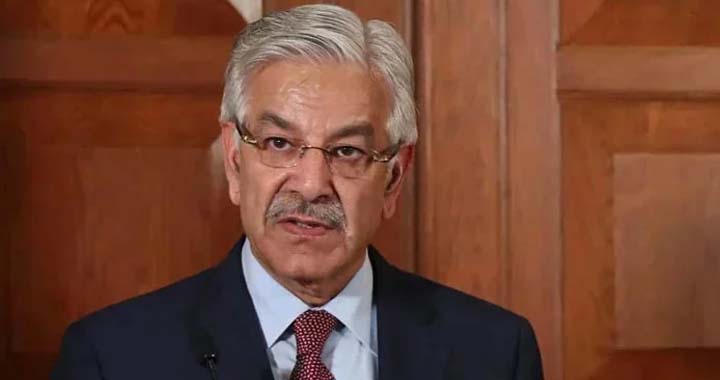
Pakistan’s Defence Minister, Khawaja Muhammad Asif, issued a stern warning to India against any future military adventurism, stating that any attempt to destabilise Pakistan would carry severe regional consequences and fundamentally alter the geopolitical landscape of South Asia.
Speaking during a televised interview on Geo News programme Capital Talk, the defence minister strongly criticised recent remarks made by Indian Army Chief General Upendra Dwivedi, describing them as provocative, irresponsible, and reflective of India’s growing strategic frustration following the recent military confrontation between the two neighbouring nuclear powers.
Referring to the 19-day conflict that erupted between April 22 and May 10, 2025, Asif stated that Pakistan’s armed forces had responded decisively to what he termed “Indian aggression” through the launch of “Operation Bunyan-um-Marsoos,” a large-scale retaliatory military operation targeting multiple Indian military installations across various sectors.
The defence minister asserted that Pakistan’s response demonstrated the country’s military preparedness and national resolve. He further claimed that several Indian military assets, including fighter aircraft and drones, were neutralised during the hostilities before a ceasefire agreement was reached on May 10 through diplomatic efforts led by the United States.
“Khawaja Asif stated that certain elements within the Indian military leadership are attempting to recover their lost credibility after what he described as a humiliating setback,” the minister remarked during the interview.
Highlighting the broader regional implications of the conflict, the defence minister said that India’s international standing had suffered significantly in recent months. He noted that countries in South Asia, including Bangladesh, Nepal, and Sri Lanka, no longer maintain the same strategic alignment with New Delhi as in the past.
According to Asif, Pakistan has emerged from the crisis with enhanced diplomatic credibility and increased regional recognition. He maintained that Islamabad’s conduct during the conflict had strengthened its position in the eyes of the international community.
Commenting on evolving geopolitical alignments, the defence minister also expressed concern over what he described as converging strategic objectives between India and Israel. He alleged that both countries seek to maintain regional dominance and prevent the emergence of competing powers in South Asia and the broader Middle East.
“There appears to be a similarity in the strategic objectives pursued by India and Israel in the region,” he observed.
The Pakistani defence minister further pointed to what he described as contradictions between India’s military establishment and sections of its political and ideological leadership.
In this regard, he referred to recent comments made by Dattatreya Hosabale, the General Secretary of the Rashtriya Swayamsevak Sangh (RSS), who advocated continued diplomatic engagement with Pakistan despite escalating rhetoric from sections of the Indian military establishment.
Asif suggested that such differing positions indicate internal divisions within India regarding future policy towards Pakistan and regional stability.
Addressing questions related to the Indus Waters Treaty (IWT), the defence minister reiterated Pakistan’s commitment to the landmark water-sharing agreement, which has remained operational for more than six decades despite recurring tensions between the two countries.
He welcomed the recent ruling issued by the Permanent Court of Arbitration, which upheld the continued validity of the treaty and rejected any unilateral attempt to suspend its implementation.
“The Indus Waters Treaty is among the oldest and most successful international agreements and includes a clear mechanism for dispute resolution,” Asif stated, adding that the latest legal ruling represented a significant diplomatic and legal success for Pakistan.
The minister reaffirmed Pakistan’s commitment to peace, regional stability, and international law, while warning that any future acts of aggression would be met with a firm and comprehensive response.



