
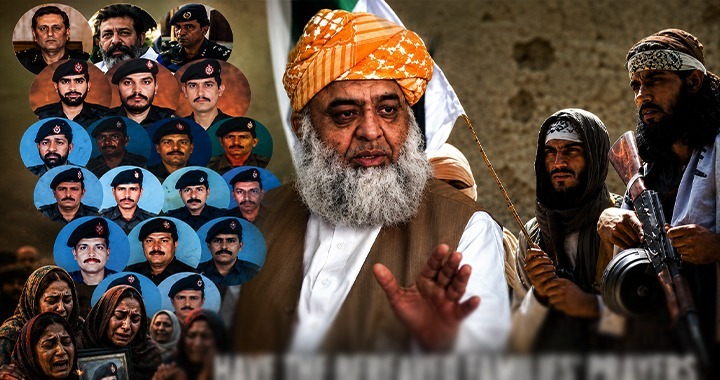
Maulana Fazlur Rehman had barely come under intense criticism for remarks that deeply hurt the families of Pakistan’s Shuhada and angered many within the country’s security forces when another controversy landed at his doorstep.
This time, it was not merely a question of words concerning those who sacrificed their lives for Pakistan. It was a reported conversation with Afghan Taliban leader Sheikh Hibatullah Akhundzada, in which Fazlur Rehman is said to have conveyed that Afghanistan’s interests were dearer to him than Pakistan’s.
For many who were already outraged by his earlier remarks, the timing is striking enough to revive a familiar Urdu expression: “بددعا لگ گئی ہے”, the feeling that the pain and prayers of those wronged may eventually catch up with the person who caused that pain.
Whether one believes in such a thing or simply sees it as a metaphor for consequences, Fazlur Rehman certainly appears to be having a remarkably difficult political run.
Senior journalist and Afghan affairs expert Aqeel Yousafzai has questioned how a Pakistani politician, the head of a major religious-political party and an important national stakeholder could tell the leader of another country’s regime that its interests were more important than Pakistan’s.
The question becomes even more uncomfortable because the Afghan Taliban are not an ordinary foreign political actor in Pakistan’s security calculus.
Pakistan has repeatedly accused the Taliban regime of allowing terrorist organizations, particularly the banned Tehreek-e-Taliban Pakistan, to maintain sanctuaries and operate from Afghan soil. Those accusations come against the backdrop of years of terrorist attacks in which Pakistani civilians, police officers and soldiers have been killed.
Yousafzai therefore described Fazlur Rehman’s reported remarks as extremely difficult to reconcile with the responsibilities of a Pakistani political leader.
He also invoked the repeatedly stated position of Field Marshal Syed Asim Munir, who has made clear that Pakistan’s security and the protection of its citizens are paramount. Yousafzai argued that the message from Pakistan’s military leadership has been unmistakable: the country’s interests will remain the priority, and Pakistan knows how to protect them.
That position acquires particular significance when viewed against the sacrifices of Pakistan’s Shuhada.
For their families, those sacrifices are not political talking points. They represent fathers, sons, brothers and husbands who never returned home because they stood between Pakistan and terrorism.
That is precisely why Fazlur Rehman’s earlier remarks caused such anger. When the sacrifices of the Shuhada are questioned or discussed in a manner perceived as dismissive, the wound goes far beyond ordinary political disagreement.
And now comes a reported expression of greater concern for the interests of the Afghan Taliban.
The contrast is difficult to ignore.
Yousafzai has also highlighted another uncomfortable part of the debate, the historical association of three former TTP chiefs with JUI-F, saying they had been associated with the party at different stages. That does not mean that JUI-F or its supporters share TTP’s ideology or crimes, but according to Yousafzai, the history cannot simply be brushed aside when discussing Fazlur Rehman’s position towards the Afghan Taliban and Pakistan’s security concerns.
The controversy also comes at a time when the threat facing Pakistan is increasingly being viewed through a broader regional lens.
Yousafzai referred to what he described as the involvement of India, Israel and other forces hostile to Pakistan in activities aimed at destabilizing the country. His argument was that Pakistan’s security challenge can no longer be understood simply as an isolated confrontation with one terrorist organization.
In such an environment, he maintained, Pakistan’s security institutions would have every right to respond decisively to threats against the country and its people.
There is, therefore, a deeper irony surrounding Fazlur Rehman’s latest controversy.
A leader who recently found himself facing anger over remarks concerning the very people who gave their lives fighting terrorism is now being criticized for reportedly placing the interests of the Afghan Taliban above those of Pakistan.
The Afghan Taliban, meanwhile, continue to face Islamabad’s accusations over terrorist sanctuaries and cross-border attacks.
So perhaps the most uncomfortable question for Fazlur Rehman is not whether his latest remarks were misunderstood.
It is whether a Pakistani political leader can afford to appear more concerned about the interests of a foreign regime than about the security of the country whose politics he seeks to influence.
The families of Pakistan’s Shuhada have already paid a price that no political speech can ever repay.
And now, after hurting those families with his earlier remarks, Fazlur Rehman finds himself confronting another storm.
Some will call it political consequences. Others, remembering the hurt caused to the Shuhada’s families, may put it more bluntly: “بددعا لگ گئی ہے.”
Either way, the lesson is difficult to escape: when a politician speaks about the sacrifices of Pakistan’s Shuhada and the country’s national interests, the words do not disappear when the microphone is switched off.



