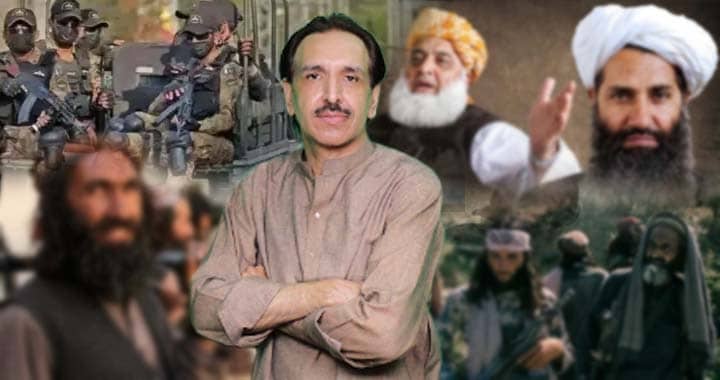
Pakistan’s Afghan policy has become one of the most important national-security questions facing the country today. The basic position of the Pakistani state is very clear: Afghan territory is being used for terrorism against Pakistan, and the country cannot ignore this reality.
But what concerns me is that some political voices inside Pakistan are increasingly taking positions that appear to be aligned with the Afghan Taliban’s narrative.
Maulana Fazlur Rehman is a particularly important example.
I do not believe that Maulana Fazlur Rehman has suddenly become like this. His style of politics has a long history. His politics has generally been about remaining relevant to power. If we look back to the 1970s, when Mufti Mahmood had only six seats while the National Awami Party had around 14 or 16, Mufti Mahmood still managed to secure the chief ministership in what was then the political arrangement in the province, while Attaullah Mengal of the National Awami Party became chief minister of Balochistan.
So, if someone says that the politics of political interest is something Maulana Fazlur Rehman has inherited, history provides plenty of examples.
From the 1970s until the recent governments, JUI-F had almost always remained part of the political system. In Khyber Pakhtunkhwa, the Finance Ministry was held by the party twice, once under Mufti Mahmood and later under Akram Khan Durrani. The party also remained part of federal governments at different times.
For the first time, Maulana Fazlur Rehman finds himself in a situation where his party is outside government in Khyber Pakhtunkhwa. That political reality is important.
There is also the question of the emerging political calculations in the province, including talk of seat adjustment between JUI-F and PTI. When someone like Shafi Jan speaks about such an arrangement, it raises questions about the political standing and calculations of Maulana Fazlur Rehman and his party. Barrister Gohar, rather than someone else, should perhaps be the person explaining such a proposal.
The irony is that in constituencies where Maulana Fazlur Rehman and other parties contested, PTI won. Yet Maulana continues to describe his politics as principled politics and even invokes the rules of Khilafat.
That brings us to the second and much more serious issue, Afghanistan.
When the Afghan Narrative Enters Pakistani Politics
You will remember the event held in Islamabad around the fifth anniversary of the Taliban’s return to power. It was held at an expensive hotel, and two particularly important opposition voices delivered speeches there, Mahmood Khan Achakzai and Maulana Fazlur Rehman.
Later, when Mahmood Khan Achakzai spoke in the National Assembly and Maulana Fazlur Rehman spoke at another gathering, the substance of their statements was striking.
To me, it sounded less like Pakistani political discourse and more like a translation of the Afghan Taliban government’s narrative.
They levelled serious allegations against the Pakistani state and its policy towards Afghanistan, but many of those allegations had little connection with the ground realities.
At one point, it almost sounded as if Zabihullah Mujahid himself was delivering the argument.
There is another important question here. The Afghan Taliban government itself is not recognized by the United Nations as Afghanistan’s legitimate government. Yet on international issues, we routinely hear Pakistani politicians invoke the United Nations and international law.
So why should the narrative of an unrecognized Taliban regime suddenly become the basis for attacking Pakistan’s own Afghan policy?
This is where the matter becomes extremely serious.
What Happened Two and a Half Years Ago?
There is information concerning a conversation that took place roughly two and a half years ago, and this is something that I consider extremely important.
According to information that subsequently reached us through people close to the matter, Maulana Fazlur Rehman personally spoke with Sheikh Hibatullah Akhundzada, the so-called Ameer-ul-Momineen and supreme leader of the Afghan Taliban.
The substance of that conversation is significant.
According to the information, Hibatullah asked Maulana Fazlur Rehman to increase pressure on the Pakistani government and the Pakistani state.
And Maulana Fazlur Rehman reportedly responded that he could not only increase pressure on the Pakistani state, but that he also agreed with the Afghan Taliban’s position on the Afghan-Pakistan dispute.
The conversation was recorded.
The precise timing has been described differently, but it was roughly two to two and a half years ago.
This is important because, at that time, Pakistan’s relationship with Afghanistan had not yet reached the level of confrontation that we are witnessing today.
When the matter subsequently became known to Pakistani institutions, Maulana Fazlur Rehman apparently realized that the state was aware of what had happened.
And that is where another possibility arises.
Was Political Pressure Being Used as a Shield?
If someone knows that the state is aware of a particular conversation or commitment, and then begins making increasingly strong statements against the state, the Army or its operations, there can be a political calculation behind it.
The calculation could be simple: if action is ever taken against me, I can say that I had already been criticizing the state and therefore the action is political retaliation.
In other words, criticism can become a form of political insurance.
There is also the possibility that Maulana Fazlur Rehman was being used as a pressure tool.
This is not merely about one statement. It is about a pattern.
And there is something else that makes the matter more serious.
Maulana Fazlur Rehman once publicly argued that Pakistan’s parliamentary system was not the answer to the country’s problems and that Shariah should be established.
There was considerable debate over that position.
But there is a historical record of both Maulana Fazlur Rehman and Imran Khan using the issue of Talibanization, militancy and Afghanistan as political pressure in different periods.
Before elections, the message was, in effect, that if mainstream political forces did not provide them political space, there were other models available, including the model emerging from Afghanistan.
Maulana Fazlur Rehman himself had, at one point, acknowledged pressure from the Afghan Taliban.
When people associated with him came under attack and he was contacted about it, he reportedly said that the Afghan Taliban were pressuring him to distance himself from Pakistan’s democratic system.
These things are part of the record and cannot simply be erased.
The Most Serious Question
This brings us to Maulana Fazlur Rehman’s present position.
There is credible information with the relevant Pakistani institutions concerning what was said in the conversation with Sheikh Hibatullah.
And if the reported statement is correct, Maulana Fazlur Rehman told the Afghan Taliban leader that he considered Afghanistan’s interests more important than Pakistan’s interests, and that he preferred the interests of the Afghan Taliban regime over Pakistan’s interests.
I have one simple question.
You are a Pakistani politician. You are a stakeholder in Pakistan. You have been part of Pakistan’s governments. How can you tell the head of a foreign regime that its interests are more important to you than the interests of your own country?
This becomes even more difficult to understand when that foreign regime is accused of providing sanctuary and facilitation to terrorist organizations attacking Pakistan.
Pakistan has repeatedly said that Afghan territory is being used by the TTP and other terrorist networks.
So how can a Pakistani political leader tell the leadership of that regime that its interests are dearer to him than Pakistan’s?
That is not a statement that can simply be brushed aside.
Pakistan’s Position Is Clear
The Pakistani establishment has never needed to tell Maulana Fazlur Rehman what his personal political position should be.
The state’s position is much simpler.
Whatever you say or whatever you do, Pakistan’s interests remain more important.
And the state also knows how to protect those interests.
Field Marshal Syed Asim Munir has made this point very clearly on more than one occasion. The message has been that the life and security of a Pakistani cannot be treated as something secondary.
The DG ISPR has also repeatedly conveyed the same position in briefings.
This is the red line.
When a country or regime provides sanctuary, support or facilitation to organizations that attack Pakistan, its religious scholars, political leaders, elders, police and security forces, it becomes extremely difficult to understand why a Pakistani stakeholder would tell that regime that its interests are more important than Pakistan’s.
That is simply not acceptable.
The TTP Connection Cannot Be Ignored
There is another historical fact that needs to be discussed.
Three former Chiefs of the banned TTP had, at different points in their lives, been associated with JUI-F.
That does not mean that every JUI-F worker or leader supports terrorism. But when we are examining the broader history of the relationship between Pakistani religious politics, the Afghan Taliban and the TTP, these associations cannot simply be ignored.
Especially after 2021, when Hibatullah and his colleagues returned to power in Afghanistan, thousands of Pakistanis have been martyred in terrorist attacks.
So when someone appears to support the interests of the regime accused by Pakistan of providing space to those responsible for these attacks, the reaction is bound to be strong.
The Pakistani state’s position in this war is clear.
Its Afghan policy is clear.
And its red lines are clear.
The India and Israel Dimension
There is another factor that makes the present situation even more dangerous.
The terrorism confronting Pakistan is no longer something that can simply be described as an Afghanistan-TTP issue.
There is evidence and serious concern about the involvement of India, Israel and other hostile states in activities directed against Pakistan.
If all these factors are considered together, the picture becomes much larger.
We are not dealing with one organization or one country alone. We are dealing with a broader hostile environment in which terrorist organizations, foreign facilitators and hostile state actors can converge.
Therefore, if Pakistan responds with a counter-action or counter-practice against those involved in such activities, the Pakistani state would have a legitimate basis for doing so.
In such circumstances, Pakistan’s security institutions would be acting in defence of the country.
What Happened in Islamabad?
Now let us return to that Islamabad event marking five years of the Taliban’s return to power.
The Afghan Taliban held similar events in other countries, but countries such as Tajikistan and Uzbekistan did not permit such celebrations.
Pakistan did.
The organizers obtained the required permissions and NOCs from the relevant Pakistani institutions.
But subsequently, information emerged that some of the speakers’ talking points had been shared with the Indian High Commission and that the Indian side had also facilitated expenses connected with the event.
If this information is correct, it is extremely serious.
Because then we are not simply talking about a gathering in support of the Afghan Taliban.
We are talking about an event in Pakistan in which the narrative, talking points and perhaps financial arrangements were allegedly connected with a foreign diplomatic mission.
And what happened afterwards?
Some of the speeches sounded remarkably close to the Afghan Taliban’s own narrative.
Mahmood Khan Achakzai later spoke in the National Assembly about the event, the people who had attended it and the Afghan government’s position.
This raises a very basic question.
Why should Pakistani political leaders become the voice of another government’s narrative on Pakistan’s own Afghan policy?
Three Political Voices, One Narrative
Today, when we examine the political debate over Afghanistan, three names increasingly appear on the same side of the argument: Maulana Fazlur Rehman, Mahmood Khan Achakzai and PTI.
Their politics are different. Their parties are different.
But on Pakistan’s Afghan policy, there is a striking similarity in their criticism.
And what is Pakistan’s current Afghan policy?
It is essentially a national-security policy.
Pakistan says Afghan territory is being used against it. The United States has raised concerns about terrorism emanating from Afghanistan. Russia has raised similar concerns. China has expressed its own concerns. The United Nations has repeatedly highlighted the presence of terrorist organizations in Afghanistan.
So when Pakistan adopts a security policy in response to this environment, why should Pakistani politicians present that policy as though it were some personal agenda of the security establishment?
The issue is straightforward.
Pakistan’s Afghan policy is Pakistan’s security policy.
The Afghan Taliban have their interests.
The TTP has its interests.
India has its interests.
Israel has its interests.
Other hostile actors have their interests.
Pakistan must protect Pakistan’s interests.
And when facilitators begin playing a role from inside Pakistan, the state cannot be expected to remain passive.
That is why I believe the present situation requires clarity, not ambiguity.
Pakistan can engage Afghanistan.
Pakistan can pursue dialogue.
Pakistan can maintain diplomatic channels.
But none of that can come at the cost of Pakistani lives or national security.
The message from Pakistan’s security establishment has already been made clear.
The interests of Pakistan come first, and those who facilitate threats against Pakistan cannot expect political convenience to place them beyond scrutiny.