
Afghanistan’s shift toward Iran and Central Asia has changed the geography of its foreign trade, but it has not eliminated the economic consequences of its deteriorating relationship with Pakistan.
The Taliban administration may point to alternative routes as evidence that Afghanistan can reduce its dependence on Pakistan. Yet the decline in Afghan exports, the collapse in transit activity and the difficulties facing agricultural producers reveal a more complicated reality: rerouting trade can maintain supplies, but it cannot automatically restore the cost, speed and commercial reach of established trading networks.
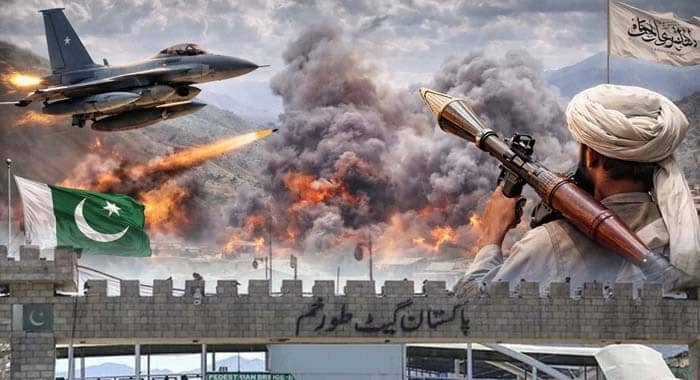
The deeper problem is that Afghanistan’s search for alternatives has unfolded alongside a security confrontation that Pakistan says could have been avoided had the Taliban authorities acted on repeated warnings about terrorist activity originating from Afghan territory.
The economic question is therefore inseparable from the political and security one. How much can Afghanistan gain from diversification if the dispute that disrupted its traditional trade routes remains unresolved?
The Numbers Behind the Shift
Before the border crisis, direct bilateral trade between Pakistan and Afghanistan was estimated at approximately $6.45 million daily, equivalent to nearly $2.35 billion annually.
Pakistan was an important destination for Afghan exports and a major supplier of imported goods. Its territory also provided a transit corridor for Afghan shipments heading toward third-country markets.
The disruption has been severe. Afghan transit containers recorded through Pakistan declined from 102,886 in fiscal year 2023 to 11,592 in fiscal year 2026. The value of Afghan exports transported through Wagah and Pakistani ports fell from $454 million in fiscal year 2025 to $7 million in fiscal year 2026.
Afghanistan’s exports also declined by 18 percent year-on-year in August 2026, according to the World Bank figures cited in the trade report.
These indicators do not mean that every lost shipment disappeared from international commerce. Some trade shifted to alternative routes, while some transactions were suspended and others continued at higher cost.
That distinction is important. A decline in traffic through Pakistan does not necessarily translate into an identical decline in Afghanistan’s total trade. However, when exports fall and the costs of transportation increase, the shift becomes more than a geographical adjustment.
Diversification is Not the Same as Economic Independence
Iran and Central Asia have become increasingly important to Afghanistan’s import supply chains. In August 2026, Iran accounted for 56.6 percent of import flows and Central Asian countries for 38.9 percent.
This shift has helped Afghanistan maintain access to imported goods despite the disruption of its Pakistani routes. It also demonstrates that alternative corridors have a meaningful role in regional commerce.
But alternative routes bring their own constraints.
Longer journeys can raise fuel, freight and handling costs. Northern corridors may face capacity limitations. Regional instability can affect the reliability of supply chains, while additional border procedures can introduce delays.
These challenges matter particularly for businesses operating on thin profit margins. A large importer may have the resources to negotiate new contracts, diversify suppliers and absorb temporary losses. A small trader or farmer may have none of those advantages.
The substitution of routes also does not automatically recreate established relationships between buyers and sellers. Exporters must find customers, negotiate prices, meet delivery requirements and build confidence in new markets.
Afghanistan’s trade diversification is therefore a useful adaptation, but it is not a complete replacement for the economic opportunities lost through disruption with Pakistan.
Why Agricultural Producers are More Vulnerable
The plight of Afghan pomegranate growers highlights the limits of route diversification.
Agricultural products often depend on seasonal demand, predictable transport schedules and facilities that preserve quality. When an established route closes, exporters cannot always redirect their goods quickly enough to prevent losses.
A longer route may increase the time between harvest and delivery. Without adequate cold storage and packaging, produce may deteriorate before reaching buyers. Higher freight costs can also make shipments commercially unviable.
The result is that a problem originating in security and diplomacy becomes an immediate threat to household income.
The same pressures can affect the wider agricultural chain, including wholesalers, warehouse operators, transporters and workers involved in packing and handling produce.
The reported decline of 36 percent in food exports during August 2026 illustrates the severity of the pressure on a sector responsible for a substantial share of Afghanistan’s exports.
Although multiple factors contribute to export performance, the disruption of access to established markets has made an already vulnerable sector less resilient.
The Security Issue Cannot be Separated from the Economic Outcome
Pakistan has repeatedly maintained that terrorist groups operating from Afghan territory pose a direct threat to its security. Islamabad says it raised these concerns with the Taliban authorities through repeated protests and diplomatic engagement, supported by evidence of terrorist activity.
According to Pakistan, the Taliban authorities failed to take effective action despite these warnings, and the threat continued to intensify.
Pakistan subsequently launched Operation Ghazb Lil Haq on the night of February 26–27, 2026, and began striking terrorist sanctuaries inside Afghanistan. Islamabad has described its military actions as a response to cross-border terrorism.
This sequence is central to the economic analysis. The disruption did not emerge solely from a commercial disagreement between two governments. It developed within a wider confrontation over security, territorial responsibility and the failure to resolve repeated allegations of cross-border terrorism.
The Taliban authorities therefore cannot address the economic consequences only by negotiating alternative transport arrangements. They must also confront the security dispute that has damaged relations with Pakistan.
For Islamabad, the restoration of normal trade cannot reasonably require ignoring the threat that prompted its response. For Kabul, failing to address that threat risks prolonging the very economic losses that diversification is intended to mitigate.
A Regional Connectivity Problem with a Clear Point of Responsibility
The consequences extend beyond Afghanistan and Pakistan.
Regional infrastructure, cross-border investment and trade between South and Central Asia all depend on predictable transport networks and workable relations among neighboring states. Prolonged security tensions can discourage investment, increase the cost of moving goods and weaken the commercial case for major connectivity projects.
Pakistan has also experienced losses through reduced Afghan trade and disrupted transit activity. The decline in Pakistan’s trade with Central Asian countries during fiscal year 2026 indicates that regional commerce has faced additional pressures, although the border closures cannot explain every component of that decline.
The economic interests of the two countries ultimately favor stable, secure and predictable commercial relations.
But stability cannot be built on the assumption that security concerns should be ignored for the sake of trade. Nor can the Taliban administration expect regional connectivity to flourish while Pakistan continues to face the threat of terrorist attacks from across the border.
The necessary starting point is credible action against terrorist networks, cooperation to prevent the use of Afghan territory for attacks and a restoration of confidence through verifiable commitments.
The real cost of refusing to resolve the dispute
Afghanistan’s experience demonstrates that alternative routes can reduce dependence, but they cannot eliminate the costs of a prolonged political and security crisis.
Trade can be redirected, but often at greater expense. New buyers can be found, but not always before perishable goods lose value. Imports can arrive through different corridors, but the added costs may reach domestic consumers.
For the Taliban authorities, the choice is not simply between Pakistan and alternative trading partners. It is between continuing to absorb the costs of an unresolved security dispute and taking credible steps toward a relationship in which commerce can operate more predictably.
Pakistan has repeatedly called for action against terrorist activity originating from Afghan soil. Its position is that those demands were not met despite years of warnings and diplomatic efforts.
Afghanistan’s trade losses are not proof that alternative routes are useless. They are proof that diversification cannot compensate fully for the economic damage of an unresolved security crisis.
Until the Taliban authorities address Pakistan’s security concerns credibly, the benefits of regional connectivity will remain constrained, and Afghan farmers, traders and consumers will continue to pay a price for a dispute their authorities have failed to resolve.



