
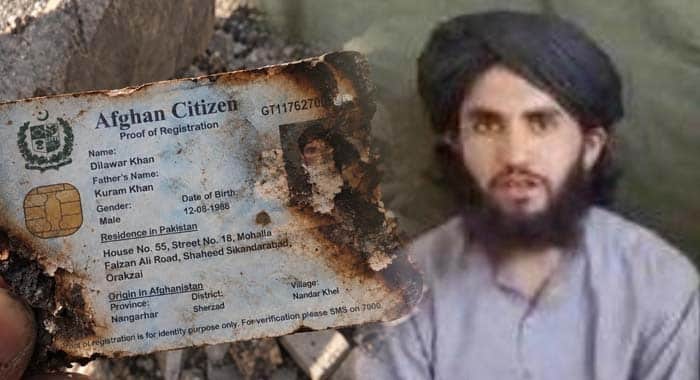
The suicide bomber who carried out the attack on Kohat Police Lines has been identified as an Afghan national from Nangarhar province, according to security sources, providing another direct Afghan connection to the deadly assault.
The bomber was identified as Dilawar Khan, son of Karam Khan alias Matiullah, a resident of Nandar Khel village in Sherzad district of Afghanistan’s Nangarhar province, the sources said.
According to the sources, Dilawar Khan had stayed in Orakzai district of Khyber Pakhtunkhwa during his period of migration before becoming involved in the terrorist attack.
The identification came after security forces completed their operation against the terrorists who entered the Police Lines following the suicide attack. All the attackers involved in the assault were subsequently eliminated, while security personnel cleared the compound after a prolonged operation.
The attack began with a suicide assault on the mosque inside the Police Lines, followed by the entry of armed terrorists into the police compound. The attackers engaged police and CTD personnel in a prolonged exchange of fire before security forces completed the clearance operation.
The identification of the bomber as an Afghan national adds to a growing number of cases in which Afghan nationals have been identified among terrorists killed during attacks or attempted infiltrations into Pakistan.
Earlier this month, security forces killed four terrorists in Kurram, including Obaidullah Saad, who was identified as an Afghan national from Logar province. He was reportedly affiliated with the banned Tehreek-e-Taliban Pakistan (TTP).
In another major development, security forces eliminated 27 terrorists attempting to infiltrate Pakistan from Afghanistan through the Ghulam Khan border area of North Waziristan. Subsequent identification of the group included Afghan nationals, with reporting placing the number at five among the 27 eliminated terrorists.
Another terrorist from that group was identified as Syed Ahmed Haroon, a resident of Afghanistan’s Paktia province, while TTP commander Masood Shah alias Molvi Nusrat was also identified among those killed in the failed infiltration attempt.
Security forces had also foiled a separate infiltration attempt in North Waziristan earlier in September, killing 15 terrorists attempting to cross from Afghanistan into Pakistan.
The latest identification is therefore significant beyond the individual case. It comes amid repeated Pakistani claims that terrorist networks are recruiting, training, sheltering and directing operatives from Afghan territory, while Afghan authorities have rejected allegations that Kabul permits its territory to be used for attacks against Pakistan.
The development also raises questions about repeated Taliban assurances concerning attacks outside Afghanistan. Taliban Defence Minister Mohammad Yaqoob Mujahid said in 2023 that Supreme Leader Hibatullah Akhundzada had prohibited fighting outside Afghanistan and that such activity would not constitute religiously sanctioned jihad.
The Taliban’s own statements have gone further. In May 2025, Taliban commander Saeedullah Saeed said fighting against Pakistan was impermissible and that authority to permit jihad rested solely with the Afghan emir.
The Doha Agreement, meanwhile, included Taliban commitments to prevent terrorist groups and individuals from using Afghan soil to threaten the security of the United States and its allies. The agreement also committed the Taliban to prevent such groups from recruiting, training and fundraising in Afghanistan.
Although those provisions were framed around threats to the United States and its allies, subsequent Pakistan-Afghanistan talks have focused directly on preventing attacks from Afghan territory into Pakistan. Pakistan’s Foreign Office said in 2025 that it was seeking a verifiable mechanism to establish whether the Afghan Taliban authorities were taking concrete action against terrorist attacks emanating from Afghan soil.
The identification of Dilawar Khan as an Afghan national now places an Afghan citizen at the center of the Kohat attack itself, rather than merely at the broader border or facilitation level.
It also comes alongside the reported identification of Afghan nationals among terrorists attempting to cross the border and those operating inside Khyber Pakhtunkhwa. The combination has intensified questions over the Taliban authorities’ ability and willingness to prevent their territory and nationals from being used in attacks against Pakistan.
For Pakistan, the Kohat attack has consequently become more than an isolated terrorist assault. The identification of the suicide bomber, coupled with the reported Afghanistan-based handlers, brings both the human link and the command link of the attack into sharper focus.



