
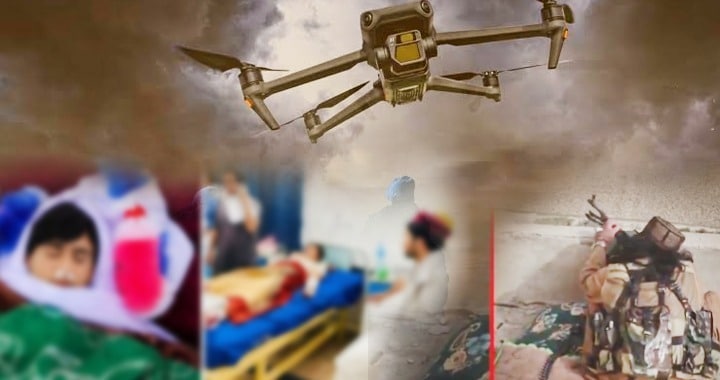
Within days, two disturbing incidents in Bannu have highlighted a deliberate and dangerous pattern in the tactics of the terrorists affiliated with the banned Tehreek-e-Taliban Pakistan (TTP), officially declared as Fitna al-Khwarij, one where civilians are exploited when they serve as cover and targeted when their suffering can be used to advance a broader agenda.
Fresh footage from Baka Khel showed terrorists using civilian areas as a shield while engaging security forces, operating from locations close to local residents and putting innocent lives at risk. Shortly afterward, the same region witnessed successive quadcopter attacks in which civilians themselves became the targets, leaving one person dead and several others injured, including a child.
The two incidents, though different in execution, point toward a common objective: placing civilians at the center of terrorist calculations to achieve multiple gains at the same time.
When terrorists position themselves among civilian populations, they attempt to exploit the restraint exercised by security forces, knowing that any response must account for the safety of innocent people. This tactic not only provides them with temporary cover but also creates the possibility of propaganda exploitation if civilians are harmed during an engagement.
The use of civilians as human shields is not a new tactic. Terrorist organizations operating in conflict zones have repeatedly used populated areas to restrict security responses, protect their own fighters and later manipulate the consequences for information warfare.
The recent quadcopter attacks in Bannu reveal another dimension of the same approach. Using inexpensive aerial platforms, terrorists have demonstrated their ability to strike civilian localities from a distance, spreading fear while attempting to project an image of operational reach.
The apparent contradiction is striking: the same civilians who are used as protective cover during attacks are also being placed directly in harm’s way through drone-based strikes. For terrorists, however, both actions serve connected purposes.
On one side, civilian presence can complicate counterterrorism operations and limit the terrorists’ exposure. On the other, civilian casualties can be exploited to create outrage, spread misinformation and generate anti-state narratives. In both cases, ordinary people bear the consequences of a calculated terrorist approach.
Security analysts believe such tactics reflect a broader shift in terrorist operations, where physical attacks are increasingly combined with psychological warfare and propaganda campaigns. The objective is no longer limited to causing immediate casualties; it also involves creating fear, weakening public confidence and shaping perceptions through manipulated narratives.
Bannu, particularly Baka Khel and surrounding areas, has emerged as one of the regions where this evolving threat has become increasingly visible. The district has witnessed a rise in quadcopter attacks, suicide attacks, targeted killings and assaults on security installations, indicating that terrorist groups are experimenting with multiple methods to maintain pressure on the state and local communities.
The use of drones has added a new layer to this challenge. Commercially available quadcopters allow terrorists to carry out attacks with limited risk to themselves, while the psychological impact on communities can be significant. Aerial attacks on residential areas create uncertainty among civilians, disrupting daily life and reinforcing an atmosphere of fear.
At the same time, every such incident becomes an opportunity for terrorist propaganda networks and their sympathizers to distort facts, conceal the terrorists’ own actions and attempt to shift responsibility onto state institutions. The cycle is designed to produce both physical damage and a narrative advantage.
The developments in Bannu therefore represent more than isolated acts of violence. They reveal a calculated terrorist conspiracy in which civilians are treated as tools, shields and targets depending on what serves the immediate objective.
For the people of Bannu, the message emerging from these incidents is clear: the greatest danger comes not only from terrorist attacks themselves, but also from a mindset that deliberately places civilian lives at risk to achieve operational and propaganda gains.



