
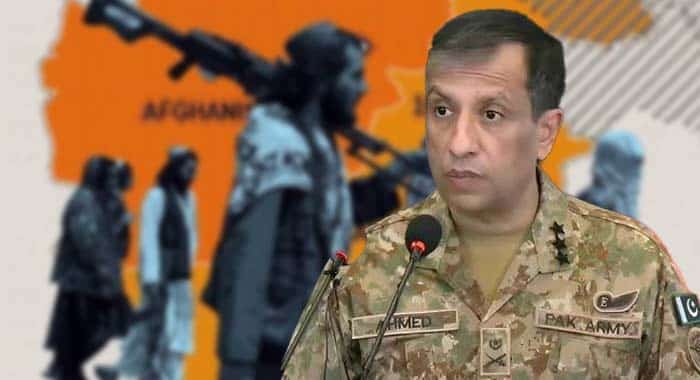
Pakistan has reiterated that terrorism remains one of the country’s foremost security challenges, with the military spokesperson highlighting what he described as links between terrorist networks, external support structures and instability emanating from Afghanistan.
Addressing an important security briefing, Director General Inter-Services Public Relations (DG ISPR) Lieutenant General Ahmed Sharif Chaudhry said that Pakistan’s counterterrorism efforts were focused not only on eliminating terrorists inside the country but also on addressing the broader environment that enables such threats.
During the briefing, the DG ISPR alleged that the Afghan Taliban regime was providing support to terrorist elements operating against Pakistan, saying that groups such as Fitna al-Khwarij and Fitna al-Hindustan were being facilitated through external networks.
He said Afghanistan had become a focal point for terrorist organizations and claimed that Pakistan had shared evidence regarding terrorist activities with the Afghan Taliban authorities.
The DG ISPR said Pakistan expected the Afghan Taliban regime to ensure that Afghan territory was not used against Pakistan or any other country. He stressed that counterterrorism commitments required practical action and verifiable measures.
He further stated that the security environment in Balochistan and Khyber Pakhtunkhwa was being affected by what he described as an external dimension of terrorism, adding that certain elements were attempting to exploit local issues to create instability.
According to the DG ISPR, Pakistan’s security forces have continued intelligence-based operations across the country to dismantle terrorist networks. He said thousands of operations had been conducted in Khyber Pakhtunkhwa and Balochistan during the year, resulting in the elimination of a large number of terrorists.
He also highlighted the alleged involvement of Afghan nationals in major terrorist incidents, saying that suicide attacks and other high-impact attacks in Pakistan had involved Afghan citizens.
The DG ISPR linked the security situation in Balochistan with what he described as a combination of internal and external factors, including terrorist groups, propaganda networks and foreign support mechanisms.
He said Fitna al-Khwarij and Fitna al-Hindustan had no difference in their objectives as both were targeting Pakistan’s security and stability.
The briefing also focused on the role of information warfare, with the DG ISPR stating that hostile propaganda networks were attempting to create divisions and portray a false picture of conditions in Balochistan and other affected regions.
He said Pakistan was enhancing technical surveillance, cyber capabilities, air surveillance and specialized training to counter emerging security threats.
The DG ISPR maintained that Pakistan’s policy towards terrorism remained clear, stating that terrorist groups would have to abandon violence and surrender, otherwise security forces would continue operations against them.
He said regional peace and security required that no country allow its territory to be used for terrorism against another state.
The remarks came amid continued concerns in Pakistan over cross-border terrorism and the presence of anti-Pakistan groups in Afghanistan



