
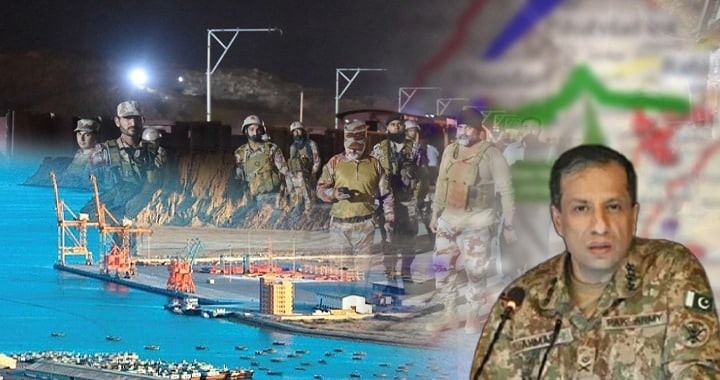
The extensive security briefing by Director General Inter-Services Public Relations Lieutenant General Ahmed Sharif Chaudhry presented Balochistan’s security situation as a challenge shaped by multiple interconnected factors: governance, development, social structures, terrorism networks and regional dynamics.
The central message emerging from the briefing was that security cannot be viewed only through the lens of military operations. Sustainable stability requires a combination of effective governance, public participation, economic opportunities and the dismantling of networks that exploit local grievances for violent agendas.
Security Begins With Governance
One of the important themes highlighted during the briefing was the relationship between security and governance.
The argument presented was that administrative effectiveness and public confidence are essential components of national security. A state’s ability to deliver services, address grievances and maintain institutional coordination directly influences the environment in which security challenges emerge.
The discussion on possible administrative reforms and new provinces reflected a broader question: whether Pakistan’s existing governance structure is sufficient for a population that has expanded significantly over decades.
The issue, therefore, is not merely about creating new administrative units, but about ensuring that governance reaches ordinary citizens effectively.
In regions with difficult terrain and scattered populations, including Balochistan, governance capacity becomes even more critical. Roads, education, healthcare, employment opportunities and access to state institutions are not separate from security, they are part of the foundation upon which stability is built.
The Balochistan Challenge: Between Development and Exploitation
The briefing presented a strong argument that the people of Balochistan themselves are the primary stakeholders of the province’s future.
A major point raised was that narratives of deprivation are sometimes exploited by actors who benefit from instability. According to the DG ISPR, certain elements linked their influence and interests with maintaining an old system where ordinary citizens remained dependent on traditional power structures.
The broader question is whether development opportunities, education and economic mobility reach the common citizen or remain concentrated among limited segments of society.
Human resources, rather than only natural resources, remain the most important asset of any region. A young population equipped with education, skills and employment opportunities can become the strongest force for stability.
This is why education, digital skills, and youth empowerment are increasingly viewed as security-related investments.
Terrorism and the External Dimension
The briefing also placed significant emphasis on what was described as the external dimension of terrorism.
The DG ISPR stated that Fitna al-Hindustan and Fitna al-Khwarij were targeting Pakistan through different methods, while alleging that their support networks existed outside Pakistan.
Afghanistan was a major part of this discussion. The DG ISPR alleged that the Afghan Taliban regime was supporting terrorist elements and said that terrorist groups were operating with external backing.
This remains one of the most sensitive aspects of Pakistan’s security environment, as Islamabad has repeatedly raised concerns regarding cross-border terrorism and the use of Afghan territory by anti-Pakistan groups.
The issue is not only bilateral, but also regional. Stability in Afghanistan directly affects Pakistan due to geography, historical links and the movement of people across the border.
Pakistan’s Regional Partnerships and Strategic Environment
The briefing also touched upon Pakistan’s relations with important regional partners, including Saudi Arabia and the United Arab Emirates.
Pakistan’s relationship with Saudi Arabia was described as strategic, with the special significance of Haramain Sharifain forming an important dimension of bilateral ties. Similarly, Pakistan’s relationship with the UAE was highlighted as an important partnership.
These relationships exist within a wider regional environment where security, economic cooperation, energy interests and connectivity are closely linked.
A stable Pakistan is important not only for its own national interests but also for regional trade routes and economic cooperation.
Information Warfare and Narrative Battles
Another major dimension highlighted during the briefing was the role of information warfare.
Modern security challenges are no longer limited to physical attacks. Propaganda, disinformation campaigns and social media manipulation have become tools used by hostile actors to influence public opinion and create divisions.
The DG ISPR referred to alleged propaganda efforts targeting Pakistan’s security institutions and Balochistan’s image, while stressing the need to strengthen cyber capabilities and counter hostile narratives.
This reflects a broader reality: the battle for stability is fought both on the ground and in the information space.
The Road Ahead: State Capacity and Public Trust
The broader lesson from the briefing is that counterterrorism cannot succeed through kinetic measures alone.
Operations against terrorist networks remain necessary, especially when armed groups threaten citizens and security institutions. However, lasting peace requires stronger governance, economic opportunity, political inclusion and institutional coordination.
For Balochistan, the challenge is to ensure that security gains translate into sustainable development and that ordinary citizens become the center of policymaking.
The province’s future will depend on whether the state can successfully combine security, governance and development into one integrated strategy.
In the evolving regional environment, Pakistan’s challenge is not only to defeat terrorist networks but also to prevent the conditions that allow hostile actors to exploit grievances.
That requires a long-term approach where the citizen, rather than any individual group or interest, remains the ultimate stakeholder.



