
Europe is facing a complex and evolving terrorism threat that, while smaller in scale compared to previous years, carries far greater unpredictability and political impact, according to newly released data and analysis by Europol covering trends in 2024.
The latest findings indicate that jihadist terrorism has not declined; instead, its nature has transformed significantly. During the peak years of 2014 to 2019, when groups such as Islamic State operated structured networks and coordinated large-scale attacks, the threat was more centralized and traceable. Today, Europe is increasingly confronted with isolated, self-radicalized individuals carrying out attacks inspired primarily by online content. This shift has created a threat environment that is less visible, more fragmented, and significantly harder to predict.
This evolving threat is driven by three interconnected factors: rapid online radicalization, geopolitical developments, and persistent social divides within European societies.
Digital platforms particularly encrypted messaging applications and social media have become the primary tools for spreading extremist ideology. Processes that once took months or years now unfold within weeks or even days. Individuals often radicalize in isolation, without direct contact with established networks, forming in what experts describe as a social and identity vacuum before becoming operational. This transformation has complicated the work of intelligence and law enforcement agencies, which are now dealing with decentralized actors rather than identifiable organizational structures.
Geopolitical developments have also contributed to this trend. The return of the Taliban to power in Afghanistan in August 2021, along with ongoing regional crises, has provided symbolic encouragement to extremist narratives. While these developments do not necessarily translate into operational networks within Europe, they influence perceptions, motivations, and ideological alignment among vulnerable individuals.
At the same time, internal social challenges including economic marginalization, integration difficulties, and identity crises among some second- and third-generation immigrants have created conditions that extremist groups can exploit. Officials emphasize that the overwhelming majority of Muslims in Europe have no connection to extremism; however, even a small minority influenced by online propaganda is sufficient to produce significant political and social consequences.
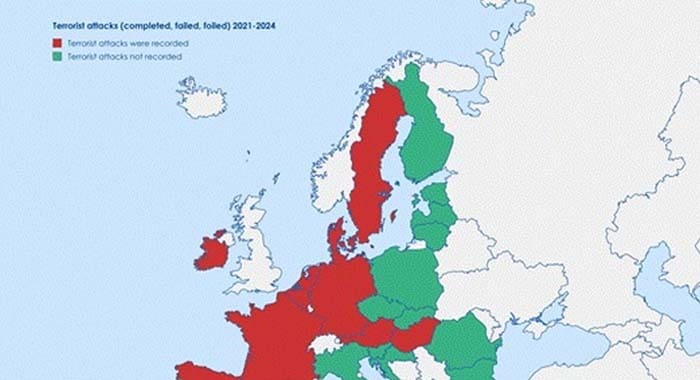
According to Europol’s data, 58 terrorist incidents were recorded across Europe in 2024. Of these, 24 attacks (41.4%) were attributed to jihadist actors, representing a notable increase compared to 2023. Other incidents included 21 far-left attacks (36.2%), 4 nationalist and separatist attacks (6.9%), 1 far-right attack (1.7%), and 8 classified under other categories (13.8%). Notably, jihadist-related attacks are the only category to have shown a substantial rise, with figures indicating a 300% increase between 2022 and 2024.
The geographic spread of these incidents also reflects the dispersed nature of the threat. At least ten European Union member states reported jihadist-related attacks in 2024, suggesting the presence of extremist activity even if limited to isolated incidents.
Arrest data further underscores the scale and reach of the issue. In 2024, 289 individuals were arrested across Europe for membership in or links to jihadist groups. Out of a total of 449 terrorism-related arrests, jihadist suspects accounted for 64.4%. Arrests were recorded in at least 22 of the 27 EU member states, indicating a broad and expanding footprint of radicalized individuals across the continent.
A particularly concerning trend identified in the report is the growing involvement of youth. Cases involving individuals aged 14 to 21 highlight the increasing focus of extremist groups on recruiting and influencing teenagers and young adults. This demographic, with high exposure to digital platforms, is considered especially vulnerable to online radicalization.
In 2024, 80 individuals were arrested for disseminating jihadist propaganda online, with many supporting ISIS, including its affiliate Islamic State Khorasan Province. These individuals ranged from those sharing existing content to those producing advanced digital and AI-generated material, demonstrating the adaptability of extremist networks in leveraging modern technology.
Terrorism financing remains another critical dimension of the threat. Europol reports that many arrests involved individuals accused of transferring funds to extremist groups through various channels, including bank transfers, digital payment systems, cryptocurrencies, and the informal Hawala network, which remains the most widely used method due to its anonymity and accessibility.
Despite the relatively limited scale of individual attacks, their political and media impact is substantial. Each incident receives extensive coverage, reigniting debates on immigration, security, and civil liberties. Far-right political movements have increasingly capitalized on this environment, using such events to reinforce narratives that portray Europe as under threat and liberal governments as ineffective in ensuring public safety.
This dynamic has contributed to a self-reinforcing cycle: attacks trigger political polarization, polarization deepens social divides, and those divides create conditions that can facilitate further radicalization. Experts warn that policies focused solely on security such as increased surveillance or stricter immigration controls may prove insufficient or even counterproductive if not accompanied by effective integration strategies and counter-radicalization efforts.
Feedback from immigrant communities also highlights challenges within integration systems. Many individuals report that these processes are overly complex and lack adequate support in areas such as education, housing, and access to essential services, further contributing to feelings of marginalization.
In response to growing political pressure, several European governments have pursued stricter measures, including controversial deportation policies involving Afghanistan under Taliban control. Germany has taken a leading role in engaging with the Taliban, with countries such as Denmark, Austria, Sweden, and Netherlands considering similar approaches.
However, analysts caution that while such measures may address short-term domestic political concerns, they have not resulted in a measurable decline in radicalization. Reports suggest that some deported individuals are not detained upon arrival in Afghanistan and may instead be reintegrated into extremist environments or facilitated by smuggling networks often operating under Taliban influence to re-enter Europe with altered identities. This cycle presents a long-term security challenge for European states.
European policymakers now face a fundamental dilemma: how to ensure security without undermining civil liberties and social cohesion. While stricter controls may offer immediate results, they risk deepening divisions and complicating the threat landscape over time.
Experts emphasize that a sustainable response requires a comprehensive approach combining targeted security measures, social integration policies, and robust efforts to counter radicalization both online and offline.
Muslim communities across Europe are also recognized as key partners in this effort. Through engagement, education, and cooperation with authorities, these communities can play an important role in countering extremist narratives, particularly among younger generations. Preventing the spread of violent ideologies and reporting suspicious activities are considered essential contributions to maintaining collective security.
Ultimately, Europe’s current challenge lies not in the number of attacks but in their evolving nature. The rise of decentralized, digitally driven extremism has created a threat that, while limited in scale, has the capacity to generate significant political, social, and media repercussions.
As Europe navigates this complex landscape, the outcome will not only determine the effectiveness of its counterterrorism strategies but also shape the future of its democratic values, social cohesion, and political stability.



