
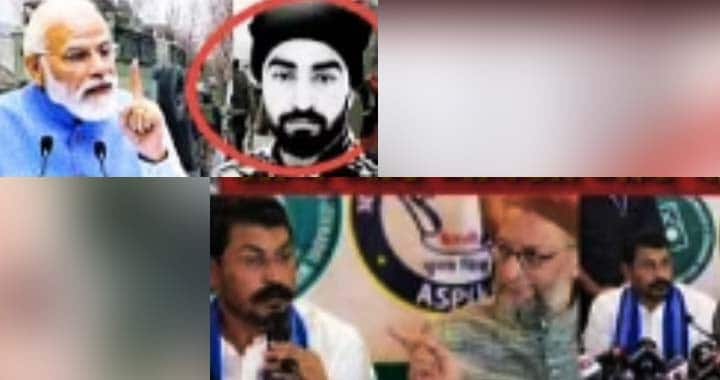
Indian media has once again come under intense scrutiny over allegations of irresponsible journalism, sensationalism and the dissemination of unverified information after News18 reportedly used the photograph of Muhammad Latif Ahmad Bhat, a Kashmiri political activist and businessman, in connection with the Kulgam firing incident, portraying him as a terrorist.
According to information reported by Kashmir Media Service (KMS), Latif Ahmad Bhat is, in fact, a young political leader affiliated with the Jammu and Kashmir National Conference (JKNC), serving as its Youth Joint Secretary. A resident of Bandipora in Indian-administered Jammu and Kashmir, he is also a businessman and a father of two children. His alleged wrongful association with a terrorist incident has triggered serious questions about the journalistic standards, fact-checking procedures and professional accountability of Indian television news channels.
The incident has raised grave concerns about the potentially devastating consequences of broadcasting unverified allegations and misidentifying individuals in sensitive security-related matters. Associating an ordinary political activist and businessman with terrorism without establishing the authenticity of the information can cause irreparable damage to an individual’s reputation, personal security, family life and professional standing.
Muhammad Latif Ahmad Bhat has reportedly demanded an unconditional public apology from News18 for using his photograph in connection with the incident. He has also announced his intention to pursue defamation proceedings and other legal remedies against those responsible. Following his warning of legal action, the channel reportedly removed the disputed report from its website. However, the removal of the content does not, in itself, resolve the questions of accountability or compensate for the potential damage caused by its publication.
The controversy has once again brought the credibility of sections of the Indian electronic media into question, particularly in matters concerning Jammu and Kashmir, where sensationalist reporting and the premature presentation of allegations as established facts can have serious consequences.
This is not an isolated controversy. Indian media outlets have faced repeated criticism over the circulation of misleading narratives and unverified claims, including during Operation Sindoor in May 2025. Several Indian television channels broadcast videos from unrelated incidents, video games and old footage while presenting them as visuals of military developments. A number of such claims subsequently faced scrutiny and rejection by international media organisations and independent fact-checkers.
Similarly, in May 2025, sections of the Indian media reportedly portrayed Qari Muhammad Iqbal, a madrassa teacher from Poonch, as a notorious militant commander and claimed that he had been killed. The BBC, in its report published on 26 May 2025, examined the claims and brought attention to his actual identity, exposing serious discrepancies in the media narrative surrounding the incident.
Another controversial episode emerged in September 2026, when claims were circulated by Indian military and media circles regarding the alleged killing of former Pakistani SSG commando Muhammad Asif, also known as Hashim Musa, in Budgam. According to the account cited by KMS, the narrative suffered a major setback on 1 October 2026, when the Director General of Inter-Services Public Relations (DG ISPR) presented retired Havildar Muhammad Asif alive before the media, challenging the claims surrounding his alleged death.
The statement also recalled remarks attributed to Sergio Gor, the US Ambassador to India, who reportedly criticised sensationalism and misinformation in Indian television coverage in August 2026. His alleged observations about the blurring of distinctions between news, analysis and facts further underscore the wider concerns surrounding media credibility and responsible journalism.
The recurring controversies raise an important question: how can a media organisation claim to uphold journalistic integrity when individuals can reportedly be branded as terrorists through the use of unverified photographs and allegations?
Journalism carries a profound responsibility, particularly in conflict-affected and politically sensitive regions. Media organisations must distinguish between verified facts, official claims, speculation and allegations. The rush to sensationalise security incidents must never take precedence over accuracy, fairness and the fundamental rights of individuals.
The latest News18 controversy reinforces the urgent need for independent verification, transparent corrections, professional accountability and an unconditional apology wherever an innocent individual is wrongly associated with terrorism or criminal activity.
Repeated incidents of this nature risk undermining public confidence in the media, damaging the credibility of Indian news organisations and reinforcing concerns that sensationalism and political narratives are being prioritised over professional journalism.



