
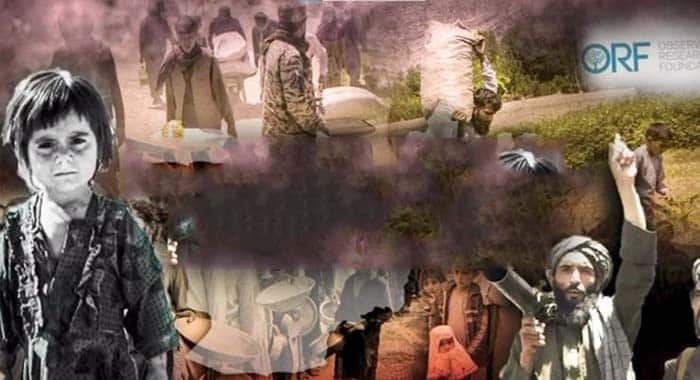
The situation in Afghanistan has continued to deteriorate following the Taliban’s takeover of power, with growing concerns over humanitarian conditions, governance challenges, restrictions on fundamental rights, and the expansion of security threats affecting the wider region, according to a recent assessment by the Observer Research Foundation (ORF). The Indian think tank has highlighted what it describes as a worsening political, economic, humanitarian, and security environment in Afghanistan under Taliban rule, warning that the consequences of the current governance model extend beyond Afghanistan’s borders and pose broader regional security challenges.
According to the assessment, Afghanistan has experienced increasing instability since the Taliban assumed control, with severe restrictions on civil liberties, economic uncertainty, and security concerns contributing to an increasingly fragile environment. The report noted that in March 2026, United States Secretary of State Marco Rubio described Afghanistan as a country associated with unlawful detentions, reflecting continuing international concerns regarding governance practices under the Taliban administration.
The assessment further stated that in December 2025, Australia imposed significant travel and financial restrictions on three Taliban ministers and the Chief Justice of the Taliban Supreme Court, citing concerns related to the regime’s conduct and policies.
The Observer Research Foundation stated that Afghanistan’s humanitarian situation has significantly worsened since the Taliban’s return to power, creating conditions of prolonged crisis for millions of Afghan citizens.
The think tank highlighted restrictions imposed on women’s education and participation in public life, stating that such policies have severely limited opportunities for Afghan women and girls.
It further noted that former government supporters, civil society members, and minority communities have continued to face security threats and attacks, adding to concerns regarding inclusion, protection of vulnerable groups, and respect for fundamental rights.
The report also raised concerns regarding transparency and accountability within Afghanistan’s governance and financial systems.
According to the assessment, the sources of Afghanistan’s annual budget and mechanisms for public expenditure remain unclear, while resources intended for national development and public services have reportedly faced significant challenges.
The think tank stated that continued financial uncertainty and lack of transparency have contributed to Afghanistan’s economic difficulties and weakened its ability to address humanitarian needs effectively.
The Observer Research Foundation warned that the continued presence of terrorist organizations inside Afghanistan represents a major security concern for the region.
The assessment pointed to the presence and activities of groups including Al-Qaeda and Fitna al-Khawarij, stating that such organizations continue to highlight the security risks emerging from Afghanistan’s current environment.
The report emphasized that the inability or unwillingness to prevent militant groups from operating within Afghan territory could have serious implications for neighbouring countries and regional stability.
Former US diplomat and Afghanistan affairs expert Jenny Forstheimer also expressed concerns regarding the situation, highlighting alleged violations of human rights, particularly affecting women, minorities, and media organizations.
She stated that the alleged presence and protection of terrorist groups by the Taliban represents a serious challenge requiring continued international attention.
According to the assessment, the combination of humanitarian challenges, restrictions on rights, governance weaknesses, and security threats has created a complex crisis requiring sustained international engagement.
The Observer Research Foundation stressed that developments in Afghanistan cannot be viewed solely as an internal matter, given the country’s strategic location and historical role in regional security dynamics.
The think tank warned that continued instability, economic decline, and militant activity could further affect neighbouring countries and international security interests.
It called for greater attention toward humanitarian assistance, accountability mechanisms, counterterrorism efforts, and policies aimed at preventing Afghanistan from becoming a source of renewed regional instability.
The assessment concluded that without meaningful changes in governance, protection of fundamental rights, and effective measures against terrorist organizations, Afghanistan risks facing deeper humanitarian suffering and prolonged security challenges.



