In a significant move to consolidate his authority over the Taliban’s intelligence apparatus, Supreme Leader Hibatullah Akhundzada personally signed a secret 13-clause decree imposing sweeping restrictions on the General Directorate of Intelligence (GDI), targeting its personnel, institutional influence, recruitment procedures and financial autonomy.
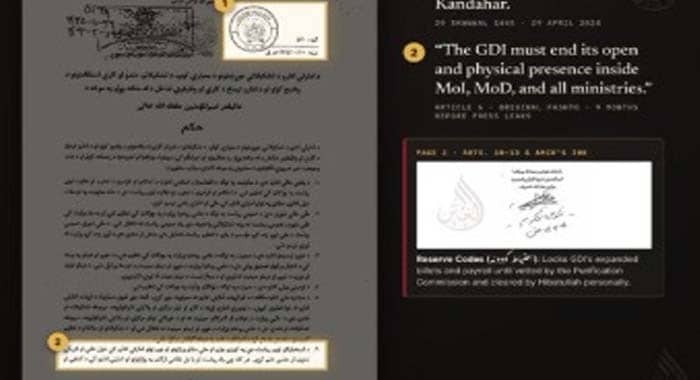
Signed on April 29, 2024, Decree No. 530 was kept confidential and had not been publicly disclosed. The order reportedly introduced a comprehensive restructuring of the intelligence agency, effectively curtailing its presence across government institutions and placing key administrative and financial decisions under the direct authority of the Taliban supreme leader.
The decree’s provisions point to a decisive shift in the internal power structure of the Taliban administration, reversing previous arrangements that had expanded the GDI’s influence throughout government ministries and departments. Clause 6 of the decree explicitly ordered the removal of GDI personnel from the Ministry of Defence, Ministry of Interior and all other government institutions.
The directive effectively reversed the 2022 initiative attributed to Abdul Haq Wasiq, through which GDI personnel had established a presence and influence across various ministries. This measure significantly restricted the intelligence agency’s institutional footprint, dismantling its previously established presence within key government departments. Clauses 10, 11 and 13 introduced further controls over the GDI’s manpower and recruitment system.
Under these provisions, the agency’s personnel were to be restricted to designated reserve codes, known as Ehtiyat Codes, maintained outside the regular official government records.
Furthermore, the recruitment of any fighter into the intelligence agency was made conditional upon mandatory biometric registration and approval from the Purification Commission. These requirements placed additional administrative controls on recruitment, personnel registration and the induction of individuals into the intelligence apparatus.
Perhaps one of the most consequential provisions concerned the agency’s financial authority. The decree reportedly stipulated that no lump-sum payment could be approved without the personal signature of Hibatullah Akhundzada.
By introducing this requirement, the Taliban supreme leader brought a critical aspect of the GDI’s financial operations under his direct supervision, significantly restricting the agency’s independent financial decision-making.
The decree’s impact reportedly became evident within just 30 days of its signing. The Kandahar leadership removed Rahmatullah Najib, the GDI Deputy Chief for Finance, from his position. He was subsequently sent into exile in Badakhshan.
Following his removal, Bismillah Abdullah, described as loyal to the Taliban Shura, was appointed to oversee the agency’s financial affairs. The rapid removal and replacement of a senior financial official underscored the far-reaching administrative changes introduced following the decree.
Decree No. 530 represents a significant development in the Taliban’s internal power structure. By restricting GDI personnel across government institutions, tightening recruitment procedures, imposing biometric registration requirements and bringing lump-sum payments under his personal approval, Hibatullah Akhundzada sought to consolidate direct control over the intelligence apparatus.
The reversal of the 2022 arrangements, followed by the removal of a senior financial official and his replacement with a Shura loyalist, further illustrates the extent of the restructuring described in the decree.
The most striking aspect of this development is that the Taliban supreme leader personally authorised sweeping restrictions on his own intelligence agency through a confidential order that remained outside public view.
The 13-clause decree, signed on April 29, 2024, provides an important insight into the internal mechanisms of authority, institutional control and power consolidation within the Taliban administration.