
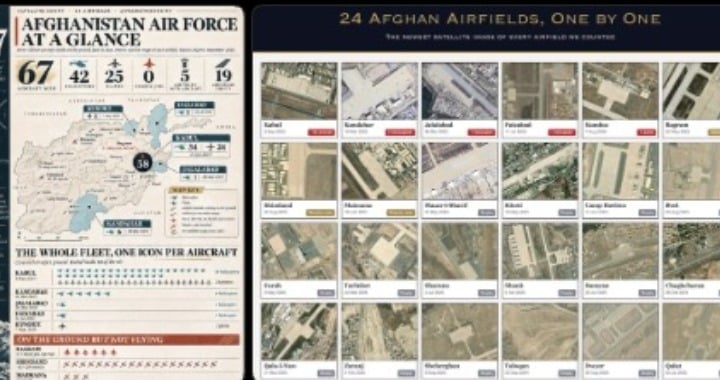
The Taliban administration’s claims of military strength and control over Afghanistan’s airspace have come under fresh scrutiny following an open-source intelligence (OSINT) assessment of the country’s 24 airfields, which reportedly reveals a severely limited aviation capability and the absence of operational fighter jets.
According to the OSINT investigation, satellite imagery indicates that the Taliban’s remaining military aviation assets consist primarily of helicopters and conventional aircraft, with no fighter jets identified among the aircraft observed. The findings challenge the Taliban’s portrayal of itself as a formidable military force capable of maintaining conventional air defence capabilities.
The assessment reportedly identified 67 aircraft visible in open areas across Afghanistan, including 42 helicopters and 25 fixed-wing aircraft. However, the presence of aircraft on the ground does not necessarily indicate that they are operational, airworthy, or available for military deployment.
The analysis further suggests that Afghanistan’s military aviation assets are heavily concentrated, while numerous other airfields show little or no visible aviation activity. Several aircraft identified in satellite imagery also appear to be non-operational wrecks or long-abandoned airframes.
One of the most significant findings of the assessment is the apparent absence of operational fighter aircraft. This raises fundamental questions about the Taliban administration’s ability to establish a conventional air force, conduct aerial combat operations, or independently defend Afghan airspace against modern military aircraft.
While helicopters and transport aircraft can provide limited mobility, logistical support, and other aviation functions, they cannot replace the capabilities of a modern fighter fleet.
The distinction is particularly important because possessing aircraft is not equivalent to maintaining an effective air force. Operational readiness requires trained pilots, qualified maintenance personnel, spare parts, functioning infrastructure, technical support, and sustainable logistical arrangements.
The OSINT assessment therefore raises questions not only about the number of aircraft available to the Taliban but also about their actual operational readiness and the administration’s ability to sustain military aviation operations.
Since returning to power in August 2021, the Taliban have repeatedly projected an image of military strength and portrayed their victory over international forces as evidence of their military capabilities.
However, the latest satellite-based assessment presents a contrasting picture of Afghanistan’s aviation infrastructure, suggesting that the administration faces substantial limitations in developing a conventional air force.
The absence of an identifiable operational fighter fleet is particularly significant in the context of regional security, where air superiority and modern aerial capabilities remain important components of national defence.
The assessment also highlights the difference between controlling former military infrastructure and possessing the technical, logistical, and operational capabilities required to maintain a modern air force.
The reported findings demonstrate the importance of independent satellite imagery and open-source intelligence in evaluating military claims and assessing the actual capabilities of armed administrations.
Nevertheless, satellite imagery provides only a snapshot of visible assets. It cannot independently establish the serviceability of every aircraft, exclude aircraft stored indoors or elsewhere, or determine the full extent of an organisation’s operational capabilities.
A comprehensive assessment would therefore require additional verification through aviation records, maintenance information, credible reporting, and other independent intelligence sources.
The central finding is significant: The possession of abandoned aircraft and military airfields does not translate into air superiority or a functional combat air force. The Taliban administration’s actual military aviation capabilities remain a serious question despite its claims of military strength.



