
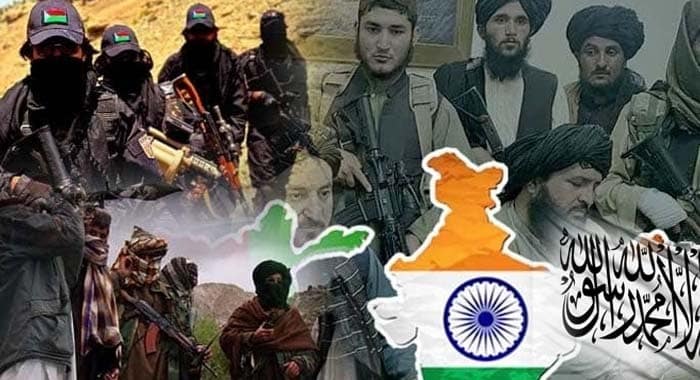
The Taliban administration’s General Directorate of Intelligence (GDI) is reportedly pursuing a coordinated information campaign intended to damage Pakistan’s international reputation by manufacturing confessional statements linking the country to militant activities inside Afghanistan.
The reported strategy involves recording statements from Afghan nationals under coercion or in exchange for financial incentives. These individuals would reportedly claim affiliation with the Islamic State–Khorasan Province (ISKP) or Afghan resistance groups and state that they received training at camps inside Pakistan to fight against the Taliban administration.
The reported campaign is intended to create a narrative associating Pakistan with cross-border militancy and then use the purported confessions to influence regional governments, international audiences, and media coverage. The statements are also reportedly intended for widespread circulation on social media and for reference in public statements and interviews by Taliban officials.
If substantiated, these activities would raise serious concerns about the use of manipulated testimony to influence regional security perceptions, undermine diplomatic confidence, and divert attention from the continuing challenge of countering extremist networks in Afghanistan and the wider region.
The purported confessions are reportedly intended to be presented to Russia, Tajikistan, Uzbekistan, and Iran as supposed evidence of Pakistan’s involvement in training or supporting armed groups operating against the Taliban administration.
The reported strategy appears designed to exploit regional concerns about terrorism and cross-border militancy by presenting claims against Pakistan in a form intended to appear credible to foreign governments.
These countries have significant interests in Afghanistan’s security environment and the prevention of extremist violence. Russia, in particular, has expressed concern about the threat posed by ISKP, while Central Asian states and Iran also face security challenges associated with instability and militant activity in the region.
The reported plan seeks to connect these existing concerns with claims about Pakistan’s role in supporting militant organisations. However, claims of this nature require credible, independently verifiable evidence and should not be accepted solely on the basis of recorded confessions whose circumstances and authenticity have not been established.
The credibility of any security assessment depends on the quality of its evidence, the transparency of its investigative process, and the ability of independent observers to examine the facts.
The planned campaign reportedly extends beyond the recording of confessional statements. It includes the coordinated dissemination of these statements across social media platforms and their use in public communications by Taliban officials.
Such a strategy could amplify a single narrative across multiple channels, creating the impression of independent corroboration even when the underlying material originates from the same source. In an increasingly interconnected media environment, recordings and statements can circulate rapidly across national borders. When presented without sufficient context or independent verification, such material can influence public opinion and complicate the work of journalists, researchers, and policymakers seeking to establish the facts.
The reported use of interviews and official media appearances would further increase the reach of the messaging by presenting the statements as part of a broader political narrative.
The central concern is whether such material is being prepared to establish the truth of a security matter or to advance a predetermined accusation against Pakistan. Independent verification, authenticated evidence, and transparent scrutiny are essential to answering that question.
The Islamic State–Khorasan Province remains a significant security concern for Afghanistan and neighbouring countries. Its activities have attracted sustained regional attention because of the risks associated with extremist recruitment, organised violence, and cross-border operations.
The reported strategy seeks to take advantage of Russia’s focus on the ISKP threat by associating the organisation’s activities with Pakistan. The objective is reportedly to influence regional perceptions of the origins and support networks of extremist organisations. If unsupported claims are presented as established facts, they could distort threat assessments and complicate efforts to develop an accurate understanding of the region’s security challenges.
Counterterrorism policies must be based on credible intelligence and verifiable findings. Establishing whether a particular organisation operates from a specific location, receives external support, or maintains training infrastructure requires evidence beyond unverified testimony.
Regional governments have a shared interest in ensuring that genuine security threats are investigated thoroughly and that political disputes do not interfere with efforts to identify and disrupt extremist networks.
One of the most serious aspects of the reported plan is the purported use of coercion or financial incentives to obtain statements from Afghan nationals. Confessions recorded under pressure or in exchange for payment raise fundamental questions about their reliability. Such statements cannot, on their own, establish an individual’s affiliation, the existence of a training facility, or the involvement of a foreign state in militant activities.
A credible investigation must examine the circumstances in which a statement was obtained, whether the individual was free from coercion, whether the recording has been authenticated, and whether independent evidence supports the claims being made.
These safeguards are particularly important when purported confessions are intended to influence international relations or support accusations involving national security. The circulation of unverified statements can have consequences far beyond the individuals featured in them. It may affect diplomatic engagement, shape public perceptions, and create pressure for policy decisions before the facts have been adequately established.
For this reason, any confessional material presented to regional governments should be subjected to independent examination rather than accepted at face value.



