
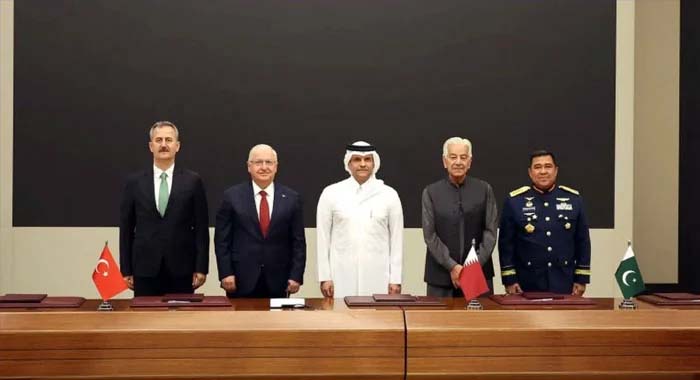
Pakistan, Türkiye, Qatar and Indonesia have signed the Badr Memorandum of Understanding (MoU) to enhance defence cooperation, strengthen their respective defensive capabilities and expand collaboration across defence production, military technology, research and development, and professional training. The agreement, signed in Doha on Wednesday, reflects the participating countries’ shared commitment to deepening strategic partnerships, promoting industrial cooperation and contributing to regional peace and stability.
According to a statement issued by Türkiye’s Ministry of National Defence, the memorandum represents a significant step towards broadening defence-sector engagement among the four countries. It establishes a framework for exploring mutually beneficial opportunities, drawing on the complementary strengths, technical expertise and industrial capacities of their respective defence sectors.
The ministry highlighted the agreement’s substantial economic importance, underscoring its potential to facilitate cooperation in military production, enhance defence capabilities and strengthen collaboration in technical military training, research and development.
The Badr Memorandum seeks to encourage closer coordination among the participating countries’ defence industries, creating opportunities to identify areas of mutual interest and develop practical avenues for cooperation. By leveraging each country’s distinctive capabilities in defence manufacturing and related technologies, the initiative aims to support industrial integration, improve production capacities and contribute to meeting the requirements of allied and friendly nations.
The framework also provides an opportunity to explore collaboration in joint production, technical expertise sharing and the development of sustainable defence-industrial partnerships, subject to applicable national and international laws, regulations and procedures.
Enhanced industrial engagement could also create avenues for knowledge exchange, technological advancement and the development of skilled human resources. Such cooperation is intended to strengthen the participating countries’ capacity to address evolving defence requirements while promoting greater efficiency, innovation and self-reliance within their respective defence sectors.
Commenting on the agreement, Pakistan’s Defence Minister, Khawaja Muhammad Asif, reiterated Pakistan’s commitment to strengthening defence cooperation with trusted international partners and expanding mutually beneficial engagement in areas of shared interest.
In his statement, the defence minister said:
“Pakistan places great importance on strengthening defence cooperation with trusted partners. This memorandum reflects our shared commitment to contributing to regional peace and stability.”
He further emphasised Pakistan’s interest in exploring opportunities to enhance self-reliance, expand industrial collaboration, promote joint production and facilitate technology transfer by drawing upon the complementary strengths of the participating countries’ defence industries.
The minister underscored that such cooperation would be pursued in accordance with relevant international and domestic laws and regulations, reflecting the importance of responsible engagement, institutional coordination and compliance with applicable legal frameworks.
“Through this partnership, we aim to advance cooperation across joint research and development, training exchanges and industrial capability building,” he added.
A key dimension of the Badr Memorandum is its emphasis on strengthening cooperation beyond conventional defence-sector engagement. The framework envisages opportunities for collaboration in research and development, technical training, professional exchanges and industrial capacity building.
Joint research initiatives could facilitate the exchange of technical knowledge and expertise, while training cooperation may support the development of professional skills and institutional capabilities. Similarly, collaboration in defence production and technology development could help the participating countries identify opportunities to improve manufacturing processes, expand technical expertise and develop capabilities aligned with their respective requirements.
The memorandum also underscores the importance of closer engagement between defence-related institutions and industries, enabling the participating countries to explore practical areas of cooperation and establish a foundation for sustained, mutually beneficial collaboration.
The signing of the Badr Memorandum reflects the participating countries’ stated intention to strengthen defence partnerships while contributing to broader objectives of peace, stability and security.
Through structured engagement and cooperation in agreed areas, Pakistan, Türkiye, Qatar and Indonesia seek to build stronger institutional and industrial links that can support their respective defence requirements and encourage constructive international partnerships.
The agreement provides a framework for pursuing shared interests through cooperation, technical exchange and the development of industrial capabilities. Its implementation will depend on the identification of mutually agreed priorities and the establishment of appropriate mechanisms for translating the memorandum’s objectives into practical initiatives.
The Badr Memorandum of Understanding marks an important development in efforts to deepen defence-industrial engagement among Pakistan, Türkiye, Qatar and Indonesia. By bringing together complementary expertise and production capabilities, the initiative creates a platform for exploring cooperation in areas that may include joint manufacturing, research and development, training, technology transfer and industrial capability building.
For Pakistan, the agreement aligns with its stated objective of strengthening partnerships with trusted countries, enhancing domestic capabilities and pursuing greater self-reliance through responsible defence-industrial cooperation.
As the participating countries explore opportunities under the memorandum, the emphasis will remain on mutually beneficial engagement, compliance with applicable laws and regulations, and the development of sustainable partnerships that serve their respective national interests.
The Badr Memorandum thus provides a basis for further cooperation among the four countries, with the shared objective of strengthening defence capabilities, expanding industrial collaboration and contributing to regional peace and stability.



