
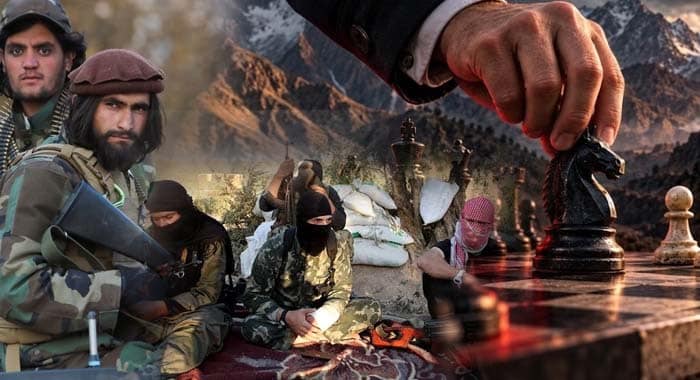
A series of attacks, competing claims of responsibility and conflicting narratives surrounding security incidents in northern Afghanistan have intensified scrutiny of the information war unfolding in Badakhshan, where the Taliban authorities, the Islamic State Khorasan Province (ISKP) and anti-Taliban resistance groups operate in a complex and contested security environment.
A central focus of the controversy is an allegation advanced by resistance-linked media that Taliban intelligence networks exploit attacks claimed by ISKP and the National Resistance Front (NRF) to portray the two groups as cooperating. The allegations suggest that overlapping claims, delays in public statements and restricted communications between fighters and media representatives can be used to construct competing narratives about responsibility for attacks.
These accusations, which include claims of covert coordination between Taliban intelligence elements and ISKP operatives, are serious and remain unproven. Nevertheless, the publicly documented pattern of competing claims surrounding some attacks in Badakhshan raises important questions about attribution, information reliability and the difficulty of independently establishing responsibility for violence in Afghanistan.
An explosion in Police District 6 of Faizabad on 4 October 2026 brought these competing narratives into sharp focus. The attack targeted a vehicle associated in media reports with Taliban intelligence official Safiullah Mutawakkil.
The National Resistance Front subsequently claimed responsibility for the incident, while ISKP also issued a claim. The competing assertions created uncertainty over responsibility and prompted conflicting accounts of the attack and its consequences.
KabulNow reported that the NRF claimed its forces had carried out a targeted operation, while ISKP separately claimed responsibility for the bombing. Other reporting also documented the competing claims and noted that key details, including casualty figures and the precise circumstances of the attack, could not be independently verified.
The incident has become a focal point for broader allegations that overlapping claims can be exploited to shape perceptions of the armed opposition in northern Afghanistan. Resistance-linked commentators argue that communication difficulties between fighters operating in remote mountainous areas and media teams outside the country may contribute to premature or inaccurate claims of responsibility. Under this interpretation, the subsequent appearance of a competing ISKP claim can be used to suggest coordination between otherwise rival organisations.
However, the existence of competing claims alone does not establish that the Taliban directed the attack, hired the perpetrators or deliberately manipulated the timing of the announcements. Those allegations would require independent evidence, including verifiable communications, corroborated testimony or other reliable documentation.
The allegations extend beyond the October incident. Resistance-linked accounts accuse elements of the Taliban’s General Directorate of Intelligence (GDI) of exploiting ISKP attacks to eliminate local rivals and subsequently shape the political narrative surrounding their deaths. The claims also allege that some individuals are publicly associated with ISKP after being killed or detained, despite questions about the evidence supporting those accusations.
Independent human rights reporting has documented broader concerns in Afghanistan regarding the treatment of individuals accused of links to armed opposition groups and ISKP. The European Union Agency for Asylum, summarising findings from Rawadari and other sources, noted concerns that accusations of affiliation with ISKP or armed opposition groups have been used against former officials and other individuals. This background provides relevant context but does not independently establish the specific allegations of Taliban–ISKP operational coordination presented here.
The distinction is important: documented concerns about arbitrary accusations and abuses should be investigated on their own merits, while claims of organised covert cooperation between opposing armed groups require separate corroboration.
Another element of the controversy concerns Al-Mirsad, a media outlet that publishes material supporting Taliban narratives on security matters. Resistance-linked commentators have criticised articles that cite claims by the NRF and ISKP concerning the same incidents as evidence of cooperation between the groups. They argue that the publication of overlapping claims can be used to portray the armed opposition as aligned with ISKP, regardless of whether the groups coordinated a particular operation.
This dispute illustrates the broader importance of source verification in reporting on Afghanistan. Statements by armed groups, intelligence-linked outlets and political opponents frequently reflect competing interests, making independent corroboration essential before conclusions are drawn about responsibility or cooperation. The timing of a public claim may be relevant to an investigation, but timing alone cannot demonstrate that one organisation directed another, that an attack was commissioned by a third party or that the subsequent reporting was deliberately coordinated.
Badakhshan has remained an important area of anti-Taliban armed activity since the Taliban returned to power in August 2021. Its mountainous terrain, dispersed communities and strategic position in northeastern Afghanistan present challenges for security operations, communications and independent reporting.
Data compiled by the Armed Conflict Location & Event Data project (ACLED) recorded an increase in reported activity by anti-Taliban armed opposition groups in Badakhshan between June–December 2025 and January–July 2026. ACLED cautions that such figures rely in part on the groups’ own reporting and are subject to limitations arising from restricted access to independent information.
In this environment, information released by armed organisations can influence perceptions of local security, the credibility of rival groups and the political standing of authorities. Conflicting accounts can also complicate efforts by journalists, researchers and human rights monitors to establish the facts surrounding individual incidents. For residents, the consequences extend beyond competing narratives. Allegations of militant affiliation, retaliatory arrests and insecurity can contribute to fear and uncertainty, underscoring the importance of reliable reporting and independent investigations.
The competing claims surrounding the 4 October attack in Faizabad illustrate the challenges of establishing responsibility for violence in northern Afghanistan. They also demonstrate how the information surrounding an attack can become a separate arena of contest, with rival organisations seeking to influence public understanding of events.
The allegations of a deliberate Taliban strategy to exploit ISKP claims remain unverified. Yet the broader issues they raise including transparency, accountability, the treatment of alleged opponents and the reliability of security-related information deserve sustained attention.
Independent verification, credible journalism and impartial human rights investigations remain essential to distinguishing established facts from propaganda and ensuring that serious allegations are assessed on the strength of the available evidence.



