
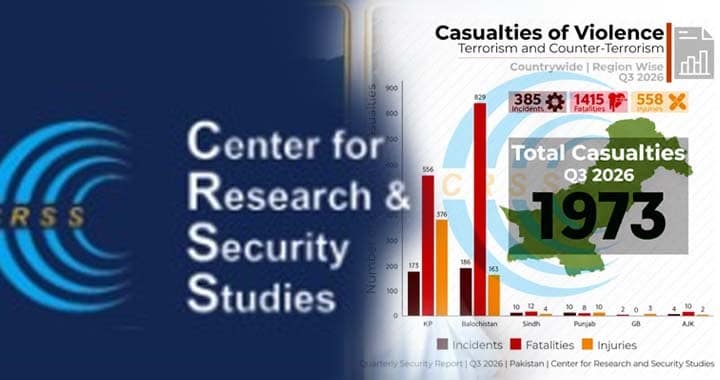
Pakistan witnessed a sharp escalation in violence during the third quarter of 2026, with violence-linked fatalities rising by 83 percent compared with the previous quarter, according to the latest assessment by the Center for Research and Security Studies (CRSS).
The surge marks a significant reversal of the declining quarter-on-quarter trend recorded during the first two quarters of the year and represents the highest escalation in violence recorded since 2021, according to the CRSS assessment.
The most striking development was the dramatic deterioration in Balochistan, where fatalities more than tripled compared with Q2. The province recorded 829 violence-linked deaths, accounting for nearly 59 percent of the national total and overtaking Khyber Pakhtunkhwa (KP) as Pakistan’s worst-affected province during the quarter.
Across the country, CRSS documented at least 1,415 fatalities and 558 injuries in 385 incidents involving terrorist attacks and counterterrorism operations during Q3 2026.
The regional distribution of violence presents a particularly stark picture. Balochistan and Khyber Pakhtunkhwa together accounted for approximately 98 percent of all violence-linked fatalities recorded nationwide during the quarter. Balochistan registered 829 fatalities, representing nearly 59 percent of the national toll, while KP recorded 556 deaths, accounting for more than 39 percent.
The two provinces also dominated the incident count. Balochistan recorded 186 violent incidents, representing more than 48 percent of all incidents documented during the quarter, while KP registered 173 incidents, or nearly 45 percent. The figures demonstrate the overwhelming concentration of Pakistan’s security challenge in the country’s southwestern and northwestern regions.
The most significant statistical shift occurred in Balochistan. Fatalities in the province jumped from 265 in Q2 to 829 in Q3, representing an increase of approximately 213 percent. The development reversed the improvement witnessed during the previous quarter, when Balochistan’s fatalities had fallen from 443 in Q1 to 265 in Q2.
The Q3 figures therefore represent not merely a continuation of violence but a dramatic deterioration in the province’s security environment. By comparison, KP also experienced a significant increase, with fatalities rising from 475 in Q2 to 556 in Q3, an increase of more than 17 percent.
At the national level, the scale of the escalation is equally significant. Violence-linked fatalities increased from 774 in Q2 to 1,415 in Q3, resulting in 641 additional deaths in a single quarter. According to CRSS, this represented an approximately 83 percent quarter-on-quarter increase and brought an end to the declining trend recorded during Q1 and Q2. The increase was driven overwhelmingly by developments in Balochistan, which accounted for nearly 88 percent of the national increase in fatalities.
A major feature of the Q3 security landscape was the substantial rise in fatalities among outlaws. CRSS recorded 921 outlaw fatalities, representing more than 65 percent of all violence-linked deaths during the quarter. These deaths resulted from approximately 154 security operations.
The number of outlaw fatalities more than doubled compared with Q2, rising from 453 to 921, an increase of more than 103 percent. Of the additional 641 deaths recorded nationwide between Q2 and Q3, 468 were outlaws, accounting for nearly three-quarters of the overall increase. The figures indicate the intensity of counterterrorism operations conducted during the quarter and the heavy losses suffered by outlaw elements during security actions.
While outlaw fatalities represented the largest share of the increase, the escalation in violence also had a substantial impact on civilians and security personnel.
CRSS recorded:
-
254 civilian fatalities, representing approximately 18 percent of the national total.
-
240 security personnel fatalities, representing approximately 17 percent.
-
921 outlaw fatalities, representing more than 65 percent.
Combined civilian and security personnel fatalities rose from 321 in Q2 to 494 in Q3, representing an increase of nearly 54 percent. Security personnel fatalities experienced the sharper increase, climbing from 134 to 240, or more than 79 percent. Civilian fatalities increased from 187 to 254, representing an increase of nearly 36 percent.
Notably, the gap between civilian and security personnel deaths narrowed considerably. In Q3, civilians accounted for only 14 more fatalities than security personnel, compared with a difference of 53 deaths in Q2.
While Balochistan recorded the highest number of fatalities, Khyber Pakhtunkhwa suffered the largest share of injuries. KP recorded 376 injuries, representing more than 67 percent of all violence-linked injuries during Q3. Balochistan followed with 163 injuries, accounting for more than 29 percent.
At the national level, civilians and security personnel collectively accounted for approximately 95 percent of all injuries. Civilians recorded 284 injuries, while security personnel suffered 247 injuries. The injury figures underline the substantial human cost of the violence beyond fatalities alone.
The quarter also witnessed a particularly sharp increase in injuries among security personnel. Security personnel injuries rose from 117 in Q2 to 247 in Q3, an increase of approximately 111 percent. Civilian injuries increased from 205 to 284, representing a rise of roughly 39 percent. The figures demonstrate that the escalating violence placed extraordinary pressure on security personnel while simultaneously increasing the burden on civilian populations.
Another notable feature of the CRSS assessment is the stark contrast between fatalities and injuries among outlaw elements. Outlaws accounted for 921 fatalities, but only 27 injuries, representing approximately five percent of all injuries recorded during the quarter. CRSS notes that the combination of a substantial increase in outlaw fatalities and a very low proportion of outlaw injuries highlights the lethal nature of the counterterrorism operations conducted during the reporting period. By contrast, civilians and security personnel suffered the overwhelming majority of recorded injuries.
Among groups claiming responsibility for attacks during Q3, the Tehreek-e-Taliban Pakistan (TTP) emerged as the deadliest, according to the CRSS assessment. TTP claimed responsibility for 13 attacks, which resulted in 117 fatalities and 65 injuries. The Balochistan Liberation Army (BLA) claimed five attacks that reportedly caused 34 fatalities and 42 injuries. Meanwhile, HGB-IUM claimed three attacks that caused 27 fatalities and 129 injuries, the highest injury toll among the groups listed in the assessment.
Historically, CRSS data shows that TTP-claimed attacks have accounted for more fatalities than BLA-claimed attacks since 2021, with 706 versus 650 deaths, respectively. However, in the listed 2026 tally, BLA led with 173 fatalities compared with 165 attributed to TTP.
The breakdown by attack method reveals significant differences in the lethality and injury patterns of various forms of violence. According to CRSS, nine vehicle-borne suicide attacks caused a combined 285 casualties, including 81 fatalities and 204 injuries. This was the highest combined casualty toll recorded for any individual method during the quarter.
By comparison, three other suicide bombings caused a combined 35 casualties. The figures demonstrate the particularly high human cost associated with vehicle-borne attacks, which generated substantially more injuries than fatalities.
Armed attacks accounted for the highest number of fatalities among the recorded methods. Across 61 incidents, armed attacks resulted in 147 deaths and 116 injuries. Shootings were also predominantly fatal, with 58 incidents producing 72 fatalities and 18 injuries. The ratio of fatalities to injuries in shooting incidents was approximately four to one, making shootings one of the deadliest forms of violence documented during the quarter.
Drone attacks produced a markedly different casualty pattern. CRSS recorded 16 drone-related incidents, resulting in 13 fatalities and 48 injuries. The figures represent nearly four injuries for every fatality, illustrating how certain attack methods can generate significantly higher injury burdens even when their fatality totals are comparatively lower.
Together with vehicle-borne suicide attacks, drone incidents demonstrate the varying humanitarian impact associated with different forms of violence.
The CRSS assessment also documented incidents involving recovered bodies and kidnapping followed by killing. Thirty incidents involving recovered bodies accounted for 77 deaths, while a single kidnapping-and-killing incident resulted in 31 fatalities. Neither category recorded injuries in the CRSS tally.
While Balochistan and KP dominated the national security landscape, other regions recorded comparatively smaller changes. Punjab’s fatalities declined from 12 to 8, while Sindh’s fell from 14 to 12. Gilgit-Baltistan recorded a complete decline from three fatalities in Q2 to none in Q3. Azad Jammu and Kashmir (AJK), however, witnessed an increase, with fatalities rising from five to 10, representing a 100 percent increase. Despite these variations, the overwhelming majority of the country’s violence-linked fatalities remained concentrated in Balochistan and KP.
The CRSS assessment presents Q3 2026 as a major turning point in Pakistan’s security landscape. After violence-linked fatalities declined during Q1 and Q2, the third quarter witnessed a dramatic reversal, with deaths increasing by 83 percent. The escalation was overwhelmingly concentrated in Balochistan and KP, with Balochistan experiencing the most dramatic deterioration.
At the same time, the substantial rise in outlaw fatalities points to an intense counterterrorism campaign, while the simultaneous increase in civilian and security personnel casualties demonstrates that the escalation carried a significant human cost across all segments of society. The figures underline the continuing complexity of Pakistan’s security environment, where terrorist attacks, counterterrorism operations and the resulting casualties remain closely interconnected.
The CRSS Q3 2026 assessment highlights several defining trends:
-
1,415 violence-linked fatalities were recorded nationwide.
-
558 injuries were documented across 385 incidents.
-
Violence-linked deaths surged 83 percent quarter-on-quarter.
-
Balochistan recorded 829 fatalities, nearly 59 percent of the national total.
-
KP recorded 556 fatalities, accounting for more than 39 percent.
-
Balochistan’s fatalities surged approximately 213 percent compared with Q2.
-
Outlaw fatalities reached 921, more than doubling from Q2.
-
Civilian and security personnel deaths collectively rose nearly 54 percent.
-
Security personnel fatalities increased by more than 79 percent.
-
Security personnel injuries increased by approximately 111 percent.
-
KP recorded 376 injuries, the highest regional injury toll.
-
Vehicle-borne suicide attacks produced 285 casualties.
-
Armed attacks caused the highest number of fatalities, with 147 deaths.
-
TTP recorded the highest fatality toll among groups claiming responsibility for attacks during the quarter.
The third quarter of 2026 has emerged as one of the most challenging periods in Pakistan’s recent security landscape, according to the CRSS assessment. The dramatic 83 percent rise in violence-linked fatalities, the unprecedented quarterly deterioration in Balochistan, the continuing pressure in KP, and the sharp increase in losses among both outlaws and state security personnel collectively point to a significant escalation in the country’s counterterrorism environment.
The concentration of nearly 98 percent of fatalities in Balochistan and KP further demonstrates the geographic intensity of the crisis, while the rise in civilian and security personnel casualties highlights that the consequences of escalating violence extend well beyond the battlefield.
The Q3 figures therefore represent more than a statistical increase: they signal a major shift in Pakistan’s security trajectory, with the coming months likely to remain critical for assessing whether the escalation represents a temporary spike or the beginning of a sustained new phase of violence.



