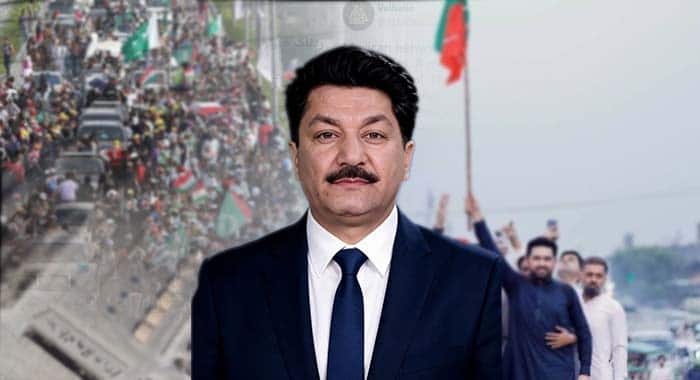
Fida Adeel
Khyber Pakhtunkhwa is once again at the centre of a political storm, with the province simultaneously witnessing intense political activity, an increasingly uncertain long-march strategy and a deteriorating security environment. At the heart of this unfolding situation is Chief Minister Sohail Afridi, whose political seriousness, organizational command and ability to deliver on repeated promises have become subjects of intense debate. The proposed long march towards Islamabad has already generated questions about its date, route, leadership, objective and expected participation. At the same time, the possibility of Governor’s Rule, internal disagreements within Pakistan Tehreek-e-Insaf (PTI), and the legal questions surrounding Afridi’s nomination have added further complexity to the political landscape.
Beyond the immediate provincial controversy lies an even wider regional question. Five years after the United States’ withdrawal from Afghanistan, the security consequences of the 2021 decision continue to be debated. The release of thousands of prisoners from Afghan jails following the Taliban takeover has raised questions about whether militants subsequently regrouped and whether some of those released later became part of organizations such as al-Qaeda or Islamic State Khorasan Province (ISKP). These questions are particularly important for Pakistan because Khyber Pakhtunkhwa remains on the frontline of the region’s security challenges.
The story, therefore, is not simply about a long march. It is about political credibility, internal party discipline, public safety, constitutional procedure and the continuing consequences of Afghanistan’s dramatic transformation.
The central political question is straightforward: how serious is Sohail Afridi about taking the proposed long march to Islamabad? The question has emerged because the political messaging surrounding the march has repeatedly changed. Before September 27, the date was presented with extraordinary certainty. PTI leaders repeatedly said they would march towards Islamabad and that September 27 was fixed. The language was uncompromising: the march would proceed at any cost. But September 27 passed. Then September 28 passed. Then September 29.
The political discussion subsequently moved towards October 4, October 5 and other possible dates. Eventually, the new announced date became October 4. PTI leadership described the postponement as a strategic decision, while critics interpreted the repeated changes as evidence that the party had not yet settled on a coherent course of action. Current reporting confirms that PTI postponed the previously announced September 27 march until October 4 after a political committee meeting.
The important issue is not simply whether changing a date is legitimate. Political parties frequently revise strategies. Circumstances change, negotiations develop, security assessments evolve and political calculations shift. The real issue is the credibility created by repeatedly calling a date “final” and then changing it. For political workers, such changes matter. When thousands of supporters are asked to prepare for a major mobilization, they make arrangements, spend money and mentally prepare themselves for confrontation. If the date is then postponed, the leadership must explain why. Otherwise, the phrase “final call” gradually loses its political meaning.
Afridi and PTI have maintained that the change is part of their strategy. They have argued that where and when they march is their own political decision. From their perspective, postponement does not necessarily mean retreat. It can be presented as political planning. But critics see something different: a leadership that is not yet ready to translate its rhetoric into action. That disagreement is now one of the defining features of the KP political debate.
Before asking how many people will march, another question must be answered: what exactly is the march supposed to achieve? The discussion surrounding PTI’s proposed movement has repeatedly referred to the release of imprisoned party leaders and founder Imran Khan. But a political procession does not automatically produce the release of prisoners. A government does not ordinarily open prison gates simply because thousands of protesters arrive at the capital.
If the objective is the release of political prisoners, then the party must explain what mechanism it expects to produce that result. Is the march intended to force negotiations? Is it designed to create political pressure? Is it intended to demand judicial intervention? Or is it primarily meant to demonstrate public support for PTI?
Each objective requires a different strategy. This is why the question of seriousness is closely connected to the question of purpose. If workers are repeatedly told to mobilize without being given a clear and achievable political objective, enthusiasm can eventually turn into frustration. The strongest political movements are usually those in which supporters understand not only where they are going, but also why they are going there.
One of the most pointed questions raised in the discussion concerns PTI’s central leadership. If the march is a national political movement, where are Barrister Gohar Ali Khan and the other central leaders? What role are leaders from Punjab playing? What is happening in Sindh? Where is the broader national organizational structure? These questions are especially relevant because Khyber Pakhtunkhwa appears to have been given a particularly prominent role in physically leading the proposed movement.
At the same time, the political activity itself has not been confined to KP. Sohail Afridi has appeared in political activities outside the province, including Karachi and Lahore, while PTI has maintained a nationwide political presence. The original discussion also refers to political activity in Balochistan. Therefore, the movement is clearly being presented as national. But if it is national, the responsibility must also be national. A political movement cannot rely primarily on the workers of one province while expecting the rest of the country to participate symbolically. Punjab has a large PTI support base. Sindh has its own political dynamics. Balochistan has its own political organizations and security environment. Islamabad is the destination. All of these areas have a role if the movement is genuinely intended to be nationwide.
The absence of a clearly visible, unified national command structure is consequently one of the most important organizational questions facing PTI.
The uncertainty does not end with the date. At different moments, the proposed starting point has been described as Peshawar, Swabi or the southern region of Khyber Pakhtunkhwa. The southern option is particularly significant because it would bring the movement through or near Dera Ismail Khan, Lakki Marwat, Bannu and Waziristan. These areas are among the most security-sensitive parts of the province.
They are areas where militant attacks have repeatedly taken place. They are areas where law-enforcement operations remain difficult. They are areas where the security environment cannot simply be treated as a secondary consideration in political planning. The original discussion therefore makes a serious point: if thousands or millions of people are brought onto the streets, the organizers must ensure that militants cannot exploit the gathering. The warning about the possibility of a suicide bomber should not be interpreted as evidence that a particular political organization intends to attack the march. No such conclusion should be drawn without evidence.
But the threat itself is real enough to require planning. A mass gathering in a conflict-affected district requires coordination between political organizers, police, administration, emergency services and security agencies. The political right to demonstrate and the state’s responsibility to protect demonstrators must exist simultaneously.
The suggestion that the march could begin from Dera Ismail Khan, Lakki Marwat, Bannu or Waziristan raises an additional concern: these are precisely the areas where security incidents occur frequently. The transcript refers to reports and statements suggesting that militant organizations maintain a presence not only in the southern districts but also in Peshawar, Swabi, urban areas and mountainous regions. The point is important because terrorism is not geographically confined to one part of KP.
The threat can emerge in a city. It can emerge on a highway. It can emerge in a rural settlement. It can emerge in mountainous terrain. The original discussion also refers to statements by Maulana Fazlur Rehman and the KP governor regarding the difficult security conditions in the southern region. Governor Faisal Karim Kundi has publicly expressed concern over the security situation and has argued that the provincial government should prioritize the restoration of peace.
The warning that police patrols become difficult in certain areas after Maghrib illustrates why organizers must take security planning seriously. A political procession cannot simply assume that ordinary security arrangements will be sufficient.
Another major theme in the original discussion is that Sohail Afridi may face opposition from within his own political camp. The criticism is that the challenge confronting him does not come only from the federal government, the establishment or the Punjab government. It also comes from disagreements inside PTI itself. This is a serious political observation, but it must be distinguished from claims of organized sabotage or betrayal unless such claims are independently demonstrated. The names mentioned in the discussion include Mahmood Khan Achakzai, Allama Raja Nasir Abbas, Asad Qaiser, Barrister Gohar and Ali Amin Gandapur. Their positions and political roles matter because a movement of this magnitude requires coordination among senior leaders.
A long march cannot have one leader announcing its beginning, another leader questioning its strategy and a third figure effectively determining whether the workers should move. The question of command becomes even more important when a date is postponed. Who announced September 27? Who announced October 4?
Who has the authority to change the plan again? These are not merely procedural questions. They determine whether a political party has a coherent strategy.
The original discussion also highlights the episode involving senior PTI figure Shaukat Yusufzai. The exchange is significant because Yusufzai is not a peripheral political figure. He is a veteran of PTI and has long been associated with Imran Khan’s political movement. The transcript describes an angry exchange surrounding a letter and the refusal to accept it, including a statement that the letter would be torn up and thrown away if received.
Regardless of the precise details of the exchange, the broader political significance is the atmosphere it reveals. When senior figures publicly disagree over letters, decisions and strategy, ordinary workers begin asking a simple question: who is actually in charge? That question becomes particularly important during a political movement.
Ali Amin Gandapur remains another important name in this story. As a former chief minister of Khyber Pakhtunkhwa and senior PTI politician, Gandapur has a substantial political network. The original discussion refers to reports of renewed contact between Gandapur and Sohail Afridi and to political groupings within the provincial party. Again, reports of political differences should not automatically be treated as evidence of a formal split. Political parties naturally contain factions, personalities and competing interests.
But when those differences begin affecting major political decisions, they become a matter of public importance. The provincial government must be able to function. The party organization must be able to mobilize. The parliamentary group must be able to communicate. And the central leadership must know who is responsible for the final decision. If those functions are divided among competing groups, the long march becomes harder to organize.
The original discussion refers to an internal parliamentary meeting in which some participants allegedly described certain people within the party as “traitors” and argued that unity was necessary. Such language illustrates the intensity of the internal dispute. But political parties should be careful about turning disagreements into accusations of treason. A difference over strategy does not automatically make someone an enemy. A demand for negotiations does not automatically make someone disloyal.
A disagreement about the route of a march does not automatically prove sabotage. The healthier approach is to distinguish between political disagreement and deliberate misconduct. PTI, like every major political party, needs internal mechanisms for settling disputes. If every disagreement becomes a public accusation, the party’s ability to present a unified national message becomes weaker.
The changing starting point has also created a striking political image. The original discussion describes the political “truck” or container as moving from one place to another in the rhetoric of the movement — first Peshawar, then Swabi, and later the southern region. The symbolism is important because PTI’s political mobilization has historically relied heavily on visible symbols of resistance.
But a movement cannot survive indefinitely as symbolism. The workers need a definite route. The leadership needs a definite plan. The public needs a definite objective. And the government needs a definite security assessment. If the route continues changing, questions about organizational preparedness will naturally increase.
The claim of approximately 40 lakh workers or supporters is another major issue raised in the discussion. A political party may genuinely have millions of supporters. But claiming that four million people will physically participate in a particular march is an entirely different matter. A crowd of four million people requires enormous transportation capacity, food, water, medical facilities, communications, security and accommodation. It also raises a geographical question.
If the march starts in Dera Ismail Khan, will people from Peshawar wait for it? If it begins in Bannu, how will participants from Hazara and Malakand join? If people leave from Waziristan or Lakki Marwat, when and where will their caravans merge? If the march moves onto the motorway, where will the different groups converge? These questions do not undermine a political movement. They demonstrate the difference between political rhetoric and logistical reality.
The possibility of Governor’s Rule adds another dimension to the political crisis. The transcript asks whether Governor’s Rule could actually be imposed in Khyber Pakhtunkhwa. This question should not be treated as an ordinary political prediction. Governor’s Rule is a constitutional mechanism, not simply a political slogan. Article 234 of Pakistan’s Constitution provides a procedure for circumstances in which the constitutional machinery of a province is considered unable to function according to the Constitution.
Governor Faisal Karim Kundi has publicly discussed the possibility of constitutional intervention in the context of the province’s security situation. That does not mean Governor’s Rule has been decided. There is a significant difference between discussing a constitutional possibility and actually initiating the constitutional process. The public should therefore distinguish between political statements, constitutional procedures and final institutional decisions.
While Pakistan’s political debate continues, Afghanistan remains an essential part of the security picture. Five years have passed since the United States withdrew from Afghanistan in 2021. The withdrawal brought an end to America’s longest war but also produced a dramatic collapse of the Afghan government and security forces. The Taliban took control of the country. Prisons were opened. Thousands of prisoners were released.
And questions began emerging about who those prisoners were and what they would do after their release. The U.S. State Department’s 2021 human-rights report documented that the Taliban released thousands of prisoners from facilities including Parwan and Pul-e-Charkhi after taking control of Afghanistan. The report specifically noted that members of ISIS-K and al-Qaeda were among those released. That fact is important because it demonstrates that the prison-release issue is not merely political rhetoric.
The central unanswered question is the composition of those released. Were they Taliban members? Were they members of al-Qaeda? Were they members of ISKP? Were they Afghan militants? Were they Pakistani militants?Were they foreign fighters? Were they people arrested during the administrations of Hamid Karzai and Ashraf Ghani? Were they detained by American forces?
The answer is not simply one organization. Afghanistan’s prisons contained people arrested under different governments, by different security agencies and for different alleged crimes. That is why the claim that “all the prisoners were terrorists” would be too broad. But the opposite claim that the releases had no security implications would also ignore documented evidence.
Bagram Air Base is at the centre of the argument. U.S. President Donald Trump has repeatedly criticized the 2021 withdrawal and argued that Bagram should not have been abandoned.
He has also criticized the Taliban’s possession and display of American military equipment. More importantly, Trump has connected the 2021 prisoner releases with the deadly attack at Hamid Karzai International Airport. On August 26, 2021, during the U.S. evacuation from Kabul, a suicide bombing at Abbey Gate killed 13 U.S. service members and many Afghan civilians.
In a 2026 statement marking the fifth anniversary of the attack, Trump said the ISIS-K attacker had been among prisoners released by the Taliban. The U.S. State Department’s earlier reporting likewise documented that the Abbey Gate attacker had been detained at Parwan and was released during the Taliban takeover. That makes the prison-release issue an important part of the history of the attack.
This is perhaps the most important security question. When large numbers of militants are released from prison, some may attempt to return to old organizations. Some may join new organizations. Some may remain inactive. Others may disappear from the security system entirely. It would be inaccurate to say that every released prisoner became an active militant again. But it is equally inaccurate to pretend that releasing known militants has no potential security consequences. The release of ISIS-K and al-Qaeda members from Afghan detention facilities created an obvious opportunity for militant networks to rebuild.
The same concern applies to reports concerning Pakistani militants. The original discussion recalls a Pakistani militant from Bajaur who was reportedly released after being imprisoned in Afghanistan. Individual cases need independent verification. But the larger strategic issue is undeniable: the collapse of Afghanistan’s prison system created an environment in which previously detained militants could once again become part of the regional security landscape.
The consequences of Afghanistan’s transformation have been particularly serious for Pakistan. Pakistan has repeatedly accused Afghanistan’s Taliban government of allowing the Tehreek-i-Taliban Pakistan and other militants to operate from Afghan territory. The Taliban government has rejected such accusations. The dispute has contributed to increasingly tense relations between Islamabad and Kabul.
Khyber Pakhtunkhwa has borne much of the security burden. This is why the Afghanistan discussion cannot be separated from the long-march discussion. When political organizers talk about taking tens of thousands of people onto roads in districts such as Dera Ismail Khan, Bannu, Lakki Marwat and Waziristan, they are operating within a security environment shaped partly by developments in Afghanistan.
That reality cannot be ignored. There is a danger in this debate of choosing one principle and forgetting the other. Political parties have the right to organize peaceful demonstrations. Citizens have the right to participate in political activity.
But citizens also have the right to safety. The government has a responsibility to protect public gatherings. Political organizers have a responsibility to cooperate with security authorities. Militant organizations must not be allowed to exploit political demonstrations. And security concerns must not become a blanket justification for suppressing legitimate peaceful political expression. The balance is difficult. But it is necessary.