
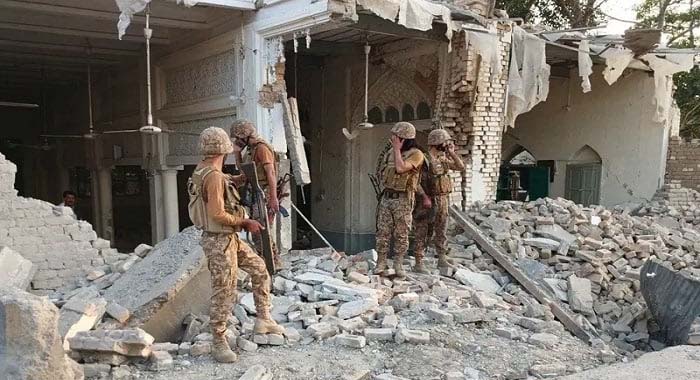
Pakistan has strongly condemned the deadly terrorist attack targeting civilians and police personnel offering Juma prayers at a mosque in the Old Police Lines, Kohat, describing the assault as a barbaric act of terrorism and reaffirming the state’s resolve to protect its citizens, territory and sovereignty.
In a statement, the Ministry of Information and Broadcasting condemned the attack in the strongest terms, stating that the perpetrators belonged to what it described as the “vilest of Khawarij” and had roots in Afghanistan. The ministry stressed that the attack once again demonstrated that terrorism has no religion, justification or legitimate cause.
The ministry stated that those who perpetrate, facilitate or provide shelter to terrorism bear responsibility for acts that deliberately target innocent civilians and law-enforcement personnel.
According to officials, 23 people were martyred and more than 100 others injured when an explosive-laden vehicle was used in the attack on the mosque during Friday prayers. The assault was followed by an attempt by the attackers to infiltrate the Police Lines, triggering a gunfight and a subsequent clearance operation by police and security forces.
Following the attack, police, the Counter-Terrorism Department (CTD), Elite Force commandos and security forces launched a coordinated operation to clear the Police Lines and surrounding buildings.
The operation continued until all affected areas and structures had been thoroughly secured. Seven Khawarij involved in the attack were killed during the clearance operation, according to security officials.
General Officer Commanding (GOC) Kohat Major General Shahid Amir Afsar said the attackers had initially targeted worshippers at the mosque before taking shelter in a building inside the Police Lines. The Special Service Group of the Pakistan Army, led by the GOC Kohat, subsequently conducted the clearance operation and secured the building.
The GOC said the timely and decisive response of the security forces had foiled the Khawarij’s plan and prevented them from causing further casualties.
The operation was conducted under the leadership of the Additional Inspector General CTD, Regional Police Officer Kohat and District Police Officer Kohat, while the GOC Kohat remained present at the scene.
Khyber Pakhtunkhwa Inspector General of Police Zulfiqar Hamid also remained at the site throughout the operation, encouraging personnel engaged in the clearance effort. He stated that the suicide bomber had attempted to target law-enforcement personnel but had failed to achieve his objective.
The IGP commended the police, CTD and security forces for their courage and professionalism and announced rewards for the personnel who participated in the operation.
According to Regional Police Officer Kohat Irfan Tariq, the attack claimed the lives of 23 people, including 17 police personnel and six civilians, while approximately 130 people sustained injuries.
Among those martyred was SP Traffic Akbar Shinwari, while SP Special Branch Kohat Al-Barahemullah was also injured in the attack.
The Police Lines is a highly sensitive security area surrounded by several important public and security installations, including the Cantonment Police Station, Traffic Police Station, Special Branch office, CTD office, National Bank, Police Club, hotels and residential buildings. The intensity of the blast caused damage to several nearby structures.
A journalist covering the incident was also injured during the attack. Funeral prayers for the martyred police personnel were subsequently offered and attended by senior police and military officers, relatives of the victims and members of the local community.
SP Traffic Akbar Shinwari was later laid to rest with full state honours in his native Hathian village in Takht Bhai. His funeral prayers, held at the Hathian Sports Complex, were attended by thousands of people, including senior police officials, civil administration officers, local elders and representatives of political and social circles.
Rescue 1122 also completed its emergency response operation following the attack. According to Rescue 1122 spokesman Bilal Ahmad Faizi, a total of 91 injured persons and patients were transported to various hospitals, while the bodies of 23 victims were shifted to medical facilities.
The rescue operation was supervised by District Emergency Officer Kohat Noorul Amin Khattak and involved medical teams, ambulances and specialized rescue resources.
As many as 24 ambulances and rescue vehicles, together with a recovery vehicle and more than 60 rescue personnel, participated in the emergency response. Additional ambulances and personnel were dispatched from neighbouring districts, including Karak and Hangu.
Following completion of the rescue operation, the bodies of 15 victims were transported through Rescue 1122 ambulances to their native districts, including Kohat, Karak, Lakki Marwat, Bannu and Mardan, following funeral prayers.
Seven critically injured persons were shifted to Peshawar for specialized medical treatment. Five were transported to Lady Reading Hospital, while two were shifted to Hayatabad Medical Complex.
In its statement, the Ministry of Information and Broadcasting reiterated Pakistan’s longstanding concerns regarding the alleged use of Afghan territory by Fitna al-Khawarij and other terrorist groups for planning and launching attacks against Pakistan.
The ministry stated that the alleged presence of terrorist sanctuaries, recruitment networks and support infrastructure in Afghanistan poses a direct security challenge to Pakistan. Pakistan has, according to the statement, repeatedly conveyed these concerns to the Afghan Taliban authorities and their interlocutors, calling for the dismantling of terrorist networks rather than the deflection of responsibility.
Against this backdrop, Pakistan described as reprehensible remarks attributed to Afghan Taliban spokesperson Zabihullah Mujahid, including a warning of a “crushing response” to Pakistan.
The Pakistani statement maintained that the Afghan authorities must address what Islamabad describes as a terrorist ecosystem operating from Afghan territory rather than shifting responsibility onto Pakistan.
It further stated that the Afghan Taliban’s counterterrorism responsibilities include preventing Afghan territory from being used to threaten other countries.
Pakistan also took note of the Afghan Ministry of Foreign Affairs’ condemnation of the Kohat attack and its expression of sympathy for the families of the victims. However, Islamabad noted that the Afghan statement did not explicitly mention terrorism.
Pakistan stressed that expressions of condemnation must be accompanied by credible, verifiable and sustained action. The Afghan Taliban, the statement said, must take concrete measures to dismantle terrorist sanctuaries, disrupt radical recruitment and training networks, and prevent terrorist organizations from planning, facilitating or launching attacks against Pakistan.
Pakistan reaffirmed that it has consistently pursued dialogue and constructive engagement with the Afghan Taliban authorities, while emphasizing that dialogue cannot be allowed to shield individuals or organizations that threaten the lives and security of Pakistani citizens.
The government reiterated that Pakistan possesses both the resolve and capability to confront terrorist threats and will take all necessary measures, consistent with international law, to protect its people, territory and national sovereignty. The statement warned that the continued presence and activities of terrorist organizations in Afghanistan could further aggravate instability and create serious repercussions for regional and international security.
Pakistan also called upon the international community to urge the Afghan Taliban authorities to take decisive and verifiable action against terrorist groups before the threat expands further across the region and beyond.



