
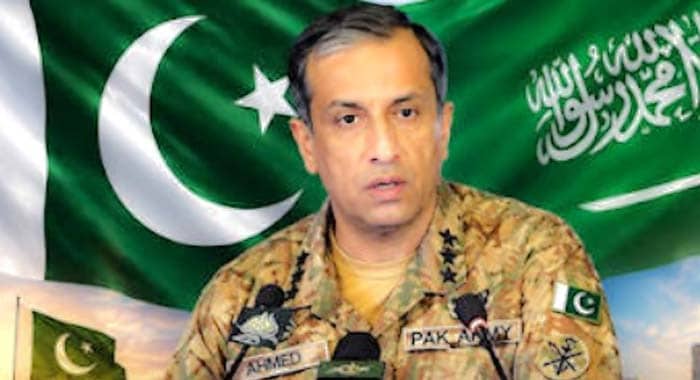
Pakistan is prepared to go “to any extent” to defend Saudi Arabia and protect Islam’s two holiest sites in Makkah and Madinah, Director General Inter-Services Public Relations (DG ISPR) Lieutenant General Ahmed Sharif Chaudhry has said, stressing that Islamabad’s commitment to the Kingdom’s security is unconditional.
In an exclusive interview with Arab News, the DG ISPR said Pakistan stood with Saudi Arabia on both diplomatic and practical fronts, while the political and military leaderships of the two countries remained in continuous communication over regional security developments.
“Pakistan fully stands with the Kingdom of Saudi Arabia, both diplomatically and physically,” Lt. Gen. Ahmed Sharif Chaudhry said, underscoring that Pakistan would go “to any extent” in defending the Kingdom against aggression.
He said the commitment also extended to the protection of Makkah and Madinah, adding that there should be “no doubt” about Pakistan’s resolve to defend Saudi Arabia.
The statement comes amid renewed attacks targeting Saudi Arabia and as the newly signed Makkah Joint Defense Agreement brings Pakistan, Saudi Arabia and Türkiye into a collective-defense framework under which an armed attack on one member is regarded as an attack on all. The agreement, signed on August 7, builds on the Strategic Mutual Defense Agreement signed between Pakistan and Saudi Arabia in September 2025.
The DG ISPR said Pakistan was also pursuing diplomatic efforts alongside its security commitments, with the country’s political and military leadership maintaining close contact with Riyadh.
He said Pakistan’s sustained diplomacy across the Muslim world had also contributed to the Islamabad Memorandum of Understanding, which emerged from Pakistan’s efforts to facilitate negotiations amid the wider regional crisis.
Pakistan’s demand from Afghan Taliban
Turning to Afghanistan, Lt. Gen. Ahmed Sharif said Pakistan had one clear and concrete demand from the Afghan Taliban government: Afghan territory must not be allowed to be used for terrorist attacks against Pakistan.
He said Afghan nationals constituted a significant proportion of suicide bombers involved in attacks in Pakistan, claiming that around 80 percent of suicide bombers were Afghan citizens.
He further said Afghan nationals were found among groups entering Pakistan to carry out attacks.
Pakistan has repeatedly raised concerns over terrorist groups operating from Afghan territory, while Kabul has rejected accusations that it allows its soil to be used against neighboring countries.
The DG ISPR warned that if the Taliban government failed to honor its commitments under the Doha Agreement, Pakistan retained the right to take measures in self-defense.
Pakistan has previously linked its concerns to commitments made by the Taliban during the Afghan peace process, particularly assurances that Afghan territory would not be used to threaten other countries.
No talks with terrorists in Balochistan
Discussing the security situation in Balochistan and allegations of Indian involvement, the DG ISPR said Pakistan’s policy toward terrorist groups remained clear and that there would be no negotiations with terrorists.
He said terrorist groups did not enjoy popular support in Balochistan and were instead attempting to impose their ideology through force.
According to the DG ISPR, India was providing support to these terrorist groups, while social media campaigns in their support were being operated from outside Pakistan.
The allegations reflect Pakistan’s longstanding position regarding Indian involvement in terrorist and separatist violence, while India has rejected such accusations.
The DG ISPR’s remarks came as Pakistan continues intelligence-based and counterterrorism operations against terrorist networks in Balochistan and Khyber Pakhtunkhwa.
His comments also underscored Islamabad’s position that the security challenge involves both domestic terrorist networks and cross-border facilitation, particularly in relation to groups operating from or maintaining infrastructure in Afghanistan.
Meanwhile, the Makkah defense framework has added a new dimension to Pakistan-Saudi security cooperation. While its full operational provisions have not been made public, the agreement provides that an armed attack against any one of Pakistan, Saudi Arabia or Türkiye will be regarded as an attack against all three.



