
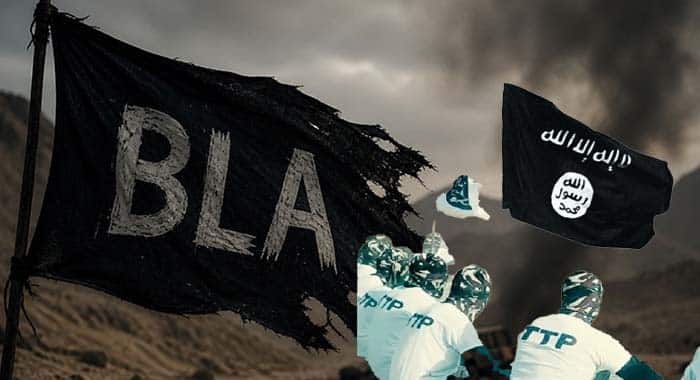
Recent developments in Balochistan, coupled with findings contained in recent United Nations Security Council reporting, have brought renewed attention to the increasingly interconnected nature of terrorist organizations operating across the region.
What once appeared to be a collection of separate groups pursuing distinct agendas is increasingly being viewed through the lens of shared training, logistical facilitation, resource networks, operational contacts, and cross-organizational cooperation.
The emerging picture points towards a broader terrorist ecosystem in which organizations including Tehreek-e-Taliban Pakistan (TTP), Balochistan Liberation Army (BLA), Al-Qaida, and ISIS-Khorasan (ISIS-K) may, despite differences in ideology and organizational identity, maintain varying forms of interaction and mutual facilitation.
The traditional understanding of terrorism in the region has largely focused on individual organizations and their respective areas of operation. However, recent international assessments suggest that the threat is considerably more complex.
The 38th report of the Analytical Support and Sanctions Monitoring Team, submitted under the United Nations Security Council sanctions regime, records information from Member States regarding contacts and cooperation between terrorist organizations. According to the report, BLA fighters were reportedly trained in Afghanistan by Al-Qaida trainers alongside TTP fighters. The same assessment notes that Al-Qaida has maintained longstanding ideological, training, and support relationships with TTP.
These reported interactions point towards an environment in which expertise and operational knowledge can move between organizations, allowing terrorist groups to strengthen their capabilities without necessarily merging into a single entity. The UN reporting also refers to information provided by Member States regarding reported cooperation between BLA, TTP and ISIS-K, including through training arrangements and shared resources.
The reported connections reportedly extend beyond training. The assessment refers to coordination surrounding attacks, meetings between commanders, and other forms of interaction. Of particular concern is the reported existence of logistical facilitation networks connecting BLA and ISIS-K. Such networks can provide terrorist organizations with access to transportation, safe locations, communications, equipment, financing, and other forms of support required to sustain operations.
This demonstrates that organizational boundaries do not necessarily prevent cooperation when terrorist groups identify opportunities to advance their respective objectives. The geographical dimension of these relationships is equally significant.
UN reporting has repeatedly highlighted the presence and activities of multiple terrorist organizations in Afghanistan and the wider region. The country has emerged as an important operating environment in which different groups can potentially access training, personnel, resources, and facilitators. The reported presence of TTP infrastructure, Al-Qaida’s continued links with TTP, ISIL-K’s efforts to maintain and regenerate its capabilities, and reported interactions involving BLA collectively raise concerns about Afghanistan’s continuing role in facilitating a wider regional terrorist ecosystem.
The reported relocation of approximately 2,000 TTP fighters and their families from areas close to the Pakistan-Afghanistan border to locations deeper inside Afghanistan further demonstrates the scale of the challenge associated with the group’s infrastructure and personnel. The most significant development may therefore not be the existence of individual terrorist organizations, but the connectivity between them.
A terrorist group does not necessarily need to formally merge with another organization to benefit from its capabilities. Access to trainers, weapons, logistics, financing, safe havens, technical expertise, intelligence, or experienced personnel can substantially increase operational capacity. This creates a network effect in which the capabilities of one organization can indirectly strengthen another.
For Pakistan, this presents a particularly complex security challenge. TTP’s activities primarily target Pakistan, while BLA operates predominantly in Balochistan. Al-Qaida provides ideological and training linkages, while ISIL-K represents another violent extremist network with its own regional ambitions. Their objectives may differ, but their reported points of contact can create overlapping threat channels.
The competing claims that frequently emerge following terrorist incidents also need to be examined within this broader context. When multiple organizations operate within overlapping geographical and logistical environments, attribution can become increasingly complicated. Groups may claim responsibility for attacks to exaggerate their operational reach, strengthen their propaganda narratives, attract recruits, or undermine public confidence.
Consequently, responsibility claims issued by terrorist organizations should not automatically be treated as independently verified evidence of operational involvement. The more important question is whether networks of cooperation allow one organization to contribute to an operation that is ultimately claimed by another. The emerging terrorist nexus demonstrates that counterterrorism cannot be limited to targeting individual fighters or isolated cells.
An effective response requires disruption of the entire ecosystem supporting terrorist activity, including:
- Training networks and instructors
- Financial and funding channels
- Weapons and equipment supply chains
- Logistical facilitators
- Cross-border movement and safe havens
- Recruitment and radicalization networks
- Communications and coordination channels
- Links between terrorist commanders and facilitators
Breaking these connections can be more consequential than simply eliminating individual members of a terrorist organization, because it prevents groups from regenerating their capabilities through external support. The information contained in recent UN assessments provides an important basis for understanding the changing nature of terrorism in the region.
The reported connections involving TTP, BLA, Al-Qaida and ISIS-K indicate that terrorist organizations should increasingly be assessed not only according to their individual structures, but also according to the networks through which they acquire training, resources, expertise, and logistical support. The challenge is therefore no longer simply who carried out an individual attack.
The larger question is:
Who trains whom? Who facilitates whom? Who provides the resources, logistics and expertise and how are these networks connected across borders?
Answering these questions is essential to understanding and dismantling the broader terrorist ecosystem threatening Pakistan and regional security.
Pakistan remains committed to confronting terrorism in all its forms and to disrupting the networks that enable terrorist organizations to sustain their activities. The international community must likewise recognize that the regional threat cannot be effectively addressed through isolated, organization-by-organization assessments.



