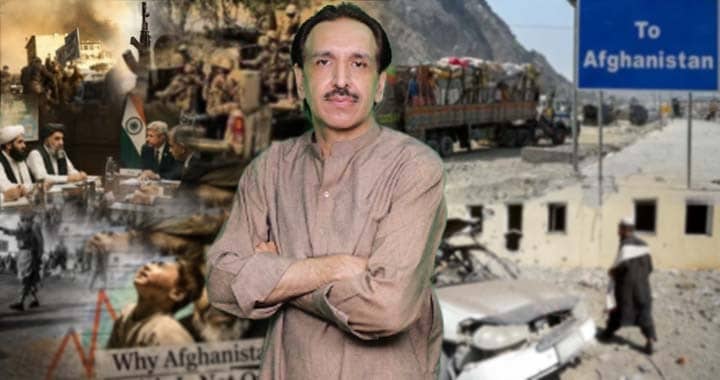
The security situation in Pakistan has reached a point where the debate is no longer simply about individual terrorist attacks. The larger question is who enables these attacks, where the attackers are operating from, and why repeated warnings about the use of Afghan soil against Pakistan have failed to produce a meaningful change.
The situation in Khyber Pakhtunkhwa and Balochistan has now reached a point where there is hardly any need for further explanation or justification about who is behind the unrest. In my view, the Afghan government, India and certain other anti-Pakistan forces have come together on the same page. Inside Pakistan, JUI, PTI and some others have effectively become their spokespersons. The entire picture has now become clear, with every character appearing connected to the others.
Whenever relations between Pakistan and Afghanistan deteriorate, the aftershocks are felt in the form of increased attacks in Khyber Pakhtunkhwa and Balochistan.
For example, the security forces recently conducted an operation in North Waziristan that lasted between 36 and 42 hours. It was the second-longest operation of the past two years and resulted in the elimination of 15 terrorists. They were coming from Afghanistan, including four Afghan nationals. One group managed to escape and returned to Afghanistan. They had been assembled in a camp in an Afghan border province, and Pakistan has all the evidence and proof regarding this.
The very next day, a terrorist attack took place in Ziarat. On the same day, around nine security or government personnel were martyred in Balochistan. Then the Ziarat attack followed in the same sequence.
One Threat, Different Names
There was confusion over whether the Ziarat attack was carried out by the banned TTP, because most attacks in the Pashtun belt are generally attributed to it. On the other hand, the BLA claimed responsibility.
Whether the BLA carried out the attack or the TTP did is not the real issue. Both are allies. If both are allies, it is their choice which group claims responsibility. What matters to us is not the name of the group claiming an attack. Our responsibility is to tell the international community what is happening in Balochistan, Khyber Pakhtunkhwa and Afghanistan.
Both the TTP and BLA are anti-Pakistan and anti-public. Their camps and leadership are in Afghanistan, and both receive patronage from the Afghan government, India and certain other countries. Therefore, I do not see a meaningful difference between the two when I look at the broader framework.
The real question is who is supporting these groups. On that point, the picture has become clear.
When five operations take place on both sides within 24 hours, it represents an extremely dangerous situation. The August security report may show that the number of attacks was higher while the number of deaths was lower, but that does not mean the situation is under control.
No Meaningful Negotiations
There has been a great deal of talk about negotiations and contacts between Pakistan and Afghanistan, but there have been no negotiations between the two countries during 2026.
Shakib Ahmad went to the National Defence University through an established institutional procedure. He had expressed his desire to visit the NDU, as people also visit other universities. I had personally accompanied former Afghan ambassador and special envoy Omar Zakhilwal to the NDU during Ashraf Ghani’s tenure. Much more open discussions took place there.
The subsequent leaking of the recent visit and its use for political point-scoring further damaged relations. The next day, Pakistan’s ambassador was summoned. It was even suggested that Pakistan could end its already limited diplomatic relations with Afghanistan in the coming days.
These people are simply not willing to correct their course. The entire world has been telling Afghanistan that terrorist groups and their leaders are operating from its territory and interfering in other countries, yet they continue to deny it. The United Nations has also raised the issue.
Meanwhile, attacks in Pakistan are increasing. When the level of conduct by an ambassador reaches this point, Pakistan has to do something.
I believe Pakistan is going to do a great deal.
Pakistan’s Policy Is About Security
Pakistan does not want a relationship with Afghanistan in the traditional sense. It is pursuing a policy of disengagement. It is not opening the borders, nor does it see a need for greater engagement with Afghanistan because Pakistan’s level of engagement is international.
Afghanistan may be a priority for people like us, but it is not among the priorities of the Pakistani state. However, Pakistan cannot remain indifferent when its territory is being targeted from Afghan soil.
Since 2022, the international community has repeatedly pointed out that terrorist groups are operating from Afghanistan, yet the Afghan side has failed to take the required action. Pakistan is one of the most powerful countries in the region and, under its defensive strategy and its right to self-defence, it will respond according to its own calculations.
That is precisely the point I am making about a response.
Information suggests that planning is under way to target two or three locations inside Afghanistan in the coming hours or days, particularly the places from where these terrorists have begun coming into Pakistan again.
The current Afghan Taliban are, in my view, even more foolish and inexperienced than the previous Taliban. They are internally divided, with different groups pursuing different priorities. One group wants Kandahar targeted, another wants Kabul targeted, while another points toward the areas associated with the Haqqani Network, including Paktia, Paktika and Khost.
There is no properly organized government there. Groups in the north are also taking advantage of these divisions. If people there attack one another, that has nothing to do with Pakistan.
A Clear Pakistani Position
Pakistan’s Afghan policy is actually very clear. We do not intend to interfere in Afghanistan. But any action against Pakistan, whether originating from India, Russia, the United States or Afghanistan, will receive a response.
This is part of Pakistan’s national security and defence strategy. It is not about an “Afghan policy” in the conventional sense. Pakistan has relations with well over a hundred countries. If relations with one country are not normal, that does not fundamentally affect Pakistan.
As far as counterterrorism and cross-border terrorism are concerned, the thinking within Pakistan’s establishment is clear. Pakistan’s ambassador has been summoned, and I repeat that Pakistan’s already limited diplomatic links with Afghanistan may either be ended or reduced further in the coming days.
There have been claims that Pakistan-Afghanistan relations were moving in a positive direction because of the NDU visit by the Afghan chargé d’affaires. I see no basis for describing that as negotiations.
The Afghan Taliban and the TTP are on the same page. They are ideologically aligned. There have been no meaningful negotiations or coordination between Pakistan and Afghanistan in 2026, nor is Pakistan seeking them. The Afghan Taliban have also taken no meaningful action against the TTP or similar groups.
Pakistan is clear on several points. The TTP, BLA and other such groups are on the same page. The Afghan government, India and even Israel are providing them direct or indirect support. PTI, JUI and certain other groups are acting as their spokespersons, supporters and facilitators inside Pakistan.
There are no negotiations between Pakistan and Afghanistan, not even at China’s request, and China is not asking for such negotiations either. These claims are incorrect.
What happened in North Waziristan and Ziarat over the past few days will receive a response from Pakistan. The limited diplomatic setup between Pakistan and Afghanistan is also likely to be reversed or reduced further in the coming days.
The Next Few Days Matter
The increase in attacks shown in the August report cannot be taken as evidence that the situation has come under control. In fact, the situation has become more complicated and dangerous.
When we analyze such developments, the focus should not only be on what has already happened. Everyone knows what has happened. The real question is what can happen and what is likely to happen.
What can happen is assessed through indications and events. What is going to happen depends on information available to those making the assessment.
In my view, Pakistan’s policy is clear. Unfortunately, because of the Afghan side’s stubbornness, its patronage of these groups, its approach and the foolish conduct displayed by its ambassador, Pakistan has once again reached the conclusion that these people are not willing to understand through words.
They will have to be made to understand through force.
That is why, in my view, the next two or three days are extremely important.