
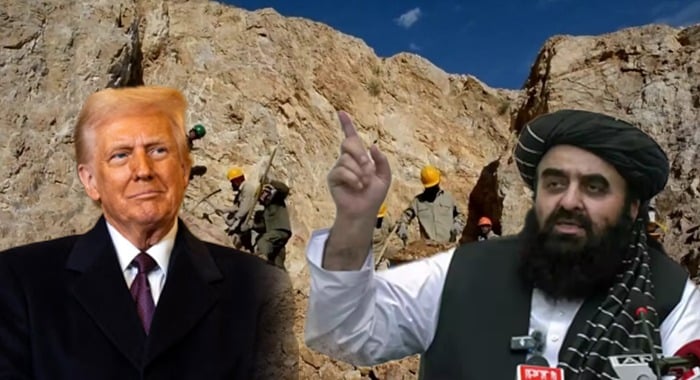
There is something profoundly revealing about the intermittent violence in Afghanistan’s Badakhshan province. The Taliban may describe itself as the government of Afghanistan, but when armed confrontations erupt over control of territory and access to valuable mineral resources, a much more fundamental question emerges: who actually gave the Taliban the authority to decide who gets Afghanistan’s wealth?
The question is not theoretical.
Badakhshan has witnessed repeated clashes involving Taliban forces and local armed groups, while disputes over gold mining have added another layer to the province’s already complicated security environment. Local miners have also protested restrictions imposed by the Taliban on mining activities, alleging unequal treatment and preferential access for powerful figures.
So why is a supposedly sovereign government still fighting over who controls the country’s gold?
And more importantly, who decided that control of Kabul automatically means ownership of Afghanistan?
Power Is Not a Mandate
The Taliban took control of Afghanistan through military force in 2021. It did not arrive in Kabul following a nationwide election or an inclusive political agreement representing the country’s ethnic and political spectrum.
Its government remains internationally isolated. Russia is the only country to have formally recognized the Taliban government, while numerous other countries maintain contact with Kabul without extending formal recognition.
Yet the Taliban has assumed the authority to negotiate mining contracts, allocate access to natural resources and determine who may exploit some of Afghanistan’s most valuable deposits.
That creates an obvious contradiction.
If the Taliban has no electoral mandate from the Afghan people, where does its mandate to dispose of national wealth come from?
Control of the state apparatus may allow a regime to issue licenses and sign contracts. But administrative power and national ownership are not the same thing.
Afghanistan’s gold does not belong to the Taliban because the Taliban controls the ministry responsible for mining.
Its lithium does not become Taliban property because Taliban officials sign an agreement with a foreign company.
Its copper, iron, cobalt and other resources are national assets. Their exploitation should therefore raise questions not merely about commercial efficiency, but about public consent, transparency and accountability.
Badakhshan’s Gold Problem
Badakhshan offers a particularly stark illustration.
The province is rich in gold and other minerals, and mining has long provided livelihoods for local communities. But attempts to regulate or control mining have repeatedly generated tensions.
Recent clashes have involved Taliban forces and fighters loyal to local commander Juma Khan Fateh before the surrender, with mining activity forming part of the wider dispute. Other confrontations have emerged around restrictions on local miners.
The consequences extend beyond the mines themselves.
When access to gold becomes a source of political and military power, whoever controls the mining areas gains more than mineral wealth. They gain revenue, influence and the ability to finance armed networks.
That is precisely why Afghanistan’s mineral question cannot be treated simply as an economic story.
It is a security story.
It is a governance story.
And ultimately, it is a legitimacy story.
The $1 Trillion Temptation
The stakes are enormous.
Geological assessments conducted by the United States and the former Afghan government have estimated Afghanistan’s untapped mineral resources at at least $1 trillion. The deposits include copper, iron ore, cobalt, niobium, gold and lithium.
Since returning to power, the Taliban has announced mining contracts and investment agreements worth billions of dollars.
The regime is now also actively seeking additional foreign investment, including from the United States.
But before foreign investors rush towards Afghanistan’s mountains, one question should be impossible to avoid:
Who represents the Afghan people in these deals?
There is no broadly elected national parliament exercising meaningful oversight over the Taliban’s decisions. There is no political system in which Afghans can freely replace the authorities making these decisions. There is no nationally representative mechanism through which communities affected by mining projects can reliably challenge the allocation of their resources.
The Taliban may argue that it is acting as the government and therefore has the right to administer the country’s resources.
But that simply returns the argument to its starting point.
Being in power does not answer the question of how that power was obtained or to whom it is ultimately accountable.
Whose Gold Is It?
This is the question Badakhshan keeps forcing into the open.
If the gold belongs to Afghanistan, then it belongs to Afghans.
If it belongs to Afghans, then Afghans should have a meaningful say in how it is extracted, who receives the contracts and where the revenues go.
And if a regime can decide all of those questions without an elected mandate, without broad political representation and without meaningful public accountability, then calling the arrangement simply “state ownership” risks disguising the underlying reality.
The Taliban may have inherited ministries.
It may control mines.
It may sign contracts.
It may command armed forces.
But none of those things, individually or collectively, establishes that the Afghan people have entrusted it with permanent authority over their national wealth.
The mineral riches beneath Afghanistan’s soil could finance development, create jobs and transform a devastated economy.
But they could also deepen political rivalries, fuel armed conflict and enrich a narrow circle of powerful actors.
Badakhshan is already offering a warning.
The Taliban’s greatest resource problem may therefore not be geological.
It may be political.
Afghanistan has gold beneath its soil. The Taliban has power above it. The unresolved question is whether power alone gives anyone the right to decide what happens to the gold.



