
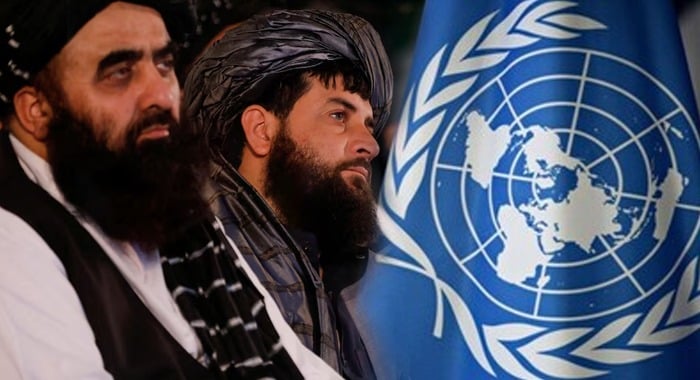
Five years after returning to power in Kabul, the Taliban controls Afghanistan’s government institutions, commands the country’s security apparatus and conducts diplomatic relations with a growing number of states.
Yet there is a remarkable gap between controlling Afghanistan and being internationally recognized as Afghanistan’s legitimate government.
The Taliban itself appears acutely aware of that distinction.
Its foreign minister, Amir Khan Muttaqi, recently said formal recognition remains an issue while urging countries to expand their relations with Kabul. He has also called on the United States to normalize relations, reopen its embassy in Kabul and consider investment in Afghanistan.
That raises a basic question:
If the Taliban is already the unquestioned government of Afghanistan, why is it still campaigning so hard to be recognized as one?
Control Is Not Recognition
The Taliban seized Kabul in August 2021 after the collapse of the former Afghan government.
Since then, it has steadily consolidated control over the country. It has appointed officials, collected taxes, controlled borders and maintained diplomatic missions abroad.
But international recognition has remained elusive.
Russia became the first country to formally recognize the Taliban government in July 2025. Most other countries have instead pursued a more cautious formula: engage with the Taliban without formally recognizing its government.
That distinction is far more important than it might appear.
Diplomatic engagement does not necessarily mean political endorsement.
A country can speak to Taliban officials about terrorism, migration, trade or border security without accepting that the Taliban possesses the political legitimacy to permanently represent Afghanistan.
This is precisely the uncomfortable space in which much of the international community has operated for the past five years.
What Is Missing?
The Taliban argues that it is a political reality and that the international community should accept that reality.
There is some obvious truth in the first half of that argument.
The Taliban does control Afghanistan.
But international legitimacy is not simply a reward for controlling territory.
Governments derive legitimacy through different combinations of constitutional authority, popular consent, political representation and international acceptance.
The Taliban’s current political structure remains deeply restrictive.
There has been no nationwide election through which Afghans could freely choose their national leadership. Political opposition remains severely constrained. Women and girls face sweeping restrictions, including bans on secondary and higher education and severe limitations on employment and public life.
Those policies remain central to international objections to normalization.
The Taliban insists that these matters are Afghanistan’s internal affairs.
The international community’s response has effectively been: then do not ask us to treat your internal political arrangement as irrelevant to international recognition.
The Recognition Campaign
Muttaqi’s recent interviews reveal how much importance Kabul attaches to changing this equation.
He has called for normalized relations with Washington, urged the reopening of the US embassy and invited American investment in mining, infrastructure, agriculture and trade.
Why Washington?
Because American recognition or substantial normalization would carry symbolic and practical weight far beyond the bilateral relationship.
If Washington reopened its embassy and moved towards recognizing the Taliban, Kabul could present it as proof that the world’s most powerful former adversary had finally accepted Taliban rule.
That could encourage other governments to follow.
It could also unlock greater economic engagement, reduce political isolation and strengthen the Taliban’s claim that its government has become an accepted part of the international system.
The Taliban therefore does not merely want diplomatic conversations.
It wants the international system to change the terminology from “authority controlling Afghanistan” to “government representing Afghanistan.”
Those are not interchangeable descriptions.
Why Are Other Countries Hesitating?
The answer is not difficult to identify.
Governments considering recognition must weigh security, human rights, political representation and regional stability.
Afghanistan remains a major concern because of terrorism and extremist networks operating from or maintaining links to the country. Regional states also remain worried about drug trafficking, border security and instability spilling across Afghanistan’s frontiers.
At the same time, the Taliban has resisted demands for an inclusive political structure.
This produces another contradiction.
The Taliban wants other governments to respect its sovereignty, but rejects external calls for a political system that includes groups outside its own ruling structure.
It wants international recognition, but resists the political reforms that many countries regard as necessary for normalization.
It wants foreign investment, but objects when international partners attach conditions to engagement.
It wants the world to treat Afghanistan as a normal state while insisting that the rules by which normal states engage with one another should not apply to its domestic system.
The Difference Between Rule and Representation
Perhaps the most important distinction is therefore a very simple one:
The Taliban can rule Afghanistan without necessarily representing all Afghans.
A regime can possess coercive power without possessing broad political legitimacy.
It can control a capital without receiving a national mandate.
It can administer ministries without being the product of a representative political process.
And it can sign international agreements while still struggling to persuade the wider world that it speaks for the Afghan nation as a whole.
That is why recognition remains such an unresolved issue five years after the Taliban’s return.
The Taliban’s problem is not that the world does not know who controls Afghanistan.
The world knows.
The problem is that much of the world has not yet accepted that control alone is sufficient to define legitimate government.
Until that distinction is resolved, the Taliban can continue to govern, negotiate, sign contracts and seek diplomatic engagement.
But it will remain caught between two realities:
It is the authority that controls Afghanistan.
It is not yet the government that most of the world is prepared to recognize.
And perhaps that is the real reason the Taliban keeps knocking on the doors of capitals it once demanded would never return.



