
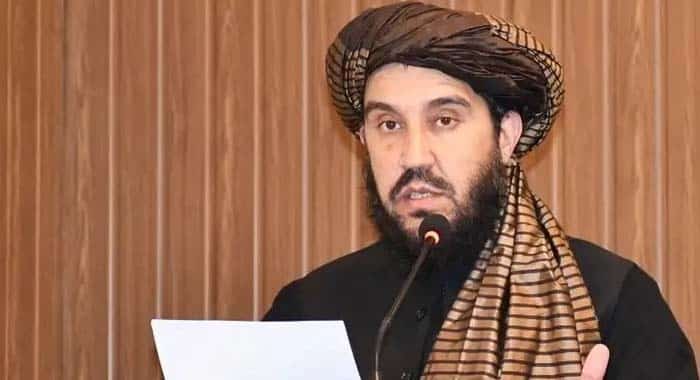
The Taliban’s ambassador in Islamabad has said the group understands Pakistan’s concerns over potential threats emanating from Afghan soil, but argued that such concerns should not be used to justify military action inside Afghanistan.
Sardar Ahmad Shakib made the remarks on Tuesday, September 1, while speaking at Pakistan’s National Defence University, where he called for direct dialogue between Islamabad and Kabul to address their respective security concerns.
Shakib said allegations concerning threats from Afghan territory should be specific and based on concrete information, including identifiable individuals, clearly defined networks and particular cases. He maintained that both Pakistan and the Taliban administration pursue their respective national interests.
He said that if Kabul was expected to cooperate with Pakistan over specific security concerns, it also expected Islamabad to engage directly with the Taliban over what it described as Afghanistan’s own security concerns.
The Taliban envoy called on both countries to move beyond what he described as outdated assumptions and base their relationship on present-day realities.
He argued that decades of war and political upheaval had made the security, political and economic affairs of Afghanistan and Pakistan closely interconnected.
According to Shakib, this interdependence is rooted in geography and strategic realities that neither country can alter.
He said the two neighbors could either allow their interconnected interests to become a source of tension or use them to promote stability, security and mutually beneficial economic opportunities.
The ambassador also stressed that geographical proximity did not require either country to endorse all of the other’s strategic decisions.
He said Afghanistan and Pakistan should be able to pursue independent foreign and security policies while remaining mindful of each other’s national and security interests.
Shakib further argued that Afghanistan’s relations with other countries should not automatically be interpreted as hostile towards Pakistan, saying an independent state could maintain ties with several countries even when those countries themselves have strained relations with one another.
The Taliban’s expanding ties with India have increasingly concerned Islamabad. Pakistan has previously accused New Delhi of using the Taliban as a proxy, particularly amid concerns over terrorist activity emanating from Afghan territory.
Rejection of Pressure and Trade Restrictions
Shakib also rejected what he described as attempts to exert political pressure on the Taliban over its sovereignty and internal affairs.
He said diplomatic engagement, rather than military action, should be used to address disagreements between the two countries.
The Taliban envoy further argued that Afghan civilians should not face what he termed collective punishment over security disputes, and opposed the use of trade and transit restrictions as instruments of political pressure.
His remarks come amid persistent tensions between Pakistan and the Taliban administration over cross-border terrorism, with Islamabad repeatedly demanding effective action against terrorist networks operating from Afghan soil.
While Kabul says it understands Pakistan’s security concerns, the two sides continue to differ sharply over the nature and scale of the threat, as well as over what measures can legitimately be taken to address it.
The challenge for both sides remains whether their stated preference for dialogue can produce concrete action on security concerns while preventing their wider political, economic and strategic differences from further damaging bilateral ties.



