
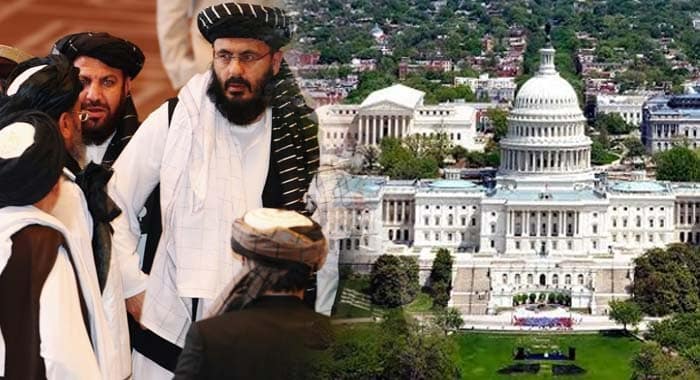
Sixteen days ago, the Taliban celebrated what it called the fifth anniversary of its “victory” over the United States and its allies. The occasion was presented as proof that the Taliban had defeated the world’s most powerful military alliance and restored Afghanistan’s independence. The Taliban’s own Ministry of Information and Culture described the events of August 15 as commemorating the political and military defeat of the United States and its allies.
Now comes the curious part.
The Taliban’s foreign minister, Amir Khan Muttaqi, is asking Washington to normalize relations with the very country his government claims to have defeated.
In two interviews published within days of each other, Muttaqi urged the United States to abandon what he called a confrontational approach, said Kabul wanted normalized relations with Washington and welcomed American investment in Afghanistan’s mining, infrastructure, agriculture and trade sectors. He also called for the reopening of the US embassy in Kabul and has previously encouraged American investment in Afghan mines, dams and roads.
So, what exactly happened to the great victory?
If the Taliban defeated the United States, why is the supposedly defeated power now being invited back as an investor, diplomatic partner and economic lifeline?
If Washington was truly conquered, why does Kabul need its recognition?
If the Taliban’s victory delivered complete independence and self-reliance, why is its foreign minister appealing to America to reopen its embassy and invest in the country’s vast mineral resources?
This is perhaps the anomaly of anomalies: the victors are pleading with the defeated for normalization.
A Victory That Needs Recognition
The contradiction becomes even sharper when recognition enters the picture.
Muttaqi says formal recognition is not necessarily the immediate priority, yet his government continues to seek wider diplomatic acceptance. Russia remains the only country to have formally recognized the Taliban government. At the same time, other regional countries have expanded practical engagement without granting formal recognition. Western governments continue to point to restrictions on women and girls, including the ban on girls’ education and restrictions on women’s employment, as major obstacles to normalization.
That raises another basic question: if the Taliban truly believes it has established an independent and legitimate political order, why is international recognition still such an important objective?
And perhaps more importantly, recognition by whom?
The Taliban did not obtain power through a nationwide electoral mandate. It did not emerge from an inclusive political settlement representing Afghanistan’s ethnic, political and social diversity. It seized Kabul by force in 2021 and continues to govern through an interim structure that remains internationally unrecognized, with Russia the sole country to have formally recognized it.
Yet the same authority now speaks of Afghanistan’s natural resources as though it possesses an unquestionable national mandate to decide their fate.
Who Owns Afghanistan’s Gold?
This question becomes particularly uncomfortable in Badakhshan.
The northeastern province has witnessed repeated clashes in recent months, including fighting between Taliban forces and forces loyal to local commander Juma Khan Fateh. Recent reporting has linked the conflict not only to disputes over authority and disarmament, but also to control of lucrative gold-mining areas.
Mining disputes have also produced confrontations between Taliban forces and local miners and residents. Reports from July described protests by mine workers after mining sites were closed, while allegations emerged that some workers had been threatened or beaten. Other reporting has linked continuing tensions in Badakhshan directly to competition over gold and precious-stone mines.
So another question demands an answer:
Who exactly gave the Taliban the authority to decide who may extract Afghanistan’s gold, who may receive mining contracts and who must surrender access to the country’s mineral wealth?
Afghanistan’s mineral reserves are potentially enormous. Geological assessments by the United States and the former Afghan government have placed the value of untapped resources at at least $1 trillion, including copper, iron ore, lithium and gold. Since returning to power, the Taliban has signed mining agreements worth billions of dollars with foreign partners.
Yet the Afghan people remain largely excluded from deciding how these resources are governed, while conflicts over access to them continue.
This is where the Taliban’s narrative of “victory” encounters its second major contradiction.
A government that claims to have liberated Afghanistan must answer a simple question: liberated for whom?
If Afghanistan’s resources belong to the Afghan people, then why should an unelected and internationally unrecognized interim authority have the final word over their exploitation?
The Real Test Is Not the Parade
The Taliban can hold military parades, display captured equipment and declare victory. It can invoke the withdrawal of foreign forces as proof of triumph. But sovereignty is more than the absence of American troops.
A genuinely sovereign and legitimate government does not merely control territory. It derives authority from its people, protects their rights, provides inclusive political representation and manages national resources in the public interest.
That is precisely where the Taliban’s victory narrative becomes difficult to sustain.
Sixteen days after celebrating the defeat of America, its foreign minister is asking America for normalization, investment and diplomatic engagement.
At the same time, Badakhshan continues to expose the unresolved struggle over who controls Afghanistan’s land, guns and gold.
Perhaps the most revealing question, therefore, is not whether the Taliban defeated America.
It is this:
If the Taliban truly won, why does its victory still seem to require everything it claims it defeated?



