
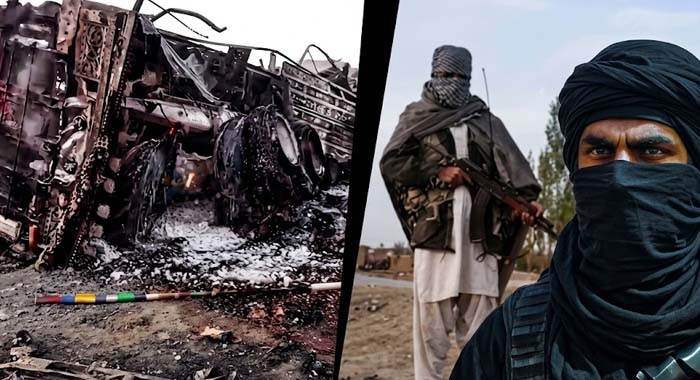
In yet another brutal attack aimed at undermining peace, economic activity and public confidence in Balochistan, Fitna al-Hindustan has reportedly killed five non-local labourers who had travelled to Saranan for commercial purposes.
According to initial information, the five labourers had come to Saranan to engage in fruit-related trade and earn a livelihood when they were targeted by Fitna al-Hindustan elements. The attack resulted in the deaths of all five individuals, turning a routine commercial activity into a devastating tragedy.
The incident once again highlights the indiscriminate nature of violence employed by Fitna al-Hindustan, which continues to target ordinary citizens whose only objective is to work, earn a living and contribute to local economic activity.
The attack carries implications far beyond the loss of five innocent lives. Targeting workers and traders engaged in legitimate economic activity is also an attempt to create fear among people seeking employment and conducting business in Balochistan.
Commercial activity, transportation, construction and development projects are essential sources of employment and economic opportunity for the people of the province. Attacks against individuals associated with these activities can disrupt local markets, discourage workers and traders from travelling to different areas and create an atmosphere of insecurity that directly affects communities.
Fitna al-Hindustan’s targeting of non-local labourers therefore represents not only an attack on innocent citizens but also an attempt to undermine economic activity and obstruct opportunities for the people of Balochistan.
Fitna al-Hindustan has previously targeted innocent civilians in an apparent effort to spread fear and insecurity among local communities. The targeting of individuals who lack any meaningful protection and are engaged in ordinary livelihood activities demonstrates the vulnerability created when terrorist elements deliberately choose soft targets.
Security analysts and observers have assessed that, following setbacks at the hands of Security Forces, Fitna al-Hindustan elements increasingly seek easier and less protected targets in an attempt to maintain a narrative of relevance and create psychological pressure. Such attacks cannot be presented as legitimate political or resistance activity. Deliberately targeting workers and civilians engaged in lawful economic activity is an assault on the very communities these groups claim to represent.
Balochistan’s economic development depends heavily on secure roads, functioning markets, reliable transportation, investment and the freedom of citizens to travel and work without fear.
Attacks against commercial workers and traders directly undermine these conditions. By attempting to frighten non-local workers away from the province and disrupt commercial movement, Fitna al-Hindustan seeks to create an environment in which economic opportunities shrink and communities become increasingly isolated.
The consequences are ultimately borne by ordinary people workers who lose employment opportunities, traders whose businesses suffer, families whose incomes are disrupted and communities that are deprived of development.
Analysts have also pointed to the contradiction between Fitna al-Hindustan’s claims of speaking for the rights of the people of Balochistan and its repeated targeting of individuals whose livelihoods are tied to the province’s economic activity. A group claiming to advocate for local rights cannot credibly justify attacks that deprive people of employment, disrupt commerce and damage prospects for economic development. Such actions risk keeping Balochistan economically marginalized while creating precisely the conditions of insecurity and underdevelopment that ordinary citizens have the greatest interest in overcoming.
According to security assessments, Fitna al-Hindustan elements have faced increasing pressure and operational setbacks as a result of counter-terrorism operations. Against this backdrop, the targeting of unprotected civilians can be viewed as an attempt to compensate for battlefield difficulties by generating fear through attacks on vulnerable targets.
However, attacks on workers and traders do not demonstrate strength. They expose the inability or unwillingness of terrorist elements to confront legitimate security challenges directly and instead reveal a reliance on fear, intimidation and violence against civilians. The latest attack reinforces the need for continued vigilance and effective security measures to protect civilians, commercial centers, transportation routes and development projects across Balochistan.
Ensuring the safety of workers and traders is essential not only for public security but also for sustaining economic activity and encouraging investment in the province. The people of Balochistan deserve an environment in which they can work, trade, travel and pursue economic opportunities without being threatened by violence. Security and law-enforcement institutions remain responsible for countering terrorist networks and preventing attacks against innocent citizens. At the same time, continued public awareness and cooperation remain essential in identifying suspicious activity and disrupting terrorist preparations.



