
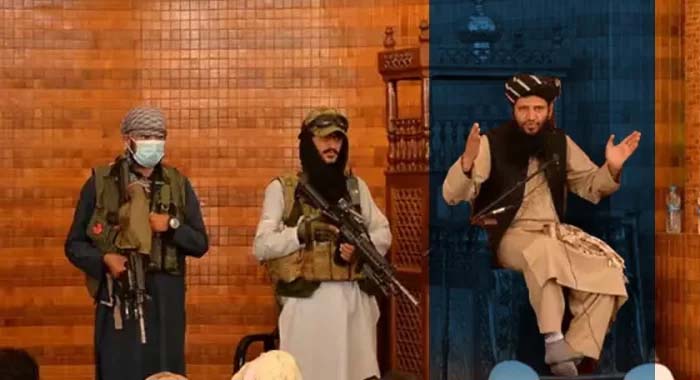
Accounts from citizens across Afghanistan indicate that Friday sermons delivered by Taliban-affiliated mullahs are increasingly being used as a platform to reinforce obedience to the Taliban’s leadership, discourage contact with opponents of the group, and promote restrictions on women and their participation in public life.
According to accounts from residents of Kabul, Parwan, Badakhshan, Balkh and Herat, the content of many Friday sermons is reportedly shaped around themes determined or encouraged by Taliban authorities. Citizens say that sermons frequently emphasize obedience to the Taliban’s Supreme Leader, warn against cooperation or contact with anti-Taliban fronts, and repeatedly address women’s clothing, mobility, social interaction and conduct.
The accounts further suggest that religious messaging is being employed not merely to communicate religious teachings, but also to reinforce the Taliban’s political and social order and encourage families—particularly men to impose the group’s preferred restrictions on women.
Taqwa, a pseudonym for a Kabul resident, says he has repeatedly witnessed mullahs devote a substantial portion of Friday sermons to women and the restrictions imposed upon them. According to Taqwa, the emphasis placed on women’s appearance, hijab and movement raises broader questions about the distinction between Islamic teachings and cultural or social interpretations presented in the name of religion.
He argues that reducing the identity of Muslim women primarily to matters of clothing, mobility and domestic responsibilities overlooks broader dimensions of Islamic history and religious sources. “The Quran does not say that a woman is responsible only for the home; rather, it also addresses women in terms of religious and social responsibilities,” Taqwa says. “Homemaking is valuable, but it should not be regarded as a woman’s entire identity.” He further observes that, in contemporary Afghanistan, hijab has increasingly been transformed from a matter of religious observance into a mechanism for monitoring women’s presence and behavior in society, with women in some cases facing severe pressure and restrictions.
Gulab, a pseudonym for a resident of Parwan Province, says that women-related issues constitute a major portion of Friday sermons delivered by Taliban-affiliated mullahs in the province. According to Gulab, the repeated focus on women’s clothing, movement, social interaction and responsibilities has also influenced the behavior of men within their families.
“Now, mullahs generally give sermons either out of enthusiasm or for the sake of Taliban propaganda,” she says. “Most of their sermons are focused on women; they talk about women’s clothing, socializing, going out, and their responsibilities.” She says the messaging has affected attitudes within households, with some men using economic provision as an argument for denying women greater autonomy.
“At home, if a woman says something, the men of the house say: you are the woman of the house; if you want clothes or something, your bread is provided, your water is provided; what more do you want?” she says. According to Gulab, the sermons also repeatedly emphasize obedience to Taliban officials, particularly the group’s leader, while warning people against maintaining contact or cooperating with fronts opposed to the Taliban. She adds that women are frequently presented as being primarily responsible for domestic work and child-rearing, while men are warned against contact with groups that challenge the Taliban’s authority.
Bilal, a pseudonym for a resident of Badakhshan Province, says Taliban mullahs in the province use Friday sermons to call upon people to follow the Taliban’s system. According to him, those who oppose the system or disobey orders attributed to the Taliban’s Amir are described as sinners or rebels. “Taliban mullahs, in their Friday sermons in Badakhshan, say that people should follow the system,” Bilal says. “Those who act against the system and disobey the orders of the Amir are considered sinners and rebels. They also emphasize preventing prejudice.”
He says sermons also address women’s movement and hijab, with mullahs reportedly instructing women not to wear makeup or perfume, not to travel without a mahram, not to use unspecified vehicles, and not to go out with a non-mahram. Such messaging, according to residents, places religious language alongside the enforcement of social restrictions and contributes to an environment in which personal and family decisions are increasingly subject to the Taliban’s interpretation of acceptable conduct.
Accounts from Mazar-e-Sharif indicate that the preparation of Friday sermons may involve organized coordination between Taliban authorities and mosque clerics. Parwiz, a pseudonym for a resident of Mazar-e-Sharif, says that Taliban mullahs from the city and surrounding areas gather every Thursday at the group’s Directorate of Guidance, Hajj and Endowments. According to Parwiz, the clerics meet with officials associated with the Taliban’s council, during which the subjects to be addressed in Friday sermons are communicated to them.
“Every week, on Thursday, all the mullahs at the city level and from areas outside the city gather at the Taliban’s Directorate of Guidance, Hajj and Endowments,” he says. “At that same meeting, the topics to be discussed on Friday are given to them, and the mullahs are required to speak about the very topics that have been determined for them.” He says the subjects generally concern social issues, while particular decrees or orders issued from Kandahar can become the focus of sermons during specific weeks. If accurate, such a system would indicate a structured effort to coordinate religious messaging at the local level and ensure consistency between Friday sermons and the Taliban’s wider political and social agenda.
Bahar, a pseudonym for a resident of Herat Province, similarly describes women’s issues as a recurring focus of Friday sermons. According to Bahar, Taliban mullahs frequently discuss hijab and encourage men to impose the restrictions and rules favored by the Taliban on women within their families. “Taliban mullahs, in their Friday sermons, mostly talk about women’s hijab,” she says. “They also try to encourage men to impose the group’s desired laws and restrictions on the women of their families.” She adds that another recurring feature of the sermons is praise and glorification of the Taliban’s system.
This combination of religious messaging, social restrictions and political praise, residents say, has made mosques an important channel through which the Taliban’s worldview is communicated to communities. The concerns extend beyond the content of sermons to the reported pressure placed upon the clerics delivering them. Nematullah, a pseudonym for a Taliban-affiliated mullah, says that clerics who fail to deliver sermons according to subjects determined by Taliban authorities may face action, including detention in some cases. According to him, the Arabic portion of the Friday sermon invoking the title “Amir al-Mu’minin” is compiled at the central Darul Ifta in Kandahar. He further says that Friday sermon material is distributed weekly to mosques through the Directorate of Mosques of the Ministry of Guidance, Hajj and Endowments.
He says larger mosques, particularly those attracting greater numbers of worshippers, are monitored by Taliban intelligence and the Ministry of Hajj and Endowments. “In cases of violations by mullahs, action is taken against them, and in some cases Taliban intelligence also detains them,” he says. These allegations, if independently corroborated, would point to an environment in which mosque-based religious discourse is subject not only to ideological direction but also to administrative and security oversight.
The reported use of Friday sermons forms part of a broader pattern in which the Taliban have relied heavily on religious institutions, traditional media and digital platforms to communicate their narratives since returning to power. Mosques provide the Taliban with direct access to communities on a weekly basis, while sermons allow messages concerning obedience, social conduct, women’s rights and restrictions, and loyalty to the Taliban system to be communicated in a religious setting. This gives such messaging a particular influence, especially in communities where religious leaders command significant social authority.
The accounts from multiple provinces suggest that the messaging is not confined to a single locality. Similar themes including obedience to the Taliban leadership, opposition to contact with anti-Taliban groups, restrictions on women, and praise for the Taliban system are reportedly recurring across different parts of the country.
The Taliban’s broader information strategy also reportedly extends beyond mosques. Since retaking control of Afghanistan, the group has made extensive use of media organizations, social-media networks and other communication platforms to promote its narrative, highlight its claimed achievements and portray its governance in a favorable light. The Taliban’s General Directorate of Intelligence has also reportedly established and supported several media platforms, including a radio station, a news website and online publications. These outlets are used to amplify the group’s messaging while limiting the visibility of dissenting or opposing narratives.
The convergence of religious platforms, state-controlled institutions and media networks creates multiple channels through which the Taliban can reinforce the same political and social messages.
The accounts presented by residents and a Taliban-affiliated mullah portray Friday sermons as an increasingly important component of the Taliban’s wider system of social and ideological control. The reported themes are notable for their consistency: women are repeatedly addressed through the lens of restrictions and domestic responsibilities; men are encouraged to enforce those restrictions within their families; citizens are warned against contact with opponents; obedience to the Taliban leadership is presented as an obligation; and the Taliban’s system is praised as the legitimate framework to which society should conform. At the same time, reports that mullahs may face disciplinary action or detention for departing from prescribed themes raise concerns about the independence of religious discourse and the ability of clerics to express interpretations that differ from the Taliban’s official position.
The experiences described by residents ultimately raise a fundamental question about the role of religious institutions under Taliban rule: Are Friday sermons serving primarily as spaces for independent religious guidance, or are they increasingly being used as instruments for political messaging, social control and reinforcement of the Taliban’s authority?
The accounts gathered from Kabul, Parwan, Badakhshan, Balkh and Herat point toward a recurring pattern that warrants continued scrutiny and independent verification. Religious teaching, social values and political authority are distinct spheres. When religious platforms are systematically used to promote political obedience, enforce social restrictions and discourage dissent, the consequences extend beyond the mosque and into the daily lives of ordinary citizens.
The reported experiences of Afghan residents therefore highlight the need for continued attention to freedom of religion, freedom of expression, women’s rights, the independence of religious scholars, and the broader use of religious and media institutions under Taliban rule.



