
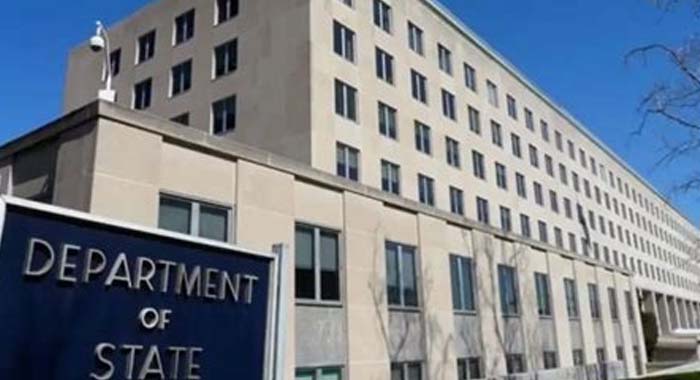
The United States has maintained its opposition to reopening its embassy in Kabul, underscoring that any expansion of engagement with the Taliban will remain dependent on U.S. national-security interests, counterterrorism commitments and the Taliban’s conduct.
The development comes amid continued efforts by Taliban Foreign Minister Amir Khan Muttaqi to encourage greater diplomatic and economic engagement with Washington, including calls for the reopening of the U.S. Embassy in Kabul and increased American investment in Afghanistan.
However, Washington’s longstanding position remains that diplomatic normalization cannot be separated from unresolved security and governance concerns.
The United States suspended operations at its Kabul embassy on August 31, 2021, and subsequently established its Afghanistan Affairs Unit in Doha, Qatar, as its diplomatic mission for Afghanistan. Current U.S. government guidance confirms that there is still no U.S. embassy or consulate operating in Afghanistan.
U.S. officials have repeatedly emphasized that future relations with the Taliban will be judged according to the group’s actions and its willingness to meet commitments made to the international community. Washington has identified several key areas, including counterterrorism commitments, the protection of human rights, the rights of women and girls, safe passage and the treatment of U.S. nationals.
In a previous State Department briefing, Washington explicitly stated that it was not in a position to reopen the Kabul embassy and that decisions concerning future diplomatic relations would depend on the Taliban’s conduct, including its adherence to counterterrorism commitments and protection of fundamental rights.
One of the most persistent obstacles to closer U.S.-Taliban relations has been Washington’s assessment of the Taliban’s counterterrorism record. U.S. officials have previously accused elements of the Taliban and the Haqqani network of sheltering senior al-Qaida leadership in Kabul, describing this as a violation of commitments made by the Taliban.
Washington has therefore continued to scrutinize whether Afghanistan under Taliban control can prevent militant organizations from using Afghan territory to threaten the United States, its allies or other countries. The United States has previously stated that the Taliban’s commitments under the Doha Agreement included preventing individuals and groups, including al-Qaida, from using Afghan territory to threaten U.S. security and that Washington continues to engage with the Taliban on compliance with those commitments.
The Taliban’s appeal for American investment reflects its broader effort to attract international capital and reduce Afghanistan’s economic isolation. For Washington, however, economic engagement is closely linked to the wider political and security environment. U.S. officials have previously indicated that financial support and broader engagement would depend on the Taliban meeting core requirements, including counterterrorism commitments and respect for fundamental rights.
This makes the Taliban’s push for American investment considerably more complicated than a straightforward economic proposal. Without a broader shift in Washington’s assessment of the Taliban’s policies and conduct, large-scale American economic engagement remains difficult to achieve.
The reopening of the U.S. Embassy in Kabul would carry significance far beyond the physical return of American diplomats. It would represent a major step toward deeper diplomatic normalization with the Taliban. Washington, however, has consistently linked such a move to security considerations and the Taliban’s fulfillment of its international commitments. The State Department has previously stated that safety and security, as well as the propriety of diplomatic representation, are among the factors involved in any decision to reopen the embassy.
For now, the Afghanistan Affairs Unit in Doha remains the U.S. diplomatic mission handling engagement with Afghanistan. The dispute highlights a broader challenge facing the Taliban authorities: securing international investment and diplomatic normalization while addressing concerns raised by Washington and other international actors. The Taliban has sought to present Afghanistan as increasingly stable and open for international economic cooperation. Washington, meanwhile, continues to evaluate engagement through the lens of American security interests and the Taliban’s conduct. The result is a diplomatic stalemate in which the Taliban is seeking greater access to Western investment and diplomatic engagement, while the United States continues to demand substantive assurances and evidence of compliance with its stated expectations.
The United States has not indicated that all communication with the Taliban has ended. Rather, Washington’s established policy has been one of limited and pragmatic engagement, designed to advance specific U.S. interests without automatically conferring diplomatic recognition.
The central question is therefore not simply whether the Taliban wants the U.S. Embassy reopened or American companies to invest in Afghanistan. The more consequential question is whether the Taliban can create the conditions that Washington considers necessary for such engagement.
For now, the message from Washington remains clear: diplomatic normalization and expanded economic engagement will not be granted simply on request. The future of U.S.-Taliban relations will continue to be determined by security considerations, counterterrorism commitments, human-rights concerns and the broader interests of the United States.



