
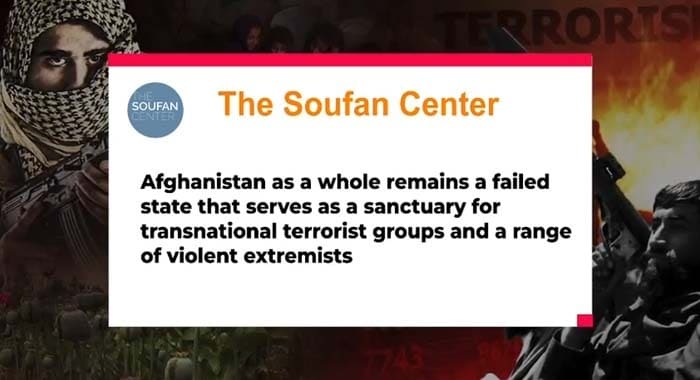
Afghanistan continues to face a deepening political, economic, security and humanitarian crisis under Taliban rule, with the country increasingly described by international analysts as a permissive environment for terrorist organizations and violent extremist elements. The Taliban’s rigid policies, alleged links with militant networks, and continued international isolation have compounded Afghanistan’s instability while placing further pressure on its fragile economy and diplomatic standing.
According to an assessment attributed to the Soufan Center, Afghanistan remains a failed-state environment in which terrorist groups and various violent extremist elements continue to find space to operate. The assessment highlights persistent concerns over the presence of militant organizations, terrorist infrastructure and criminal networks, underscoring the continuing regional and international security implications of developments inside Afghanistan.
The continued presence of terrorist organizations in Afghanistan remains one of the most serious concerns surrounding Taliban rule. According to the reported assessment, Al-Qaeda continues to maintain an operational footprint in Afghanistan, including training facilities through which militant elements are reportedly provided instruction and support.
The persistence of such networks raises significant concerns for regional security, particularly given Afghanistan’s geographic proximity to South and Central Asia. The continued ability of extremist organizations to operate, recruit, train and maintain networks from Afghan territory presents a challenge not only to Afghanistan’s immediate neighbors but also to the broader international community.
Analysts further maintain that the Taliban’s engagement with or tolerance of militant elements has contributed to an environment in which terrorism, organized crime and violent extremism can continue to flourish. Such conditions risk turning Afghanistan into a long-term security challenge rather than a source of regional stability.
The Taliban’s governance model has also attracted widespread criticism for its increasingly restrictive social and political policies. Experts have particularly highlighted sweeping restrictions imposed on women and girls, including limitations on education, employment and participation in public life.
These policies have consequences extending beyond human rights concerns. They have also contributed to Afghanistan’s diplomatic isolation, weakened the country’s international engagement and complicated efforts to restore sustainable economic development.
The continued implementation of hard-line policies has made meaningful engagement with the international community increasingly difficult. Rather than creating an environment conducive to political normalization and economic recovery, the Taliban’s approach has reinforced Afghanistan’s isolation and deepened uncertainty about the country’s future.
Afghanistan’s economic situation remains extremely fragile. Since the Taliban’s return to power, the country has struggled with weak economic activity, limited international investment, restricted access to financial systems and persistent humanitarian needs.
The reported assessment by the Soufan Center characterizes Afghanistan as suffering from continuing international isolation while its economy remains under severe pressure. The absence of broad diplomatic recognition and the Taliban’s policies have further complicated efforts to integrate Afghanistan into the international economic system.
Experts warn that prolonged economic weakness can create conditions conducive to unemployment, poverty, illicit economic activity and recruitment by extremist organizations. Without meaningful political and economic reforms, Afghanistan risks remaining trapped in a cycle of instability in which insecurity reinforces economic hardship and economic hardship, in turn, fuels further insecurity.
Afghanistan also continues to face serious challenges related to illicit economies and organized criminal networks. The country has historically been a major center of global narcotics production and trafficking, and concerns remain regarding the persistence of trafficking networks despite changes in Taliban policy and enforcement.
According to the cited assessment, Afghanistan continues to be regarded as an important center in the international narcotics-trafficking landscape. The continued presence of illicit networks adds another layer to the country’s security crisis and creates opportunities for criminal organizations and militant groups to generate revenue.
The convergence of terrorism, organized crime, illicit trafficking and weak governance presents a particularly serious threat to regional stability. It also underscores the importance of sustained international monitoring and coordinated efforts to prevent Afghan territory from becoming a base for transnational criminal and terrorist activity.
Experts further emphasize that the presence of multiple militant and extremist groups in Afghanistan following the Taliban’s takeover remains a major regional security challenge. Afghanistan’s instability has implications well beyond its borders. The presence of extremist networks, combined with porous borders, illicit trafficking routes and economic vulnerability, creates conditions that can facilitate the movement of militants, weapons, narcotics and illicit funds across the region.
For neighboring states, the continued uncertainty represents a direct security concern. For the international community, it raises the possibility that Afghanistan could once again become a permissive operating environment for organizations seeking to plan, train for or facilitate attacks beyond Afghan territory.
Experts argue that lasting stability in Afghanistan will require more than the mere absence of open warfare. Sustainable peace depends upon effective governance, respect for fundamental rights, economic opportunity, responsible counterterrorism measures and meaningful engagement with the international community. The Taliban’s continued restrictions on women and girls, coupled with concerns over terrorist networks operating from Afghan territory, remain major obstacles to diplomatic normalization and economic reintegration. Addressing these concerns is essential if Afghanistan is to move away from prolonged isolation and toward a more stable and sustainable future.
The international community must therefore continue to closely monitor terrorist and criminal networks operating in Afghanistan, assess the regional consequences of developments inside the country, and pursue policies that encourage genuine improvements in governance, security, human rights and economic conditions.
Afghanistan under Taliban rule remains confronted by a convergence of terrorism, political repression, economic fragility, international isolation and illicit criminal activity. The concerns highlighted by the Soufan Center and regional experts underscore the continuing risks associated with the presence of extremist organizations and the Taliban’s hard-line governance model.
Unless meaningful changes are undertaken, Afghanistan risks remaining caught in a cycle of insecurity and economic deprivation, with consequences extending across the region and beyond.
The international community’s challenge is to ensure that Afghanistan does not again become a safe haven for terrorism and transnational crime while simultaneously supporting conditions that can lead to a more peaceful, economically viable and internationally responsible Afghanistan.



