
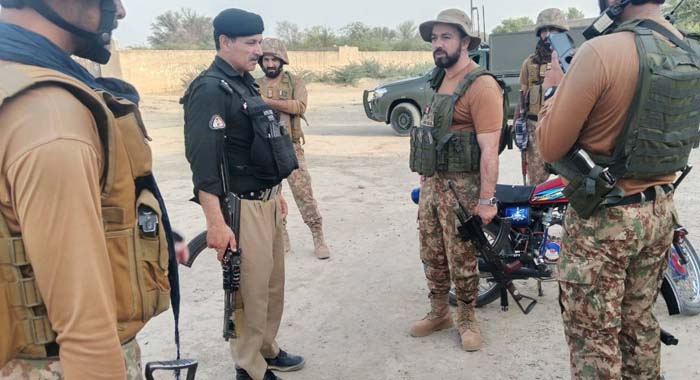
In a significant step towards strengthening security and restoring lasting peace in the region, Lakki Marwat Police, in coordination with specialized law-enforcement units and local peace committees, conducted a comprehensive search and strike operation across several areas of the district on Sunday, successfully destroying multiple hideouts used by Khawarij.
The coordinated operation was launched simultaneously in Shah Hasankhel, Ahmadkhel, Kattakhel, Mastikhel, and Dhoda on the special directions of District Police Officer Shahbaz Ilahi, with the objective of disrupting Khawarij networks, dismantling their hideouts, and preventing them from using the difficult mountainous and rural terrain as a base for anti-peace activities.
The operation brought together personnel from several specialized formations, reflecting a coordinated and multi-layered approach to countering the Khawarij threat.
According to police officials, Elite Force commandos, Counter-Terrorism Department (CTD) personnel, Rapid Response Force teams, and members of local peace committees participated in the operation. The participating personnel were supported by armoured personnel carriers, enabling law-enforcement teams to operate effectively across challenging terrain and reach areas that are otherwise difficult to access.
The coordinated deployment enabled security personnel to conduct simultaneous searches across multiple locations and target suspected Khawarij hideouts in remote and mountainous areas. During the operation, law-enforcement personnel successfully destroyed mountainous hideouts used by Khawarij, depriving anti-peace elements of locations that could potentially be used for shelter, planning, or other hostile activities.
Police officials stated that the operation was conducted with the objective of denying the Khawarij any opportunity to exploit the district’s rugged terrain and remote settlements for concealment or operational activity. The destruction of the hideouts represents an important operational achievement and reinforces the resolve of the law-enforcement agencies to dismantle the infrastructure used by Khawarij elements in the area.
A notable feature of the operation was the extensive use of advanced surveillance technology and drones. Police personnel employed aerial surveillance to monitor rural localities, mountainous areas, and difficult-to-reach terrain. The use of drones enabled law-enforcement teams to obtain a broader operational picture, identify suspicious movement, monitor potential hideouts, and improve situational awareness during the operation.
The integration of modern surveillance capabilities with conventional ground operations reflects the evolving operational preparedness of the police and their efforts to employ technology to enhance the effectiveness and safety of security operations.
The participation of specialized units alongside regular police personnel demonstrates the importance of coordinated operations in addressing security challenges in difficult terrain. The combined capabilities of the Elite Force, CTD, Rapid Response Force, local peace committees, and police units, supported by armoured vehicles and aerial surveillance, enabled the forces to conduct a comprehensive operation across multiple locations simultaneously.
Such coordinated efforts are aimed at preventing Khawarij elements from establishing permanent footholds, rebuilding infrastructure, or exploiting isolated areas to threaten local communities.
Speaking on the occasion, District Police Officer Shahbaz Ilahi reaffirmed that the police would continue to utilize all available resources and capabilities to establish lasting peace in Lakki Marwat and protect the lives and property of the people. He emphasized that the safety and security of the local population remain the foremost priority of the police and that every necessary measure would be taken to prevent Khawarij elements from disrupting peace and normal life in the district.
The DPO also underscored the importance of sustained security efforts and close coordination among law-enforcement agencies and local communities in maintaining stability.



