
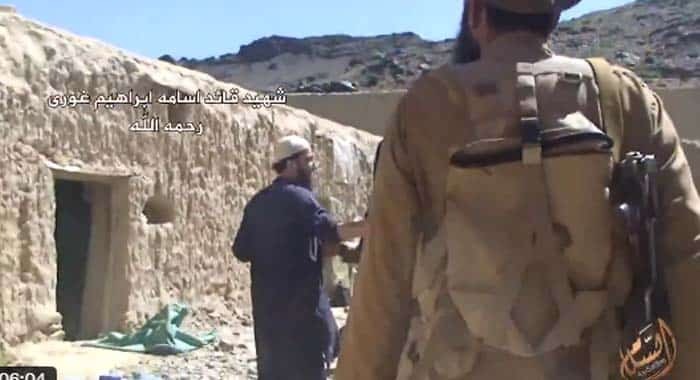
Al-Qaeda in the Indian Subcontinent (AQIS) has released a new documentary marking the fifth anniversary of the Taliban’s return to power in Afghanistan on August 15, 2021. The release highlights the continued ideological and historical relationship between Al-Qaeda and the Taliban and offers a revealing look at how the anniversary is being portrayed within Al-Qaeda’s propaganda ecosystem.
The documentary features former Al-Qaeda commander Khurram Saeed Kiyani, also known as Haji Qasim, who was killed in a U.S. drone strike in Zabul Province in 2017. Kiyani was reportedly active within Al-Qaeda’s network in Pakistan and had previously been associated with Al-Badr Mujahideen (ABM) and Lashkar-e-Taiba (LeT), including involvement in the conflict in Kashmir.
The timing of the documentary’s release is significant. Rather than simply commemorating the Taliban’s political and military victory, the production can be viewed as part of Al-Qaeda’s broader effort to portray the Taliban’s return to power as a major strategic development for the wider jihadist movement.
For Al-Qaeda, August 15 carries significance beyond the Taliban’s return to Kabul. The anniversary provides an opportunity for the organization to reinforce a narrative that Afghanistan once again offers an environment in which its personnel, networks, and senior leadership can operate with considerably greater freedom than was possible during the years following the September 11, 2001 attacks.
The documentary’s focus on a deceased Al-Qaeda commander further serves that narrative by connecting the organization’s current propaganda with the history of its operations in the Afghanistan-Pakistan region.
Since the Taliban seized control of Kabul in August 2021, concerns have persisted regarding the presence of Al-Qaeda personnel and affiliated networks inside Afghanistan.
Analysts and international observers have repeatedly examined the relationship between the Taliban and Al-Qaeda, particularly allegations that elements of the Al-Qaeda network continue to maintain a presence in the country.
The broader Al-Qaeda network has historically included multiple components operating across South Asia. These have included Al-Qaeda Central, including senior leadership and specialized commissions, as well as AQIS, which has maintained a regional focus encompassing Afghanistan, Pakistan, India, Bangladesh, and surrounding areas. The development of additional Al-Qaeda-linked structures in Afghanistan has also attracted attention in recent years, adding further complexity to the militant landscape in the country.
The release of the documentary appears designed not merely to commemorate an anniversary, but also to reinforce Al-Qaeda’s interpretation of the political transformation that followed the Taliban’s takeover. By highlighting figures from Al-Qaeda’s past while connecting their legacy to the present-day environment, AQIS appears to be presenting the Taliban’s return to power as evidence of the endurance of the movement’s broader ideological project.
The messaging also reflects an important distinction: the Taliban and Al-Qaeda are separate organizations with different structures and objectives, even though they have maintained a longstanding relationship. The Taliban’s return to power therefore does not mean that Al-Qaeda itself governs Afghanistan. Rather, the significance for Al-Qaeda lies in the environment it believes has emerged following the Taliban takeover.
The documentary comes amid continuing international scrutiny of Afghanistan’s security environment and the activities of transnational militant organizations operating from or maintaining connections to the country. For Al-Qaeda, propaganda surrounding the Taliban’s fifth anniversary provides an opportunity to portray the post-2021 period as a reversal of the strategic setbacks the organization experienced after 2001.
The documentary’s emphasis on former commanders such as Kiyani helps Al-Qaeda preserve institutional memory, glorify its past personnel, and connect previous generations of militants with the organization’s current narrative. Such productions are also intended to communicate with supporters and sympathizers, reinforcing perceptions of continuity despite years of military pressure, leadership losses, and organizational disruption.
The release underscores the continuing importance of Afghanistan within the wider history and contemporary propaganda of Al-Qaeda and other militant organizations. While the Taliban has repeatedly stated that Afghan territory will not be used against other countries, questions surrounding the presence and activities of foreign and transnational militant groups remain an important element of international security assessments concerning Afghanistan. The documentary therefore provides another indication of how Al-Qaeda views the post-2021 Afghan landscape and how the organization seeks to interpret the Taliban’s return to power for its own supporters.
AQIS’s release of a documentary marking five years since the Taliban’s return to power demonstrates the continued importance Al-Qaeda places on Afghanistan in its strategic and ideological messaging. By featuring former commander Khurram Saeed Kiyani and linking his legacy to the anniversary, the documentary attempts to portray a direct line between Al-Qaeda’s historical experience in the region and the environment that emerged after the Taliban’s takeover in 2021.
For Al-Qaeda, the anniversary is consequently more than a celebration of the Taliban’s return to Kabul. It is an opportunity to promote the narrative that the post-2021 Afghan environment has restored opportunities that the organization lost following the events of September 11, 2001. The documentary should therefore be understood not simply as historical material, but as a piece of Al-Qaeda propaganda intended to shape perceptions of its relationship with the Taliban, preserve the memory of its former commanders, and portray Afghanistan as a strategically significant environment for the organization.



