
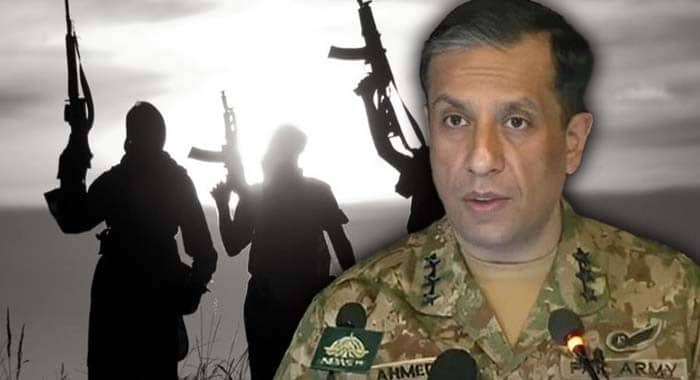
Pakistan has reaffirmed its zero tolerance policy against terrorism, declaring that there will be no negotiations with terrorists and warning that armed groups must either surrender or face elimination, as the military leadership outlined what it described as a comprehensive strategy to dismantle terrorist networks and their support structures.
Addressing a wide-ranging press conference focused primarily on the security situation in Balochistan and Pakistan’s broader counterterrorism campaign, Director General Inter Services Public Relations (ISPR), Lieutenant General Ahmed Sharif Chaudhry, said the Constitution places clear responsibilities on every citizen, foremost among them loyalty to the state and adherence to the Constitution.
He stressed that citizens could legitimately demand their rights only after fulfilling their constitutional responsibilities, adding that national unity and loyalty to Pakistan should remain every citizen’s foremost identity.
The military spokesperson referred to remarks made days earlier by the Field Marshal during a workshop in Balochistan, saying national discourse often focuses on rights while overlooking civic responsibilities. He argued that strengthening awareness of citizens’ constitutional duties was essential for national cohesion and long-term stability.
Counterterrorism Campaign
Presenting the country’s latest counterterrorism statistics, the DG ISPR said security forces and law enforcement agencies had conducted 40,348 intelligence-based operations (IBOs) across Pakistan so far this year.
According to the figures shared during the briefing:
31,080 operations were conducted in Balochistan.
7,177 operations were carried out in Khyber Pakhtunkhwa.
2,091 operations took place in other parts of the country.
He said 3,145 terrorist incidents had been recorded nationwide during the same period.
The spokesman stated that security forces had eliminated 2,084 terrorists this year, averaging roughly ten terrorists every day, while Pakistan had suffered 819 martyrs, averaging around four per day.
Among those martyred were:
303 Pakistan Army personnel
394 members of law enforcement agencies
322 civilians
He added that 28 suicide attacks had occurred this year and alleged that, as in the previous year, Afghan nationals were involved in all suicide bombings, including attacks in Tank and Karachi.
‘No More Appeasement’
Delivering one of the strongest policy statements of the briefing, the DG ISPR said the era of appeasing terrorist facilitators and vested interests was over.
“Terrorists will have to surrender their weapons, otherwise we will eliminate them,” he said, adding that terrorist organizations had realized there would no longer be any leniency toward them.
He also declared that individuals who sought to use violence as leverage to secure political or financial concessions would no longer succeed.
According to the military spokesman, public resources allocated for Balochistan would be directed toward the people of the province rather than influential elites.
Balochistan’s Challenges
The military spokesperson argued that the province’s principal internal challenge remained what he described as the entrenched tribal elite structure, alleging that influential families sought to preserve the status quo by preventing ordinary citizens from progressing through education and professional opportunities.
He maintained that genuine stakeholders in Balochistan were its people rather than privileged elites.
He further alleged that certain influential groups benefited from smuggling, narcotics trafficking and illegal fuel trade, and resorted to supporting or encouraging terrorism whenever state institutions attempted to dismantle these illicit networks.
Foreign Support for Terrorism
The DG ISPR alleged that external actors continued to fuel terrorism inside Pakistan, accusing the Afghan Taliban administration of supporting terrorist groups operating against Pakistan.
He also alleged that India continued backing what Pakistan refers to as Fitna al-Hindustan, while asserting there was no operational distinction between Fitna al-Hindustan and Fitna al-Khwarij, claiming both shared common objectives against Pakistan.
According to the military spokesman, Pakistan possessed evidence linking Afghan nationals to several recent terrorist attacks.
Security Forces’ Role
Highlighting recent counterterrorism operations, he praised the role of Balochistan Police, Frontier Corps and other law enforcement agencies, saying numerous attacks on police stations had been successfully repelled despite coordinated assaults by heavily armed terrorists.
He cited attacks in Kachhi, Quetta, Jhal Magsi, Kalat, Khaliqabad, Dhadar and Khuzdar, stating that security personnel fought with exceptional courage, preventing terrorists from capturing police installations despite sustaining casualties.
The spokesman urged greater public recognition of sacrifices made by police officers and FC personnel, arguing that successful defensive operations often received less attention than terrorist propaganda videos circulated online.
Development Under Threat
The DG ISPR maintained that terrorist organizations deliberately targeted development projects, transportation infrastructure and civilian facilities in an effort to obstruct economic progress before portraying Balochistan as neglected.
He rejected what he described as narratives of systematic deprivation, arguing that cities including Gwadar and Turbat possessed modern infrastructure, hospitals, roads, educational institutions and an international airport that compared favorably with many urban centers elsewhere in Pakistan.
He added that Balochistan’s per capita income remained higher than several other provinces despite persistent security challenges.
Technology and Future Strategy
Outlining future measures, the military spokesman said Pakistan was expanding technical surveillance capabilities, enhancing cyber and aerial monitoring, strengthening specialized training centers and further empowering police and other law enforcement institutions.
He also announced that nearly 11,000 young people in Balochistan were receiving IT training annually, describing the province’s youth as its most valuable resource.
According to him, long-term peace in Balochistan depended not only on defeating terrorism militarily but also on investing in education, skills development and direct engagement with local communities.
Missing Persons and Online Radicalisation
Addressing the issue of missing persons, the DG ISPR said the Commission on Missing Persons had received 2,933 cases from Balochistan. He alleged that several individuals listed as missing had later been found among terrorist ranks or had been eliminated during security operations.
He also accused terrorist organizations of exploiting social media to recruit young people and alleged that women and girls had been blackmailed through “honey trap” operations into facilitating terrorist activities.
According to the briefing, more than half of the social media accounts spreading anti-Pakistan propaganda linked to these campaigns were allegedly being operated from India.
Concluding the press conference, the DG ISPR reiterated that Pakistan’s Constitution and laws applied equally to all citizens and said defeating terrorism required national unity, loyalty to the state and continued cooperation between security institutions and the public.



