
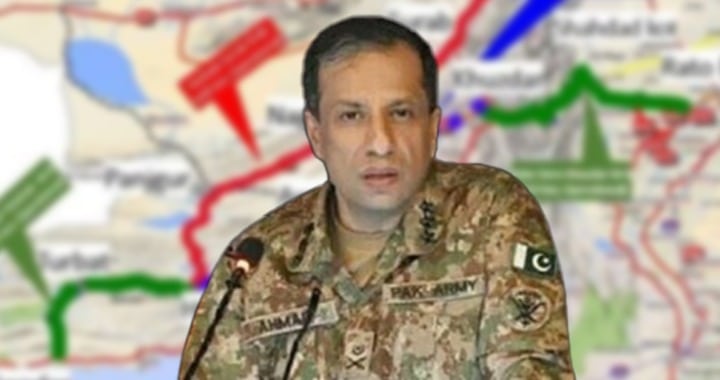
Director General Inter-Services Public Relations (DG ISPR) has stated that the narrative of deprivation in Balochistan does not align with ground realities, highlighting major progress in infrastructure, resource allocation, and public development across the province.
Addressing the issue, the DG ISPR said that at the time of independence, Balochistan had a limited road network, with only 375 kilometers of roads in 1949. He stated that today the province has witnessed significant expansion, with the road network extending to approximately 24,433 kilometers, including more than 4,400 kilometers of national highways, reflecting substantial investment in connectivity and infrastructure.
The DG ISPR further stated that an assessment of development allocations shows that Balochistan receives a higher per capita development budget compared to other provinces, particularly Punjab. He emphasized that claims suggesting the province has been deprived of resources do not correspond with available data and development allocations.
Highlighting challenges to progress, the DG ISPR stated that Khawarij and hostile terrorist elements deliberately target development projects in Balochistan. He said that workers, engineers, teachers, and other professionals involved in development activities have been targeted, while roads, bridges, and other infrastructure projects have also come under attack.
He stated that such attacks are aimed at preventing economic growth and development in the province. According to the DG ISPR, hostile elements attempt to create instability, obstruct progress, and then exploit the resulting challenges to promote narratives claiming that Balochistan remains neglected or that the state is not pursuing development.
The DG ISPR said that terrorist elements oppose industrial growth, agricultural development, educational advancement, and opportunities for youth because empowerment of citizens weakens outdated systems of control and enables people to become more independent.
Addressing the issue of political representation, the DG ISPR stated that the democratic and electoral system introduced under the 1973 Constitution applies equally to Balochistan and all other provinces of Pakistan. He said that elections continue to provide citizens with the opportunity to choose their representatives through the constitutional process.
He noted that over the years, many of the same political families, tribal leaders, religious groups, and influential personalities have repeatedly succeeded in elections and reached legislative assemblies. He stated that when such groups win elections, the process is recognized as democracy, but questions are sometimes raised when outcomes do not align with certain expectations.
Discussing the issue of missing persons, the DG ISPR stated that the government has established a permanent commission headed by a retired Supreme Court judge to investigate such cases. He said that representatives of the commission are present in districts and each case is examined through established legal procedures.
The DG ISPR emphasized that the issue of missing persons should be addressed through constitutional and legal forums rather than being used as a tool for misinformation against state institutions. He reiterated that Pakistan remains committed to resolving legitimate concerns through lawful mechanisms.
Reaffirming the state’s commitment to Balochistan, the DG ISPR stated that security forces and state institutions will continue efforts aimed at ensuring peace, eliminating terrorism, protecting development initiatives, and creating greater opportunities for the people of the province.



