
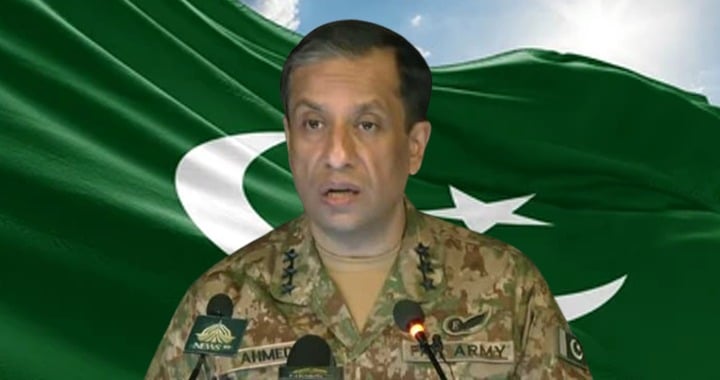
Director General Inter-Services Public Relations (DG ISPR) has emphasized that every citizen must recognize their constitutional responsibilities and duties while seeking their rights, stating that rights and obligations go hand in hand in a constitutional state.
Addressing the issue of civic responsibilities, the DG ISPR stated that discussions in various forums often focus only on individual rights, while equal attention must be given to the duties and responsibilities imposed on citizens under the Constitution of Pakistan.
He highlighted that Article 5 of the Constitution establishes loyalty to the state and obedience to the Constitution and law as fundamental responsibilities of every citizen. He stressed that fundamental rights cannot be separated from fundamental duties, and both are essential for the stability and progress of a nation.
The DG ISPR stated that society must overcome the contradiction where demands for rights are raised while constitutional responsibilities are overlooked. He emphasized that every Pakistani must prioritize national responsibility and adherence to law as the foundation of a stable and prosperous society.
He further referred to the recent address by Field Marshal Syed Asim Munir at the National Workshop Balochistan, where he underscored that the first, foremost, and ultimate identity of every citizen should be being Pakistani. The DG ISPR stated that national identity and loyalty to the state form the foundation of a strong and united Pakistan.
Highlighting the importance of national cohesion, the DG ISPR said that provincial, linguistic, ethnic, or regional identities must remain secondary to the broader national identity. He stated that a strong state provides the foundation for the protection of politics, economy, security, dignity, and collective national interests.
Discussing the situation in Balochistan, the DG ISPR stated that the core challenge is not only terrorism but also an outdated social and tribal structure that has, for decades, restricted opportunities for ordinary citizens and hindered development.
He stated that certain influential elements seek to prevent young people from accessing education, pursuing professional careers, establishing businesses, and contributing to national development. Instead, these elements attempt to keep communities dependent on outdated systems of influence and control.
According to the DG ISPR, this mindset has contributed to stagnation and challenges in parts of Balochistan, where certain elements exploit insecurity and terrorism for their own interests before attempting to portray the situation as a failure of the state in order to seek concessions or political accommodation.
The DG ISPR made it clear that the state will not accept narratives or pressure aimed at undermining national stability. He reiterated that the solution to Balochistan’s challenges lies in strengthening constitutional governance, enforcing the rule of law, ensuring the writ of the state, and providing opportunities for public development.
He further stated that security forces remain committed to countering Khawarij and other hostile elements who attempt to exploit grievances and disturb peace and stability. Alongside security measures, the state continues to focus on development, education, economic opportunities, and the empowerment of citizens.
The DG ISPR reaffirmed that a prosperous and peaceful Balochistan can only be achieved through national unity, constitutional principles, equal opportunities, and collective responsibility among all citizens.



