
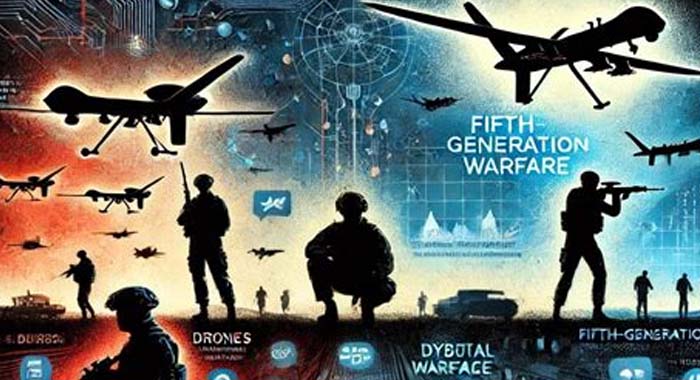
The nature of warfare has undergone a profound transformation. While armed conflict continues to exist, the defining battles of the twenty-first century are increasingly being fought not on conventional battlefields, but in the cognitive and informational domain, where public perception, social cohesion, and national identity have become the principal targets.
Today, states and non-state actors possess unprecedented capabilities to influence millions of people across borders with minimal financial investment. What once required vast propaganda ministries, extensive broadcasting infrastructure, and significant state resources can now be achieved through coordinated digital campaigns, sophisticated social media operations, and strategically crafted narratives disseminated through smartphones and online platforms.
This evolving strategic environment is widely described as Fifth Generation Warfare (5GW) a form of conflict in which the primary objective is not the physical destruction of an adversary’s armed forces, but the systematic erosion of public confidence in state institutions, democratic governance, and national identity.
Unlike conventional wars, a nation subjected to successful Fifth Generation Warfare may never witness invading armies crossing its borders. Instead, its institutions gradually lose legitimacy, its citizens become increasingly polarised, communities are encouraged to distrust one another, and national sovereignty weakens while all formal structures of the state continue to exist.
Pakistan today faces precisely this strategic challenge. The country’s information environment has become the arena for multiple coordinated influence campaigns conducted by hostile state and non-state actors seeking to exploit existing social, political and economic grievances in pursuit of broader geopolitical objectives. These campaigns are neither accidental nor spontaneous. Their methods remain remarkably consistent across different theatres and audiences.
The first stage involves constructing an emotional framework before presenting specific factual claims. Audiences are conditioned to distrust the Pakistani state and its institutions before they are exposed to individual allegations. Once this emotional foundation has been established, information supporting the desired narrative is readily accepted, while contradictory evidence is dismissed as propaganda or institutional deception.
The second stage relies upon selective presentation of genuine grievances.
Real governance failures, administrative shortcomings, corruption, underdevelopment and isolated instances of injustice are extracted from their broader political and historical context and presented as evidence of deliberate, systematic oppression. Administrative failure is transformed into proof of institutional malevolence.
The third stage seeks informational saturation.
Rather than persuading audiences through superior arguments, influence operations flood digital ecosystems with a constant stream of repetitive messaging until alternative interpretations become increasingly difficult to locate, evaluate or sustain.
Finally, these operations seek to merge political narratives with personal identity.
Once political claims become inseparable from an individual’s sense of ethnic, regional or cultural identity, disagreement ceases to be viewed as democratic debate and is instead perceived as an attack upon the individual or community itself.
These are among the defining characteristics of contemporary information warfare. Pakistan confronts several actors simultaneously employing variations of these methods. India’s intelligence apparatus has long articulated strategic concepts centred upon exploiting Pakistan’s internal vulnerabilities. National Security Advisor Ajit Doval publicly described the doctrine of “defensive offence” in 2014, outlining approaches focused upon imposing costs through internal destabilisation rather than conventional military confrontation.
Simultaneously, separatist organisations operating in Balochistan continue to receive varying forms of external political, diplomatic and informational support that amplify their messaging well beyond Pakistan’s borders. The media infrastructure associated with the Baloch Liberation Army (BLA) has increasingly adopted sophisticated English-language communications directed towards international policymakers, parliamentarians, journalists and human rights organisations who often possess limited independent access to developments inside Balochistan.
Similarly, Tehreek-e-Taliban Pakistan (TTP) has significantly enhanced its digital media capabilities, producing high-quality multimedia content that rapidly adapts to evolving political and security developments. Its messaging frequently reaches audiences faster than official responses, allowing militant narratives to dominate early public discourse.
In parallel, certain affiliated movements—despite the presence of legitimate concerns among many ordinary supporters have, intentionally or otherwise, contributed to the amplification of narratives portraying the Pakistani state as fundamentally predatory while distancing themselves formally from the armed organisations benefiting from those narratives.
The effectiveness of these campaigns should not be misunderstood. They succeed not because they possess overwhelming intellectual strength, but because they frequently encounter little meaningful political contestation. This represents perhaps the most significant strategic vulnerability in Pakistan’s response to Fifth Generation Warfare. Successive political governments, regardless of party affiliation, have developed two dominant modes of political communication.
When in government, they emphasise development, economic performance, public projects and governance achievements. When in opposition, they focus upon electoral grievances, institutional failures, allegations of political manipulation and criticism of state institutions. Between these two narratives exists a critical vacuum. That vacuum is the democratic defence of Pakistan itself.
It remains extraordinarily rare for elected political leaders to directly engage separatist narratives before their own constituents using the language of democratic persuasion rather than administrative denial. The reasons for this reluctance are politically understandable. A politician who publicly challenges the narratives advanced by separatist organisations risks being portrayed as speaking on behalf of the military establishment—a politically damaging accusation in an increasingly polarised digital environment.
Likewise, political leaders in Khyber Pakhtunkhwa often hesitate to confront militant organisations directly for fear of being perceived as hostile to Pashtun communities or supportive of military operations that have historically resulted in civilian displacement.
Each individual political calculation may appear rational. Collectively, however, they have produced a profound strategic consequence. An entire narrative battlefield has been abandoned. History demonstrates that narratives do not always prevail because they are stronger. They often prevail because they remain uncontested.
The observation frequently attributed to Joseph Goebbels that a narrative requires only the absence of effective competition rather than outright victory illustrates a central principle of information warfare. For many years, separatist narratives portraying Pakistan as an occupying power have circulated extensively within diaspora communities, international advocacy networks, foreign parliamentary discussions and university environments with comparatively limited sustained democratic political rebuttal originating from Pakistan itself.
This situation requires urgent reconsideration. One recent example demonstrates that meaningful political engagement remains possible. Since assuming office as Chief Minister of Balochistan in 2023, Sarfraz Bugti has emerged as one of the few elected political leaders to directly challenge separatist narratives before Baloch audiences through political discourse rather than purely administrative communication.
He has publicly identified the BLA, questioned the motivations of diaspora organisations claiming exclusive representation of the Baloch people, and argued that external actors exploit genuine local hardships to advance broader geopolitical objectives.
Importantly, these positions have been articulated while holding elected office and remaining politically accountable to the electorate. His experience demonstrates that democratic leaders are capable of entering this contested narrative space without suffering the political consequences often assumed to be inevitable. His example suggests that there exists a substantial audience willing to engage political arguments that combine acknowledgement of legitimate grievances with unequivocal rejection of militancy, separatist violence and foreign interference.
The challenge posed by Fifth Generation Warfare cannot be addressed through institutional communications alone. Military briefings, official press statements and government information campaigns remain necessary, but they are insufficient. Only elected political leadership possesses the democratic legitimacy required to persuade citizens through political trust rather than institutional authority.
Countering extremist and separatist narratives ultimately requires politicians themselves to lead the conversation. It requires elected representatives to acknowledge governance failures honestly while simultaneously rejecting attempts by hostile actors to weaponise those failures against the Pakistani state. It requires democratic leadership to defend constitutional order, national unity and peaceful political participation with the same conviction that political parties defend their own electoral mandates.
Silence is no longer a neutral position. In the contemporary information environment, an unchallenged narrative rapidly becomes the dominant narrative. Pakistan’s response to Fifth Generation Warfare therefore demands a comprehensive national approach that integrates democratic political leadership, responsible governance, institutional transparency, strategic communications, media literacy and public resilience.
The information battlefield has become central to national security. Winning that battle requires not only capable institutions, but courageous political leadership prepared to speak directly to the people, confront misinformation with credible democratic argument, and reaffirm the shared constitutional foundations upon which Pakistan’s future depends.



