
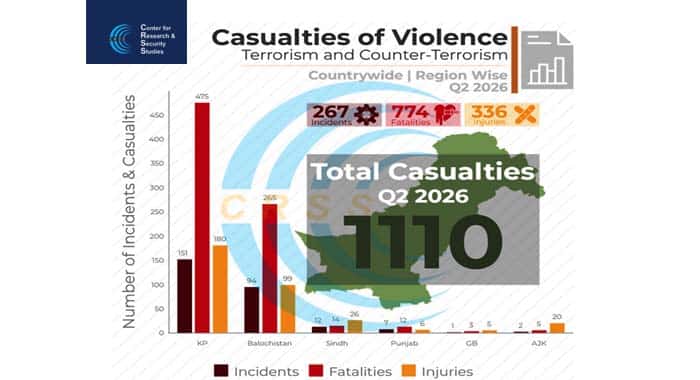
The latest Center for Research and Security Studies (CRSS) Security Report for the Second Quarter (Q2) of 2026 presents a comprehensive assessment of Pakistan’s security landscape, highlighting encouraging progress in the overall reduction of violence while underscoring the continued concentration of terrorist threats in specific regions of the country.
According to the report, Pakistan recorded 774 violence-linked fatalities and 336 injuries during the second quarter of 2026 across 267 incidents involving terrorist attacks and counter-terrorism operations. The casualties included civilians, security personnel, and outlaws engaged in acts of terrorism.
The report notes that the country witnessed an encouraging five percent quarter-on-quarter decline in overall violence, continuing the downward trajectory first observed during the opening quarter of 2026. Fatalities declined from 813 in Q1 to 774 in Q2, reflecting the sustained effectiveness of Pakistan’s national counter-terrorism strategy and the relentless efforts of security forces across multiple theatres.
One of the most significant developments highlighted in the report is the marked improvement in the security situation in Balochistan, where violence-linked fatalities declined by more than 40 percent, falling from 443 deaths during Q1 to 265 during Q2. Approximately 60 percent of all violent incidents in the province were concentrated in the districts of Quetta, Chagai, Washuk, Kech, and Gwadar, indicating that terrorist violence remains geographically concentrated despite the overall reduction.
Despite the national improvement, the report warns of a serious deterioration in the security environment of Khyber Pakhtunkhwa, which emerged as the country’s most affected province during the reporting period. Fatalities surged by approximately 53 percent, increasing from 311 during Q1 to 475 during Q2. Nearly 63 percent of all violent incidents in KP occurred within the districts of Bannu, Lakki Marwat, Kurram, and Bajaur, reflecting sustained terrorist activity in these areas.
Together, Khyber Pakhtunkhwa and Balochistan accounted for nearly 96 percent of all violence-related fatalities recorded nationwide, with KP responsible for more than 61 percent (475 fatalities) and Balochistan contributing 34 percent (265 fatalities). KP also recorded the highest number of violent incidents (151 incidents, representing 57 percent of the national total) followed by Balochistan with 94 incidents (35 percent).
The report further records that KP suffered the highest number of violence-related injuries (180), followed by 99 injuries in Balochistan, reaffirming that both provinces remain the principal focus of terrorist violence.
Elsewhere in the country, Sindh experienced a slight increase in fatalities from seven to fourteen, while Gilgit-Baltistan recorded an increase from one to three fatalities. Punjab demonstrated modest improvement, with fatalities decreasing from 14 to 12 during the reporting period. Azad Jammu and Kashmir (AJK) recorded five fatalities, compared with none during the previous quarter. Notably, the Islamabad Capital Territory (ICT) recorded zero incidents and zero fatalities, a substantial improvement compared to 37 fatalities recorded during Q1 2026.
The report also provides a detailed assessment of the impact of Pakistan’s counter-terrorism operations. Of the 774 fatalities, 453 were outlaws eliminated during approximately 80 security operations, while 187 civilians and 134 security personnel lost their lives in terrorist-related violence.
Although terrorist attacks significantly outnumbered security operations, with 188 attacks compared to 79 counter-terrorism operations, the report emphasizes the exceptional operational effectiveness of Pakistan’s security forces. Security operations accounted for the elimination of 453 outlaws, substantially exceeding the combined fatalities suffered by civilians and security personnel (321), demonstrating that intelligence-based operations continue to dismantle terrorist networks with decisive results.
The report further reveals that while terrorist attacks primarily sought to maximize civilian casualties and public disruption, security operations remained highly targeted and operationally effective. Terrorist attacks resulted in 322 injuries, compared to only 14 injuries associated with security operations, illustrating the indiscriminate nature of terrorist violence, particularly through attacks targeting populated civilian locations.
An encouraging development highlighted in the assessment is the 17.2 percent reduction in civilian fatalities compared to the previous quarter. Fatalities among security personnel remained unchanged, while the number of outlaws neutralized also remained consistent, indicating sustained operational pressure against terrorist organizations throughout the reporting period.
Nevertheless, the report cautions that civilians continue to remain highly vulnerable. With 187 civilian fatalities, non-combatants constituted the second-largest category of victims after outlaws, emphasizing the continuing threat posed by terrorist violence to ordinary citizens.
The report also examines responsibility claims issued by banned organizations. As of 25 June 2026, banned groups claimed responsibility for 22 fatal attacks, resulting in 76 fatalities and 29 injuries.
Among these, the Balochistan Liberation Army (BLA) claimed responsibility for eight attacks causing 41 fatalities and 20 injuries, while the Tehreek-e-Taliban Pakistan (TTP) claimed seven attacks resulting in 26 fatalities and four injuries. Collectively, these two organizations accounted for more than 65 percent of all claimed incidents and nearly 84 percent of all fatalities resulting from claimed attacks during the reporting period.
Additional attacks were claimed by Jamaat-ul-Ahrar (JuA), the Sindhudesh Republican Army (SRA), and the Balochistan Liberation Front (BLF), each responsible for one or two localized attacks that collectively caused seven fatalities and three injuries.
The report further documents evolving terrorist tactics and the continued adaptation of violent extremist groups. Of the 188 terrorist attacks recorded, shootings remained the most common method, accounting for 67 attacks that resulted in 88 fatalities. These were followed by 29 coordinated armed assaults causing 53 deaths.
Security analysts also noted the recovery of 36 bodies, highlighting the persistence of covert targeted killings.
Particularly concerning is the increase in suicide attacks. During the reporting period, six vehicle-borne suicide attacks caused 40 fatalities and 43 injuries, while security forces successfully foiled six additional suicide attack attempts before they could be executed. The report notes that suicide attack attempts doubled compared to Q1 2026, reflecting the continued determination of terrorist organizations to inflict mass casualties.
The deadliest incident occurred near Chaman Phatak on 25 May 2026, when a vehicle-borne explosive device struck a passenger shuttle, killing 15 people and injuring 20 others. The incident illustrates the increasing use of high-yield explosives against civilian targets.
The report also identifies the continued use of improvised explosive devices (IEDs), drones, grenades, rockets, and mortars, indicating that terrorist groups are employing increasingly sophisticated methods to challenge state security institutions and target civilian populations.
The findings reinforce the importance of maintaining sustained intelligence-led operations, enhanced inter-agency coordination, strengthened border security, and continued public cooperation in the collective fight against terrorism. Pakistan’s security forces remain fully committed to eliminating terrorist threats, protecting citizens, and ensuring lasting peace and stability across the country.



