
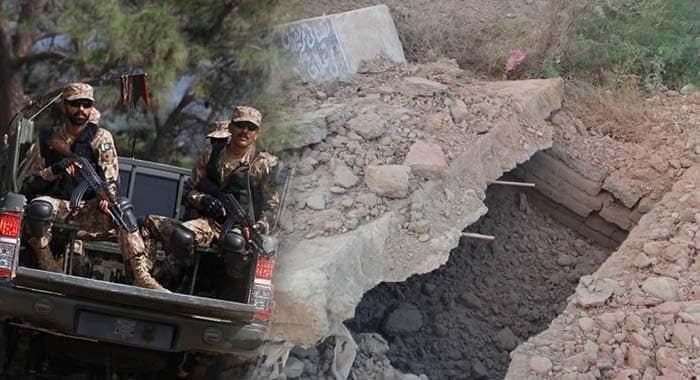
The destruction of a link bridge in Bannu’s Hani Khel Bachak area of Miryan once again highlights a disturbing pattern that has emerged in southern Khyber Pakhtunkhwa, where terrorist organizations have increasingly turned their attention toward civilian infrastructure to disrupt everyday life and create fear among local communities.
According to local reports, armed individuals planted explosives on a public bridge, destroying the structure and leaving residents facing severe difficulties in transportation. The attack did not target a security installation or a military position but a facility used by ordinary citizens for their daily movement.
Such incidents reflect a broader tactic adopted by terrorist organizations operating in the region. When unable to establish conventional control over territory, these groups attempt to weaken communities by damaging roads, bridges, schools, communication networks, and other essential facilities that connect people with markets, healthcare services, and educational institutions.
Bannu and surrounding districts have repeatedly witnessed similar attempts to disrupt public life. In recent months, the region has faced a series of security incidents, including attacks targeting security personnel, law enforcement officials, and civilian areas. Alongside direct attacks, terrorist groups have increasingly used sabotage as a tool to pressure local populations and challenge the state’s ability to provide basic services.
The targeting of infrastructure has been a recurring feature of terrorist activity in Khyber Pakhtunkhwa. Previously, terrorist elements have damaged educational institutions, communication towers, roads, and other public facilities, particularly in areas where they seek to create an atmosphere of insecurity. Schools have been among the most frequent targets, with attacks aimed at discouraging education and spreading fear among families.
Similar tactics have also been observed in other districts of southern KP, where terrorist organizations have attempted to exploit difficult terrain and local vulnerabilities. Attacks on infrastructure serve multiple purposes for these groups: they create immediate inconvenience for civilians, generate negative perceptions regarding security conditions, and provide propaganda opportunities by portraying disruption as influence.
However, such tactics also reveal the changing nature of the terrorist threat. Instead of openly confronting state institutions, terrorist networks increasingly attempt to impose costs on communities. By targeting facilities used by ordinary people, they seek to turn civilians into indirect victims of their campaign.
Security analysts have repeatedly noted that attacks on public infrastructure are part of a broader strategy of psychological warfare. The objective is not merely physical destruction but creating uncertainty and reducing public confidence. Terrorist groups understand that damaging a bridge or a school can affect hundreds or thousands of people, making such targets valuable from their perspective.
Pakistan’s counterterrorism response has increasingly focused on disrupting these networks through intelligence-based operations. Security forces and law enforcement agencies have conducted numerous operations across southern Khyber Pakhtunkhwa to identify terrorist cells, eliminate commanders, and prevent attacks before execution.
The challenge, however, extends beyond security operations. Rebuilding damaged infrastructure, restoring public services, and maintaining community confidence are equally important components of defeating terrorist strategies. Communities affected by terrorism require not only protection but also continued development and state support.
The repeated targeting of civilian facilities demonstrates that terrorism affects societies far beyond the immediate victims of an attack. A destroyed bridge represents disrupted livelihoods, delayed access to services, and increased hardship for ordinary citizens who have already suffered years of insecurity.
For terrorist organizations, such attacks are intended to demonstrate presence and influence. But for affected communities, they represent another reminder of the importance of defeating extremist networks that seek to prevent normal life from returning.
The destruction of the public bridge in Bannu is therefore not merely an act of sabotage against a physical structure. It is part of a wider pattern in which terrorist groups attempt to attack connectivity, development, and public confidence. Countering this strategy requires both effective security measures and continued efforts to protect and strengthen the communities that remain on the frontline of the fight against terrorism.



