
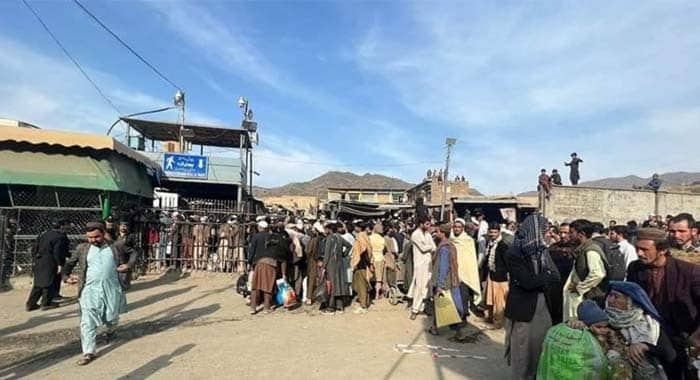
Following the expiry of the Federal Government’s final deadline of 10 July for illegally residing foreign nationals to voluntarily leave Pakistan, authorities in Khyber Pakhtunkhwa have intensified enforcement operations across the province as part of the government’s nationwide policy to ensure compliance with Pakistan’s immigration and residency laws.
In the first phase of the post-deadline enforcement campaign, 157 Afghan nationals residing illegally in Pakistan were deported after being taken into custody during coordinated operations carried out by the Police, District Administration, and other relevant law enforcement agencies.
The joint operations commenced immediately after the deadline expired, with authorities conducting inspections in markets, commercial areas, residential neighborhoods, and rented accommodations throughout Peshawar, while similar enforcement activities continue across other districts of the province.
According to police officials, the Government has adopted a revised operational strategy aimed at streamlining the repatriation process. Under the new procedure, illegally residing Afghan nationals are no longer subjected to routine criminal proceedings, such as registration of First Information Reports (FIRs) and court appearances. Instead, individuals found to be residing unlawfully are transferred directly to designated Deportation Centres, where their identities and legal status are verified through the National Database and Registration Authority (NADRA) and other relevant agencies.
Following the completion of the verification process and examination of their documentation, eligible individuals are transported to the Torkham Border Crossing for repatriation to Afghanistan in accordance with applicable laws and government directives.
Officials confirmed that the 157 Afghan nationals deported during the latest operation were found to be residing in Pakistan without valid legal documentation authorizing their stay.
To facilitate the orderly implementation of the repatriation policy, Deportation Centres in Peshawar and District Khyber have been fully activated. These facilities serve as processing centers where individuals undergo identity verification, documentation review, and other legal formalities before being transferred to Torkham for their return.
Law enforcement authorities emphasized that the repatriation process is being conducted in an organized, transparent, and systematic manner. Security personnel continue to inspect residential areas, commercial establishments, rented properties, and other locations where illegally residing foreign nationals may be present. Officials stated that comprehensive preparations had already been completed before the enforcement phase commenced, including the compilation of district-wise records of individuals residing illegally. Prior to the deadline, authorities also conducted awareness campaigns and door-to-door visits to inform affected individuals of the Government’s decision and encourage voluntary compliance.
The provincial government has issued strict instructions to ensure that enforcement operations are carried out professionally and in accordance with the law. Police officials have been directed to maintain respectful conduct throughout the process and to strictly refrain from any form of misconduct, harassment, or corruption.
Authorities warned that any police officer or public official found engaging in bribery, abuse of authority, or inappropriate treatment of individuals during the operations will face strict disciplinary and legal action. Oversight mechanisms have been strengthened to ensure transparency, accountability, and adherence to professional standards.
The Government has also arranged dedicated transportation to facilitate the transfer of detained individuals from processing facilities to the Torkham border, ensuring that the repatriation process proceeds efficiently and in an orderly manner.
Pakistan launched the Illegal Foreigners Repatriation Programme (IFRP) in October 2023 with the objective of ensuring that all foreign nationals residing within the country possess valid legal documentation. The initial phase focused on individuals residing illegally, while subsequent phases extended to holders of the Afghan Citizen Card (ACC), who were also directed to leave the country under the Government’s phased repatriation policy.
The Federal Government has consistently maintained that only foreign nationals possessing valid travel documents, visas, or lawful residence permits are authorized to remain in Pakistan. Enforcement actions against individuals residing illegally are being undertaken in accordance with Pakistan’s immigration laws and established legal procedures.
According to official government statistics, 988,812 Afghan nationals have returned to Afghanistan since April 2025. This figure includes 686,772 illegally residing Afghan nationals, 71,570 holders of Afghan Citizen Cards (ACC), and 230,470 holders of Proof of Registration (PoR) cards.
Data published by the United Nations High Commissioner for Refugees (UNHCR) and the International Organization for Migration (IOM) indicate that more than 2.39 million Afghan nationals returned from Pakistan to Afghanistan between September 2023 and May 2026, with the majority reported to have returned voluntarily.
According to UNHCR, approximately 932,000 registered Afghan refugees holding valid Proof of Registration (PoR) cards remain in Pakistan. The combined population of registered and unregistered Afghan nationals currently residing in the country is estimated at around two million, with the largest concentration residing in Khyber Pakhtunkhwa.
The Government of Pakistan reiterates that the ongoing repatriation process is being implemented under the framework of national law, with due regard for administrative procedures, public order, and border management. Authorities remain committed to conducting the process in an organized, transparent, and humane manner while safeguarding Pakistan’s national security and ensuring compliance with immigration regulations.



