
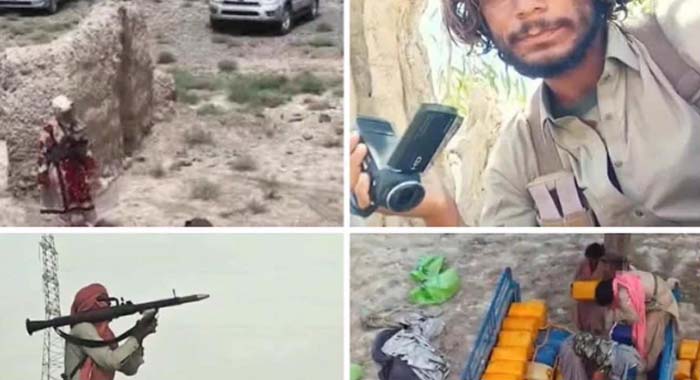
The persistent attempt by certain individuals and online propaganda networks to portray the banned Baloch Liberation Army (BLA) as a movement driven solely by deprivation, marginalization, or the struggle for basic rights demands serious scrutiny. Such narratives overlook critical questions that deserve objective consideration.
A review of the organization’s own publicly released high-definition (HD) propaganda videos raises significant concerns about the true nature of its operational capabilities. These productions depict an organization equipped with sophisticated military hardware, advanced communications technology, and well-organized logistical infrastructure—capabilities that are difficult to reconcile with the image of an impoverished grassroots movement.
Several important questions arise:
- How does the organization obtain modern assault rifles, rocket launchers, and other advanced weaponry?
- Who provides access to night-vision equipment, surveillance technology, and sophisticated drones?
- How are satellite communication systems and high-value vehicles financed?
- What financial resources sustain professionally produced documentary-style propaganda videos and a continuously active media wing?
- Who maintains the logistics and supply chains capable of transporting large quantities of explosives and military equipment?
- How are recruitment, training, intelligence gathering, and operational planning coordinated over extended periods?
These are not the characteristics typically associated with a movement struggling under economic deprivation. Rather, they are indicators commonly associated with organized terrorist networks possessing substantial external support, structured financing, advanced training, secure sanctuaries, and sustained logistical assistance.
There are longstanding allegations that the BLA benefits from external sponsorship and support beyond Pakistan’s borders. According to these allegations, India serves as the principal sponsor, while Afghan territory has historically been used as a training and operational sanctuary. The difficult mountainous terrain and the long, porous border have allegedly provided escape routes and safe havens following attacks inside Pakistan. These claims have featured prominently in Pakistan’s official security narrative and continue to shape the country’s counterterrorism assessments.
The continued availability of sophisticated weapons, advanced communications equipment, intelligence support, and propaganda infrastructure raises important questions regarding the existence of transnational networks facilitating the organization’s activities. Such capabilities require sustained financial investment and organizational coordination that extend well beyond what would ordinarily be expected of a locally deprived insurgent group.
It is equally important to distinguish between the legitimate socio-economic concerns of the people of Balochistan and the violent activities of a banned terrorist organization. The aspirations of ordinary citizens for development, education, employment, healthcare, infrastructure, and political participation should never be conflated with acts of terrorism targeting civilians, security personnel, and public infrastructure.
The people of Balochistan deserve peace, stability, economic opportunity, and inclusive development. Violence, intimidation, sabotage of infrastructure, and attacks on public institutions only deepen hardship and delay progress for the very communities whose welfare is often invoked in extremist propaganda.
Peace and development are mutually reinforcing. Every attack on roads, schools, hospitals, communication networks, energy infrastructure, or public institutions undermines investment, discourages economic growth, and deprives local communities of opportunities for prosperity. Terrorism does not resolve grievances it exacerbates them.
The international community has consistently recognized that terrorism cannot be justified through political rhetoric or narratives of victimhood. Where legitimate grievances exist, they should be addressed through constitutional, democratic, and peaceful means rather than through violence and extremism.
It is therefore imperative for media organizations, analysts, civil society, and social media users to critically evaluate propaganda before amplifying narratives that may inadvertently legitimize or romanticize a proscribed terrorist organization. Responsible public discourse requires distinguishing between genuine advocacy for human rights and deliberate disinformation designed to obscure acts of terrorism.
The central question remains straightforward:
Does an organization operating with sophisticated weapons, advanced surveillance equipment, satellite communications, organized logistics, professionally managed propaganda platforms, secure cross-border sanctuaries, and sustained financial resources resemble a marginalized grassroots movement or a structured terrorist network with external backing?
The people of Balochistan deserve lasting peace not perpetual conflict. They deserve development not destruction. They deserve opportunity not fear. Sustainable progress can only be achieved through stability, the rule of law, and constructive engagement, not through violence that continues to inflict suffering on innocent communities.



