
The security environment in South Asia has once again drawn international attention following a series of developments involving terrorism, cross-border militant networks, organized crime, narcotics trafficking, extortion, and overseas targeted violence.
Recent terrorist attacks in different parts of Pakistan, including Balochistan and Karachi, have prompted Pakistani authorities to present what they describe as evidence of external support for militant organizations. At the same time, law enforcement actions in the United States against international criminal networks have brought renewed focus on the activities of Indian-origin criminal groups allegedly involved in organized crime, drug trafficking, extortion, and targeted killings abroad.
While these developments represent separate security matters, they have raised a broader international question regarding whether interconnected networks of terrorism and organized crime operating across borders are becoming a major challenge for regional and global security.
Following recent terrorist attacks in Pakistan, Director General Inter-Services Public Relations (DG ISPR) Lieutenant General Ahmed Sharif Chaudhry stated during a media briefing that elements associated with what Pakistani authorities refer to as “Fitna al-Hindustan” were involved in recent terrorist activities in Balochistan.
According to the DG ISPR, these terrorist groups targeted innocent civilians as well as security personnel, adding that the state would continue taking decisive action against such elements without discrimination.
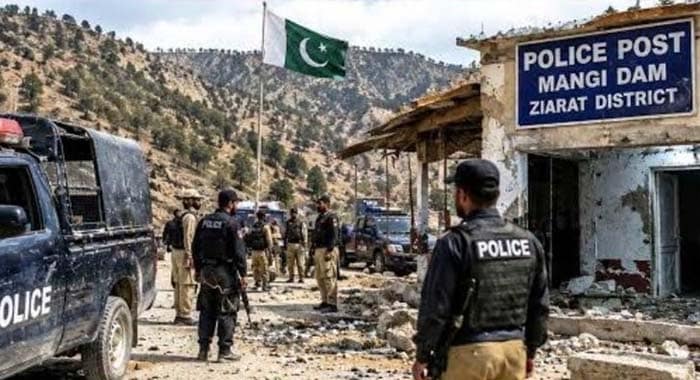
He stated that terrorist incidents were reported in areas including Mangi Dam and the Quetta Pumping Station region, while security forces conducted effective operations against militants in Ziarat.
During the briefing, the DG ISPR stated that at least 15 terrorists were killed during operations in Ziarat. He further revealed that two separate operations conducted recently resulted in the killing of 14 additional terrorists. According to official figures presented during the media briefing, a total of 54 terrorists were eliminated during security operations conducted over the past few days.
Lieutenant General Ahmed Sharif Chaudhry also highlighted the sacrifices made by law enforcement personnel during counterterrorism operations. He stated that 18 police officials embraced martyrdom, while a total of 42 security personnel lost their lives while defending the country during the three major terrorist attacks.
During the briefing, Pakistani security officials stated that terrorism in Balochistan has links with external actors and alleged that India is supporting militant groups involved in attacks against Pakistan. Officials further stated that Afghan territory is being used for anti-Pakistan activities and alleged that certain militant organizations receive support from elements operating from Afghanistan.
According to Pakistan’s security authorities, these groups are attempting to intensify their activities in Balochistan with objectives extending beyond attacks on security forces. Officials stated that terrorist networks are also targeting Pakistan’s economic and strategic development initiatives, including the China-Pakistan Economic Corridor (CPEC), mineral exploration projects, infrastructure development, and efforts aimed at promoting economic growth in Balochistan.
Authorities described the recent attacks as part of a planned external strategy rather than isolated incidents of internal unrest, alleging that hostile networks are attempting to disrupt peace, stability, and development in the province. Meanwhile, investigations and enforcement actions by US authorities have brought renewed attention to international criminal networks allegedly connected with Indian-origin organized crime groups.
According to US prosecutors, details regarding alleged criminal activities involving Indian-linked networks emerged during proceedings related to the murder case of Hardeep Singh Nijjar. US authorities stated that under Operation Hardball, law enforcement agencies launched a major operation against an international organized crime network, resulting in multiple arrests and investigations.
According to reports from US authorities, agencies in the United States, Canada, and Europe arrested 24 individuals linked to three alleged international criminal groups. Officials stated that 11 arrests were carried out in California, involving suspects connected to investigations in the United States, Canada, and Spain. They further stated that 10 suspects remain at large.
US authorities also stated that legal proceedings were initiated against 37 individuals on allegations involving extortion, weapons offenses, narcotics trafficking, and murder-related activities. Court documents reportedly referred to Indian-origin criminal figures, including Lawrence Bishnoi and Goldy Brar, in connection with investigations into organized criminal networks and alleged links to the killing of Sikh leader Hardeep Singh Nijjar in Canada.
US officials have emphasized that targeted killings conducted on foreign soil, attacks against migrant communities, harassment of individuals abroad, and the use of criminal proxies represent serious threats to international sovereignty and the rule of law. Authorities have expressed concern that criminal command structures allegedly operating from within prisons in India could pose challenges to security beyond national borders.
The developments have highlighted a wider international concern: modern criminal networks increasingly rely on advanced communication technologies, international financial systems, fake identities, informal financial mechanisms such as hawala networks, cryptocurrency transactions, and cross-border connections to conduct operations in multiple countries simultaneously.
The evolving security environment has demonstrated that terrorism, organized crime, narcotics trafficking, extortion, targeted killings, and overseas criminal operations are no longer limited to individual countries but are becoming increasingly interconnected global security challenges. Security experts note that certain groups that may initially appear to be local criminal gangs can possess sophisticated structures extending across continents. When such networks are allegedly used for political, strategic, or geopolitical purposes, they create challenges not only for law enforcement agencies but also for national security institutions.
Recent developments have shown that criminal organizations can exploit international borders, financial systems, digital platforms, and informal networks to expand their influence and operations. The United States, Canada, and other Western countries have increased cooperation against international organized crime, overseas assassination plots, and narcotics trafficking networks in response to these growing challenges.
The latest developments demonstrate that combating cross-border terrorism and organized crime requires stronger international cooperation, intelligence sharing, and coordinated legal action. Experts emphasize that effective responses against such networks require transparent investigations, international judicial cooperation, improved coordination among security agencies, and consistent implementation of the rule of law.
The changing nature of global security threats shows that terrorism, organized crime, and politically motivated violence are no longer confined within national boundaries but operate through complex international networks.
Recent developments in South Asia and Western countries have once again highlighted the increasingly interconnected nature of modern security challenges. Pakistan maintains that it will continue strengthening its counterterrorism measures, protecting national security, and taking action against threats to its citizens and development projects. At the same time, international law enforcement agencies are expanding cooperation to address transnational criminal networks, overseas violence, and illicit activities that threaten global stability.
The situation underscores the need for a unified international approach based on cooperation, effective law enforcement, judicial coordination, and respect for national sovereignty to confront emerging security challenges in an increasingly interconnected world.



