
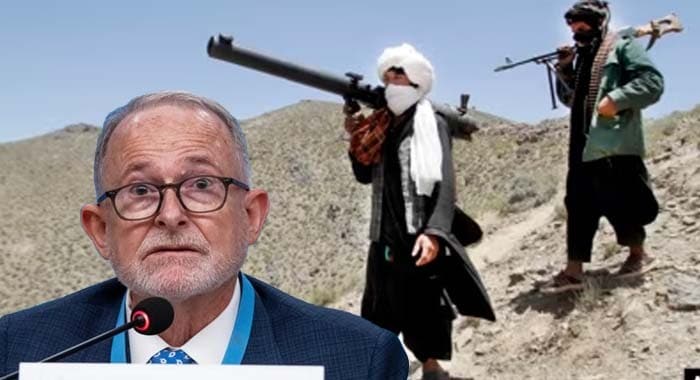
Serious questions have emerged regarding the recent statements and approach of the United Nations Special Rapporteur on the situation of human rights in Afghanistan, Richard Bennett, whose remarks are being viewed by observers as aligning with and amplifying narratives propagated by the Afghan Taliban regime.
According to reports, Pakistan’s recent counter-terrorism actions against terrorist hideouts operating from Afghan territory drew a response from the UN Special Rapporteur. However, his reaction has been criticized for allegedly reinforcing claims consistent with Taliban propaganda, particularly regarding unverified allegations of civilian casualties.
It is further noted that following restrictions imposed by the Taliban authorities on his entry into Afghanistan, Richard Bennett appears to be attempting to maintain his relevance by relying on information disseminated through Taliban-controlled or influenced sources. These sources have repeatedly circulated unverified claims, including allegations of civilian harm, which are being presented without independent verification.
Observers have also raised concerns over his continued silence regarding persistent cross-border terrorism emanating from Afghan soil into Pakistan. Numerous terrorist attacks claimed by groups such as Jamaat-ul-Ahrar and other affiliated networks, operating from Afghan territory, have not received comparable attention in his public statements, raising questions about selective engagement with the issue.
Pakistan maintains that credible evidence, including findings from multiple United Nations monitoring mechanisms, has consistently highlighted the presence and operational freedom of terrorist groups within Afghanistan. In particular, reports by the United Nations Security Council’s Analytical Support and Sanctions Monitoring Team have repeatedly confirmed that groups such as Jamaat-ul-Ahrar, Fitna al Hindustan, and other affiliated organizations continue to operate with relative freedom under the prevailing conditions in Afghanistan.
These groups have been identified as posing a serious threat to regional peace and security, with documented involvement in cross-border terrorist activities targeting Pakistan and other neighboring states. Despite this, critics argue that such verified institutional assessments have not been adequately reflected in the recent public discourse of the Special Rapporteur.
Concerns have further been raised regarding the selective reliance on unverified claims while overlooking established United Nations documentation that highlights the use of Afghan territory by terrorist organizations, including the exploitation of civilian areas for militant operations and the deliberate blurring of lines between civilian and combatant spaces.
Officials and observers argue that such selective interpretation risks undermining the credibility of independent human rights reporting mechanisms and may inadvertently align with narratives promoted by terrorist networks and their sympathizers.
Pakistan reiterates that Afghanistan continues to face a serious terrorism challenge, with its territory being exploited by multiple extremist organizations. This reality, documented by credible international monitoring bodies, underscores the need for balanced, fact-based, and comprehensive assessments that take into account all dimensions of the security and human rights situation.
It is emphasized that any responsible international engagement on Afghanistan must consider verified institutional evidence, including reports of cross-border terrorism, safe havens for militant groups, and the use of civilian populations as shields in conflict zones.
Pakistan remains committed to the protection of human rights, regional peace, and the elimination of terrorism in all its forms and manifestations. It urges all international stakeholders to adopt an objective and evidence-based approach that supports peace, accountability, and stability in the region.



