
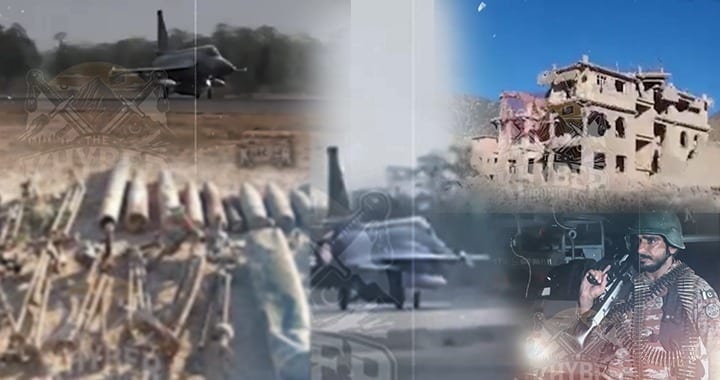
The foiled terrorist assault on the Pakistan Rangers camp was never going to remain an isolated incident. The attackers failed to achieve their objective, but they succeeded in triggering something they should have anticipated long ago, a decisive Pakistani response.
Under Operation Ghazb Lil Haq, Pakistan carried out precision retaliatory strikes against terrorist hideouts across the border in Afghanistan’s Paktia, Paktika and Kunar provinces, targeting infrastructure that Pakistani authorities say was being used by the banned Tehreek-e-Taliban Pakistan (TTP) and Jamaat-ul-Ahrar. According to official Pakistani accounts, more than 29 terrorists were eliminated and multiple terrorist facilities, including weapons and ammunition depots, were destroyed. Pakistani officials have also stated that one of Noor Wali Mehsud’s close associates was among those killed.
There is one fact that deserves greater attention than the strikes themselves.
Pakistan did not launch these operations out of expansionist ambitions, territorial designs or political adventurism. The operation followed repeated terrorist attacks on Pakistani civilians and security forces, culminating in the assault on the Rangers facility. Islamabad has consistently maintained that these strikes were retaliatory and directed against terrorist infrastructure allegedly operating from across the border. The Afghan Taliban reject those allegations and accuse Pakistan of causing civilian casualties, illustrating the sharply contested narratives surrounding the operation.
This distinction matters.
For years, Pakistan exercised considerable restraint despite mounting evidence presented by its officials that terrorist groups had established sanctuaries across the border. Diplomatic engagement, intelligence sharing and repeated warnings preceded kinetic action. The message remained unchanged: prevent your territory from being used against Pakistan.
When those warnings failed to produce meaningful results and terrorist attacks continued, Pakistan adjusted its response.
Operation Ghazb Lil Haq reflects that shift.
The doctrine is increasingly straightforward. Pakistan will not initiate conflict for its own sake, but neither will it absorb terrorist attacks indefinitely. Every cross-border act of terrorism now carries the risk of immediate and proportionate retaliation against the infrastructure from which such attacks are allegedly planned or supported.
That message is directed first and foremost at terrorist organizations.
Groups such as the TTP and Jamaat-ul-Ahrar must now calculate not only whether they can launch an attack, but whether the cost of doing so will be the destruction of their training camps, command centers, logistics networks and leadership.
It is equally a message to those who knowingly or unknowingly provide them space to operate.
Whether through active patronage, passive tolerance or deliberate inaction, allowing terrorist groups to maintain safe havens inevitably carries consequences. Modern counterterrorism no longer ends at the point of attack. It follows the planners, facilitators and operational bases that make those attacks possible.
The signal also extends beyond Afghanistan.
Every regional actor contemplating the use of proxy terrorism against Pakistan should now recognize that the strategic environment has changed. Whether the sponsor is direct or indirect, visible or concealed, Pakistan appears increasingly prepared to respond wherever it believes the operational infrastructure exists.
For Pakistan’s security establishment, deterrence is no longer built solely on defensive deployments inside its own borders. It is increasingly being reinforced through the demonstrated willingness to strike terrorist infrastructure after attacks occur.
The failed Rangers camp assault has therefore produced exactly the opposite outcome its planners likely intended.
Instead of intimidating Pakistan, it reinforced the state’s resolve.
Instead of weakening deterrence, it strengthened it.
Instead of forcing Pakistan onto the defensive, it invited a response that reached beyond the border.
For terrorists, their facilitators and anyone contemplating proxy warfare against Pakistan, the lesson is becoming increasingly unmistakable.
Pakistan may not fire the first shot.
But if attacked, it intends to ensure that the final and more consequential response belongs to it.



