
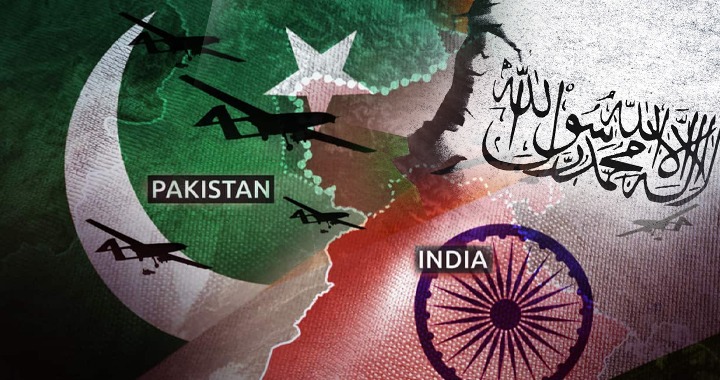
As Pakistan continues to face an unprecedented wave of cross-border terrorism emanating from Afghan soil, a compelling legal and strategic argument has emerged that firmly distinguishes Pakistan’s right to conduct air strikes inside Afghanistan from India’s controversial military strikes on Pakistani territory last year and the distinction, experts argue, could not be more clear-cut under international law.
Pakistan recorded 80 terrorist attacks in February, 146 in March, and 85 in April alone averaging three devastating attacks every single day. These are not statistics. These are funerals. These are families torn apart. These are communities living under the shadow of violence that a neighbouring government is either unable or, as Pakistan’s defence minister has argued, deliberately unwilling to stop.
Under the customary practice of self-defence as formulated under the United Nations Charter, a state that faces persistent, organized, and imminent terrorist attacks originating from the territory of another state particularly when that state demonstrably fails to prevent them retains the legitimate right to use proportionate force to degrade and destroy the threat.
Pakistan’s case meets every single criterion this legal standard demands.
The attacks are not sporadic or isolated. They are sustained, brutal, and escalating concentrated particularly across Balochistan and Khyber Pakhtunkhwa. Pakistan’s selection of targets has been explicitly confined to military objects: ammunition depots, weapons storage facilities, terrorist training camps, and sanctuaries located in Kabul, Kandahar, Paktia, and Paktika. Intelligence gathered through ground networks and satellite imagery guides each strike. The objective is not to attack Afghanistan as a sovereign state Kabul itself has repeatedly stated it has not authorized any group to conduct terrorist strikes inside Pakistan but to neutralize the very groups that Kabul has utterly and completely failed to control.
This is the crux of the matter. The Afghan government under the Islamic Emirate exercises no meaningful executive, police, or military control over these terrorist organizations. Whether this represents an inability or a deliberate unwillingness and Pakistan’s defence minister has been unambiguous in asserting it is the latter, citing an alleged covert Afghan-Indian arrangement that allows India to conduct proxy operations against Pakistan through these groups the legal outcome is the same: Pakistan is left with no viable diplomatic alternative. Force becomes not a choice but a necessity.
Here the comparison must be made with absolute clarity, because conflating the two situations would be both legally incorrect and dangerously misleading.
India’s strikes on Bahawalpur and Muridke last year carried out under the banner of Operation Sindoor in alleged retaliation for the Pahalgam attack fail to meet even the most basic threshold required to invoke the right of unilateral self-defence under international law.
First, there was no imminent attack originating from these locations against India. The individuals India claimed to be targeting were not active operational commanders directing cross-border strikes. They were individuals already enmeshed in Pakistan’s own legal and judicial processes facing actions under Pakistan’s terrorism laws and FATF compliance frameworks, filing appeals in Pakistani courts for the de-sealing of properties and bank accounts, and petitioning the United Nations ombudsman for removal from international proscription lists.
Second, and most critically, India never established attribution. More than a year after the Pahalgam attack, India has produced no credible, internationally accepted proof linking it directly to Pakistan or any state-sanctioned Pakistani entity. Under international law, the burden of proof for attribution is not a courtesy it is a legal prerequisite for the use of force. Without it, military action is not self-defence. It is aggression.
The correct course of action available to India was clear and well-established: invoke the Indian Criminal Procedure Code in conjunction with Section 19 of Pakistan’s Mutual Legal Assistance Act, 2020, and formally request a joint investigation. This is the law-enforcement route the lawfare route that responsible states pursue when they have genuine grievances and genuine evidence. India rejected this path and chose instead a military response that was not only legally unjustified but, by all accounts, deeply counterproductive, inflicting significant embarrassment upon itself in the eyes of the international community
The distinction between Pakistan’s position vis-à-vis India and its position vis-à-vis Afghanistan rests on one of the most significant recent developments at the intersection of international law and state practice: the “unable or unwilling” standard.
This standard holds that when a host state is unable or unwilling to prevent non-state actors from using its territory to launch attacks against another state, the targeted state acquires the right to act in self-defence, even across international borders.
Pakistan unambiguously meets the “able and willing” test with respect to terrorism on its own soil directed toward India. Pakistan possesses a robust law-enforcement mechanism, a functioning investigation apparatus, comprehensive prosecution frameworks, effective policing, and sophisticated intelligence capabilities that far exceed those of the Afghan government. Pakistan exercises full executive control over all its territories. Its FATF reviews conducted by the most rigorous international counterterrorism assessment body in existence have repeatedly and explicitly endorsed Pakistan’s counterterrorism actions as both effective and result-oriented.
These favourable assessments have come at a cost. Pakistan has had to navigate complex political terrain, including reassessing long-standing positions on issues such as the right of the Kashmiri people to self-determination under international law. Yet no global counterterrorism forum not in the eighteen years since the 2008 Mumbai attacks has been able to identify any specific, overt, or covert Pakistani state support for non-state actors conducting terrorism inside mainland India. This represents an extraordinary record, sustained by the collective political commitment of Pakistan’s entire leadership spectrum, backed by its armed forces and intelligence agencies.
Afghanistan, by stark contrast, fails this test entirely. The Islamic Emirate neither controls nor meaningfully constrains the terrorist organizations operating from its soil. This failure whether rooted in incapacity or, as Pakistan alleges, deliberate policy strips Afghanistan of the legal protection that sovereignty would otherwise afford and activates Pakistan’s right to act in self-defence.
Critics may attempt to argue that Pakistan cannot simultaneously protest India’s strikes while conducting its own across an international border. This argument collapses upon even minimal legal scrutiny.
Pakistan’s strikes inside Afghanistan are legally justified because Afghanistan is both unable and unwilling to stop terrorist attacks on Pakistan emanating from its territory. India’s strikes on Pakistan were not legally justified because Pakistan is demonstrably able and willing to address terrorism within its borders and because India failed to meet the foundational requirement of establishing attribution before resorting to force.
These are not contradictory positions. They are two entirely distinct legal situations, governed by the same body of international law, arriving at two entirely different conclusions.
While Pakistan’s use of force in self-defence is legally sound and strategically necessary under present circumstances, it must be emphasized that force alone cannot deliver lasting peace. The long-term solution to the terrorism crisis gripping this region must be diplomatic, political, and economic pursued with patience, consistency, and the genuine participation of all regional stakeholders.
No responsible government advocates for the indefinite use of military force. But no responsible government can afford to absorb three terrorist attacks per day indefinitely while waiting for a diplomatic solution that the other side shows no interest in facilitating.
Pakistan has chosen self-defence. International law supports that choice. And the burden now falls on the international community to hold all parties including the Afghan government accountable to the standards that global peace and security demand.



