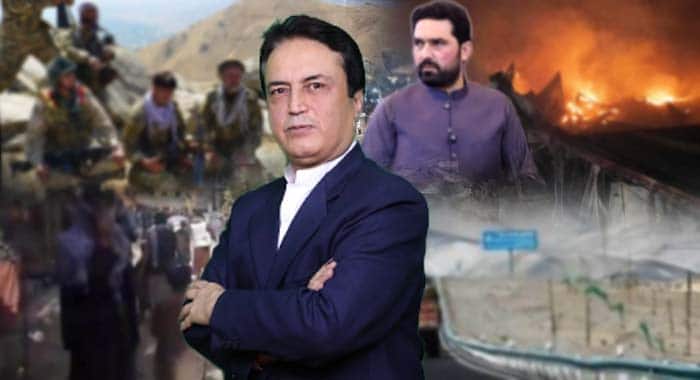
The struggle against the Taliban in Afghanistan is no longer confined to a single district or a single resistance group. According to senior journalist Arif Yousafzai, developments in Badakhshan and other northern areas indicate that resistance activity is spreading, although he does not believe the emerging groups currently possess the capacity to overthrow the Taliban regime.
Speaking about the latest clashes in Badakhshan, Yousafzai said the developments should be viewed in the broader context of Afghanistan’s political and military history. Since the Taliban returned to power on August 15, 2021, Afghanistan has experienced relative stability under Taliban control, but that stability is now being challenged by different forms of resistance emerging in several parts of the country.
He stressed that the resistance is not restricted to Zebak or Badakhshan. Activity has appeared in different northern areas, while statements from resistance figures have added a more confrontational dimension to the situation. Sami Sadat, he noted, has openly challenged the Afghan Taliban and warned that resistance fighters could eventually target the Taliban leadership.
Yet Yousafzai does not believe these groups can presently dismantle the Taliban government.
The Taliban, he argued, have spent four decades fighting and have established their writ across Afghanistan. They defeated the forces of the former Afghan government and ultimately forced the United States and its allies to withdraw. The groups now opposing the Taliban largely consist of figures who were themselves part of Afghanistan’s political and military establishment for decades.
Many of these leaders previously commanded their own militias and possessed considerable weapons and manpower. Yet when the Taliban advanced in 2021, those forces failed to mount an effective military challenge and many of their leaders left the country.
For that reason, Yousafzai does not expect the current resistance to put the Taliban on the verge of collapse. But he believes something important has changed: the Taliban’s period of relative calm may be ending.
Wakhan Could Become the Next Strategic Flashpoint
The more significant concern, in his view, may not be whether the resistance can defeat the Taliban outright, but where it chooses to strike next.
Yousafzai pointed specifically to the Wakhan Corridor, where China has developed growing strategic and economic interests. The corridor is among the world’s most difficult terrains, with extremely limited periods during which major infrastructure activity can take place. Yet roads and other infrastructure are being developed there, increasing its strategic significance.
He believes the Taliban’s opponents could eventually attempt to target the Wakhan Corridor, particularly because the Taliban are increasingly dependent on security in an area that is becoming important to China’s regional ambitions.
This, he suggested, could transform the northern resistance from a largely political and territorial challenge into a threat to a major emerging economic corridor.
The question, therefore, is no longer simply whether resistance exists in Afghanistan. It is whether that resistance can reach locations that matter strategically to the Taliban and their external partners.
China Wants the Regional Pieces on the Same Board
On China’s efforts to bring Pakistan and Afghanistan closer, Yousafzai sees a fundamentally economic calculation.
In his assessment, China wants regional connectivity to move beyond Pakistan and eventually link Afghanistan and Central Asia with the wider Belt and Road network. CPEC, therefore, should not be viewed in isolation. Beijing’s broader objective is to create an interconnected economic corridor extending from Pakistan through Afghanistan and onward toward Central Asia and Europe.
But continuing tensions between Pakistan and Afghanistan make that vision considerably more difficult.
Yousafzai argues that China wants both countries to resolve their disputes because instability would obstruct its economic ambitions. Pakistan, therefore, should not view Chinese engagement negatively. Rather, Islamabad should understand that China’s regional ambitions can also create opportunities for Pakistan.
At the same time, he believes China’s expanding role inevitably intersects with American strategic interests.
Washington does not want China to expand its economic influence through Pakistan and Afghanistan without resistance. Yousafzai therefore sees the possibility of increased American pressure, including attempts to engage former Afghan power brokers and resistance figures.
In this wider competition, Afghanistan becomes more than a bilateral Pakistan-Afghanistan issue. It becomes part of a larger contest over regional connectivity, economic influence and strategic access.
KP’s Security Crisis Is Moving Beyond the Mountains
Turning to Khyber Pakhtunkhwa, Yousafzai argued that the province is experiencing a serious deterioration in its security environment.
He pointed to the intensified intelligence-based operations being conducted in KP and Balochistan, saying that around 80 terrorists had reportedly been eliminated in KP during the preceding week, with significant operations also reported in Lakki Marwat, Dir and Swat.
But for him, the more worrying development is the changing nature of the terrorist threat.
The threat, he argued, is no longer confined to remote mountainous areas. Terrorist groups are increasingly attempting to operate in urban centers and target police and security installations.
The attack on a police compound in Hangu was cited as an example of this changing pattern, with police personnel killed, others injured and some reportedly taken hostage before being released.
Yousafzai also referred to videos attributed to TTP leadership figures, including Noor Wali Mehsud and Abu Asim Mansoor, showing movement through mountainous areas and meetings with their supporters.
For him, these developments point toward a rural-urban warfare model, in which terrorist networks maintain bases in difficult mountainous terrain while simultaneously seeking to project their presence into towns and cities.
That creates a much more complicated security challenge for KP.
The Question for the KP Government
Yousafzai was particularly critical of the provincial government’s handling of the security situation.
He argued that political activity is a legitimate democratic right, but that the seriousness of the security environment demands that peace and public safety remain a central governmental priority.
With attacks continuing and police and security personnel being targeted, he questioned whether the provincial government has a coherent strategy for dealing with the threat.
The central question, in his view, is straightforward: where does the KP government stand when it comes to peace and security?
He argued that as chief executive of the province, the chief minister bears primary responsibility for law and order. Criticism, therefore, is unavoidable when the government fails to meet public expectations, just as success would deserve recognition.
The broader regional picture makes that responsibility even more important.
Afghanistan is entering a period in which northern resistance groups are becoming more vocal, China is seeking greater economic connectivity, and the United States is watching China’s regional expansion closely. At the same time, Pakistan continues to confront terrorism spilling from Afghanistan and an increasingly sophisticated threat inside KP.
For Pakistan, the challenge is consequently twofold: it must protect its own security while positioning itself intelligently within the emerging regional economic and geopolitical competition.
China’s push for connectivity may offer Pakistan an opportunity. But that opportunity depends on stability, and stability cannot be separated from the security situation on either side of the Durand Line.
For KP in particular, the message is even more immediate. If terrorist networks are moving from remote sanctuaries toward urban centers, the province cannot afford a security strategy that remains reactive.
The battlefield is changing. The question is whether the political and security architecture can change with it.