
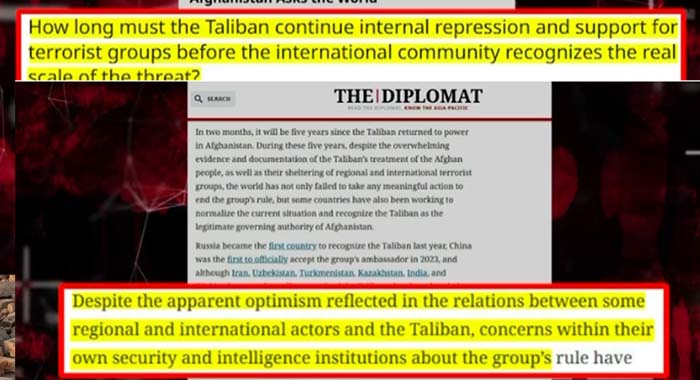
A recent report published by the international journal The Diplomat has raised serious concerns over the presence and consolidation of terrorist groups operating from Afghanistan, warning that the evolving security landscape poses a significant threat not only to neighboring countries but to regional and global stability.
According to the report, Afghanistan has increasingly become a convergence point for various regional and international terrorist organizations, enabling greater coordination and operational connectivity among extremist networks. The publication highlights that this growing nexus of militant groups presents a heightened security risk that extends far beyond Afghanistan’s borders.
The report questions the international community’s response, asking how much further escalation of terrorism is required before the severity of the threat is fully acknowledged and addressed. Despite what it describes as clear and consistent evidence of terrorist activity and safe havens within Afghanistan, global action remains limited and largely ineffective.
Security analysts cited in the report warn that Afghanistan continues to provide operational space for terrorist elements, allowing them to regroup, plan, and coordinate activities with relative freedom. These safe havens, experts argue, contribute to the persistence and expansion of extremist networks across the region.
The publication further notes that despite ongoing diplomatic engagement with the Afghan interim authorities, security concerns persist among several regional and international intelligence agencies. These concerns are particularly focused on the potential spillover effects of instability and militancy originating from Afghan territory.
In addition to security challenges, the report also highlights governance and human rights issues within Afghanistan, including restrictions on fundamental rights, particularly those affecting women. These developments, according to the analysis, are viewed by observers as contributing factors to broader international apprehension regarding the country’s internal trajectory.
Experts quoted in the report emphasize that the international community must move beyond verbal condemnation and adopt more decisive and structured measures to address the presence of terrorist organizations operating from Afghan soil. They argue that without a firm and coordinated global response, the risk of continued instability across the region will remain high.
The report concludes that Afghanistan’s evolving security environment requires urgent attention, sustained monitoring, and collective international action to prevent further entrenchment of terrorist networks and to mitigate risks to regional peace and security.



