(Fida Adeel)
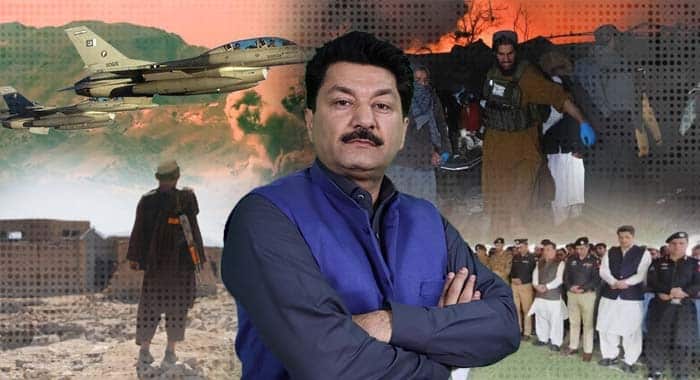
The already fragile relationship between Pakistan and Afghanistan appears to be entering a new and more dangerous phase of tension, shaped by cross-border militancy, retaliatory airstrikes, and a deepening trust deficit between the two neighbours. Recent developments particularly an attack on a Frontier Corps (FC) post in the Peshawar region and Pakistan’s subsequent airstrike inside Afghan territory have once again brought the long-standing security dispute into sharp international focus.
What makes the current moment especially significant is not just the violence itself, but the speed and intensity of responses. Within hours of the FC post attack, Pakistan reportedly carried out an air operation across the border. Afghan authorities, meanwhile, strongly condemned the strike, claiming civilian casualties, including children. Pakistan, on the other hand, has consistently maintained that its operations target militant hideouts and command structures responsible for orchestrating attacks inside its territory.
This cycle of attack and retaliation is no longer an isolated pattern it is becoming the defining feature of Pakistan-Afghanistan relations.
The Pakistan-Afghanistan border region has long been one of the most volatile zones in South and Central Asia. In recent months, the frequency of attacks in areas such as Waziristan, Bannu, and other tribal districts has raised alarm within Pakistan’s security establishment.
Militant attacks on police stations, military checkpoints, and FC posts have continued despite repeated counterterrorism operations. According to security officials, these attacks are not random acts of violence but coordinated operations involving organized militant groups such as the Tehrik-i-Taliban Pakistan (TTP), Jamaat-ul-Ahrar, and other affiliated networks.
Pakistan’s concern is not limited to domestic operations alone. Officials argue that many of these groups maintain sanctuaries or logistical support networks across the border in Afghanistan. This allegation has been repeatedly denied or downplayed by the Afghan authorities, but it continues to dominate Pakistan’s security narrative.
The recent FC post attack in the Hassan Khel area of Peshawar is being seen as part of this broader escalation. Reports suggest that militants targeted the post during late-night hours, resulting in casualties among security personnel. Within 24 hours, Pakistan responded with an airstrike across the border an action that immediately escalated diplomatic tensions.
As with previous incidents, the airstrike has produced sharply contrasting narratives. Afghan spokespersons have claimed that civilians were killed, including children, and that non-combatants were affected. These allegations have triggered condemnation and calls for restraint. Pakistan, however, maintains that its strikes are based on credible intelligence and are directed at militant infrastructure, not civilian populations. According to Pakistani security perspectives, previous operations in Afghan provinces such as Kunar, Khost, and Paktika have targeted militant camps, weapons depots, and training facilities allegedly linked to attacks inside Pakistan. Officials further claim that some high-value militant commanders have been eliminated in these strikes.
This divergence in narratives is not new. Each cross-border incident follows a predictable pattern: Pakistan justifies its actions as counterterrorism, while Afghan authorities accuse Pakistan of violating sovereignty and harming civilians. The truth, as is often the case in conflict zones, is difficult to verify independently.
What is clear, however, is that both sides are operating within an increasingly hostile information environment, where trust is minimal and suspicion is high.
At the heart of the Pakistan-Afghanistan tension lies one central issue: the presence and operational capacity of the TTP and similar militant organizations. Pakistan has repeatedly stated that its primary demand from the Afghan administration is simple: ensure that Afghan territory is not used for planning or launching attacks against Pakistan. Islamabad insists it is not hostile toward the Afghan state or its people but considers cross-border militancy an existential security threat.
The Afghan side, however, faces its own internal complexities. While some factions within the Afghan Taliban reportedly favour improved relations with Pakistan, others are accused of maintaining indirect links or tolerance toward groups like the TTP. This internal divergence complicates the possibility of a unified policy response. Pakistan also highlights that the issue is not isolated to one group. It points to a network of organizations including the TTP, Gul Bahadur Group, Daesh affiliates, and other militant formations that allegedly operate in overlapping ecosystems across the border region.
From Islamabad’s perspective, the failure to dismantle or expel these groups undermines every diplomatic engagement between the two countries.
Despite escalating tensions, diplomatic engagement between Pakistan and Afghanistan has not completely collapsed. In fact, backchannel communications and informal negotiations continue through multiple regional platforms, including meetings in Doha, Istanbul, Riyadh, and other locations. These talks, however, have produced limited tangible outcomes. The core disagreement remains unresolved: Pakistan demands verifiable action against militant groups, while Afghan authorities often seek recognition of sovereignty concerns and assurances of non-interference.
A key sticking point is trust. Pakistan argues that verbal assurances are not enough and insists on written commitments preventing Afghan territory from being used against it. Afghanistan, meanwhile, views repeated cross-border strikes as violations of sovereignty that undermine trust-building efforts. Even as official dialogue continues, the security situation on the ground appears to be deteriorating, raising questions about whether diplomacy can keep pace with violence.
The Pakistan-Afghanistan security equation cannot be understood in isolation. Regional dynamics play a significant role in shaping both countries’ strategic calculations. Pakistan has increasingly engaged with regional partners such as China and Russia on counterterrorism concerns. Discussions between Pakistani leadership and Chinese officials have included references to militant organizations such as ETIM and TTP, highlighting shared security concerns in the broader region. Meanwhile, Afghanistan’s reported efforts to upgrade or repair military equipment through technical cooperation with Russia signal its intent to strengthen its defensive capabilities. However, such developments also raise questions about how Afghanistan intends to manage its security environment and border challenges.
Neighboring countries including Iran and Central Asian states also share concerns about militant spillover, suggesting that the instability is not confined to a bilateral issue but part of a wider regional security challenge.
While political and military narratives dominate discussions, the human cost of ongoing conflict remains significant but often underreported. On both sides of the border, civilians live in fear of sudden violence. In Pakistan’s tribal districts, security personnel face constant threats from ambushes, bombings, and coordinated militant attacks. Schools, police stations, and infrastructure have repeatedly been targeted.
In Afghanistan, communities living near contested areas often bear the consequences of cross-border strikes and militant presence. Displacement, economic instability, and lack of infrastructure continue to affect daily life. Claims of civilian casualties during airstrikes further complicate the humanitarian picture, fueling resentment and mistrust between populations that are already struggling with economic hardship.
One of the key arguments emerging from Pakistan’s security discourse is the need to strengthen internal counterterrorism infrastructure. Officials and analysts alike point to vulnerabilities in policing structures, border security systems, and local defense capabilities. Attacks on installations such as police stations and FC posts reveal, according to security experts, gaps in defensive preparedness. In several incidents, relatively small explosive devices have caused disproportionate damage to buildings and personnel.
This has led to calls for modernizing security infrastructure, including the construction of more resilient facilities capable of withstanding blast impacts. There is also increasing emphasis on improving intelligence coordination and rapid response mechanisms. At the same time, Pakistan continues to assert that air operations are part of a broader counterterrorism strategy designed to eliminate militant leadership and disrupt operational planning networks.
However, critics argue that reliance on cross-border strikes risks further destabilizing relations and may not address the root causes of militancy.
Perhaps the most important question in the current crisis is not military capability but political will. Can both Pakistan and Afghanistan commit to a sustained framework that addresses mutual security concerns without resorting to escalation? Or will the cycle of attack, retaliation, and denial continue indefinitely? Pakistan insists that it has repeatedly attempted dialogue, but without sufficient action on militant sanctuaries, negotiations lose effectiveness. Afghanistan, on the other hand, argues that external pressure and strikes undermine sovereignty and complicate internal stability.
This deadlock has created a situation where neither side fully trusts the other’s intentions, yet both remain bound by geography, history, and necessity. The latest escalation between Pakistan and Afghanistan is not an isolated incident it is part of a broader and deeply entrenched conflict cycle shaped by militancy, mistrust, and unresolved political grievances.
Airstrikes and militant attacks may dominate headlines, but they are symptoms of a much deeper structural problem: the absence of a durable and mutually trusted security framework. Without meaningful cooperation, intelligence sharing, and verifiable action against militant networks, the region risks sliding further into instability. At the same time, continued reliance on force alone may deepen resentment and prolong the cycle of violence.
The path forward requires more than military responses or diplomatic statements. It demands political courage, institutional coordination, and above all, a recognition that security for one side cannot come at the permanent destabilization of the other.
Until that realization takes root on both sides of the border, the cycle of escalation is likely to continue bringing with it more attacks, more airstrikes, and more uncertainty for millions living in the shadow of this fragile frontier.