
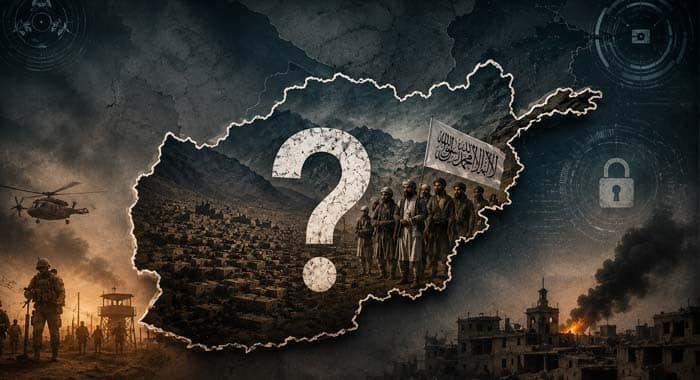
Five years after the Afghan Taliban returned to power in Kabul, Pakistan finds itself confronting a difficult and unexpected question that emerged after the dramatic political changes of August 2021: how did a government that Islamabad engaged through diplomatic channels and hoped would contribute to regional stability become associated with one of the country’s most serious security challenges?
The security environment along Pakistan’s western borders has deteriorated significantly, with the frequency and sophistication of terrorist attacks in Khyber Pakhtunkhwa and Balochistan reaching alarming levels. Soldiers, police personnel, tribal elders and civilians continue to lose their lives in a conflict that appears increasingly complex and difficult to contain. The central debate is no longer whether Pakistan is facing a security crisis; rather, the key question is whether this violence is solely the result of hostility from Afghan-based militant networks or whether it reflects a wider geopolitical competition in which Pakistan has become a primary target.
The continued terrorist activity linked to Afghan territory requires serious examination by policymakers and regional stakeholders, particularly in a region where proxy conflicts have historically influenced political and security dynamics. Afghanistan has repeatedly been a stage for competing interests, from the Cold War era to the post-9/11 period and through the withdrawal of NATO forces. Given this history, it would be unrealistic to assume that the use of non-state actors as instruments of strategic competition has completely disappeared from regional politics.
Pakistan’s security situation remains particularly distinct compared with other neighbouring countries. Afghanistan shares borders with Iran, China, Tajikistan, Uzbekistan and Turkmenistan, all of which have their own security concerns related to developments inside Afghanistan. However, none of these countries faces the level of sustained cross-border militant violence that Pakistan continues to experience. This reality alone highlights the need for a comprehensive strategic assessment of the factors driving instability along the Pakistan-Afghanistan border.
International assessments, including reports by the United Nations, have repeatedly highlighted the continued presence of various terrorist organisations operating from Afghan territory. These include groups such as Tehreek-e-Taliban Pakistan (TTP), Al-Qaeda, the Islamic Movement of Uzbekistan (IMU) and the East Turkestan Islamic Movement (ETIM). In addition, the Balochistan Liberation Army (BLA) remains a significant security challenge in Balochistan, with allegations of external support and safe havens outside Pakistan.
The fundamental question facing regional policymakers is whether the Afghan Taliban authorities possess both the willingness and the capability to take effective action against these organisations and prevent Afghan territory from being used for attacks against neighbouring states.
The Afghan Taliban have repeatedly rejected allegations that they allow Afghan soil to be used against other countries. However, the continuation of attacks inside Pakistan that are linked to Afghan-based militant networks has created a growing gap between diplomatic assurances and security realities. Statements of commitment, observers argue, cannot replace measurable action and verifiable outcomes.
This situation has raised broader questions regarding the nature of the Taliban government, its responsibilities as a governing authority, and its relationship with various armed factions operating in or around Afghanistan. A state’s legitimacy is traditionally built on its ability to maintain control over the use of force within its territory. Armed movements, by contrast, often derive influence through their ability to accommodate multiple armed actors. The challenge for the Taliban authorities is that they cannot simultaneously seek the privileges associated with sovereignty while avoiding responsibility for armed groups operating in areas under their control.
Another important dimension of the Afghan question is the international community’s continued engagement with Kabul despite the absence of formal diplomatic recognition for the Taliban government.
Western governments and international organisations continue to provide significant humanitarian assistance to Afghanistan, primarily through United Nations agencies and other humanitarian mechanisms. Media reports have frequently cited approximately $40 million in humanitarian cash assistance entering Afghanistan each week.
The objective behind this assistance remains clear: preventing humanitarian collapse, reducing suffering, and ensuring that ordinary Afghan citizens do not bear the consequences of political disputes and international disagreements.
However, the humanitarian model has also generated important policy debates. Questions remain over whether large-scale financial flows into an economy controlled by the Taliban could directly or indirectly strengthen governing authorities. While humanitarian assistance remains essential for vulnerable populations, international stakeholders face the challenge of ensuring that aid reaches intended beneficiaries while reducing the possibility of diversion, misuse or political influence.
A transparent and independently monitored system is necessary not only to protect Afghan civilians but also to maintain the confidence of international donors. As economic hardship and poverty continue to affect large sections of Afghan society, accountability and oversight remain central requirements for sustaining humanitarian support.
Pakistan’s security concerns cannot be viewed in isolation. The country is simultaneously dealing with multiple strategic pressures, including terrorism along its western border, long-standing tensions with India in the east, domestic economic challenges and increasing competition among major global powers.
The continuation of militancy in Khyber Pakhtunkhwa and Balochistan has consequences that extend beyond immediate security concerns. Persistent violence affects economic confidence, discourages foreign investment, creates obstacles for regional connectivity projects and forces the state to divert resources from development toward security priorities.
Whether these consequences represent unintended outcomes of Afghan instability or serve the interests of actors opposed to Pakistan’s regional role remains a matter requiring continued investigation. However, policymakers cannot ignore the strategic reality that instability in Pakistan affects broader regional connectivity, economic integration and strategic autonomy.
As a country affected by terrorism, Pakistan maintains that responsibility must ultimately rest with those responsible for planning, supporting and carrying out attacks. Islamabad has argued that a comprehensive counterterrorism approach is required, particularly as it believes the Taliban authorities have not adequately addressed concerns related to militant sanctuaries and cross-border violence.
A sustainable response requires more than military measures alone. Pakistan’s approach must combine diplomacy, regional cooperation, domestic reforms and international engagement.
Diplomatically, engagement with Kabul remains necessary, but future cooperation should increasingly be based on measurable progress rather than verbal commitments. Counterterrorism cooperation must be linked with practical steps against all terrorist organisations without selective distinctions.
At the regional level, Pakistan can strengthen security coordination with countries that share concerns regarding transnational extremism, including China, Iran, Russia, Central Asian states and other neighbouring countries. Greater intelligence cooperation, coordinated border management and collective efforts against extremist networks can contribute to regional stability.
Domestically, Pakistan must continue strengthening governance structures in the merged districts of Khyber Pakhtunkhwa while addressing long-standing socio-economic challenges in Balochistan. Security operations can contain threats, but lasting peace requires economic opportunities, political inclusion, effective administration and public trust.
Pakistan also needs to continue presenting evidence of cross-border terrorism through international platforms, particularly the United Nations. The debate over regional security should move beyond competing political narratives and focus on verifiable facts, intelligence sharing and international cooperation.
Ultimately, the issue is not determined by whether the Afghan Taliban consider Pakistan a friend or adversary. International relations are shaped primarily by national interests, security calculations and state responsibilities rather than personal relationships.
The real test for the Taliban authorities is whether they can demonstrate the capacity and willingness to ensure that Afghan territory is not used to threaten neighbouring countries. Their actions will influence not only Afghanistan’s efforts to gain international legitimacy but also the future security environment of South and Central Asia.
Pakistan invested heavily in the expectation that peace in Afghanistan would translate into peace along its western frontier. Five years after the Taliban’s return to Kabul, Islamabad is seeking more than assurances. It is seeking measurable commitments, transparent cooperation and genuine regional responsibility.
Only through practical action, mutual accountability and sustained engagement can Pakistan and Afghanistan move beyond the repeated cycle of violence and work toward building the peaceful and stable neighbourhood that their people deserve.



