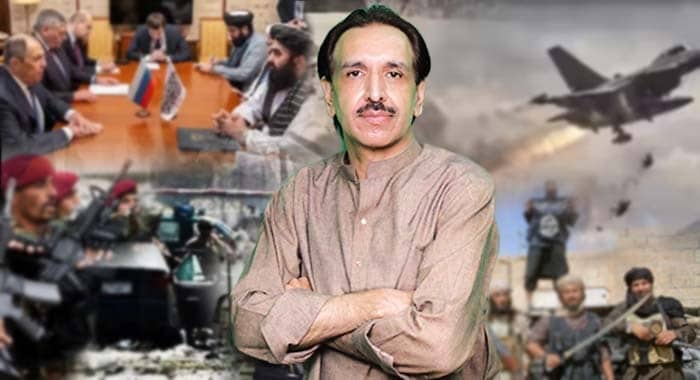
The recent excitement in Kabul over growing contacts with Russia says more about the Taliban’s insecurities than their achievements.
Over the past few weeks, Taliban officials have attempted to portray Russian engagement as a strategic breakthrough. Statements coming from Kabul have even created the impression that some sort of defence arrangement now exists that would fundamentally alter regional equations. In my view, this interpretation is detached from reality.
First, we need to separate diplomacy from wishful thinking.
What has been discussed publicly is, at best, a memorandum of understanding and not the kind of comprehensive defence agreement some Taliban officials and their supporters have tried to portray. Serious military arrangements are not concluded overnight. They involve multiple institutions, technical consultations, financial commitments, implementation mechanisms and lengthy timelines. Anyone familiar with defence procurement understands that even purchasing a military platform can take years from negotiation to delivery.
That is why I found some of the celebrations in Kabul premature.
The larger question is not what Russia may or may not provide. The larger question is why Russia became interested in engaging the Taliban on security matters in the first place.
The answer is simple.
Russia itself views Afghanistan as a growing security concern.
For years, regional states have repeatedly warned about the presence of terrorist groups inside Afghanistan. Pakistan has suffered the most direct consequences, but it is far from the only country expressing concern. Tajikistan, Uzbekistan, China and Russia have all voiced worries about terrorist networks operating from Afghan territory.
The horrific terrorist attack in Moscow remains a reminder that these concerns are not theoretical. Russia understands that instability originating in Afghanistan can travel far beyond Afghanistan’s borders.
This is where the contradiction becomes impossible to ignore.
On one hand, Taliban officials celebrate growing engagement with Moscow. On the other, Russian reports continue to warn about the presence of thousands of extremists and terrorist fighters inside Afghanistan.
If Afghanistan were truly the model of security the Taliban claim it to be, why do so many regional security assessments continue to raise alarm?
The reality is that Afghanistan’s biggest challenge today is not external pressure. It is internal failure.
Poverty is widespread. Economic opportunities remain scarce. Institutions remain weak. International recognition remains absent. Large numbers of former fighters have found themselves without meaningful employment or economic prospects. Under such circumstances, extremist organizations inevitably find opportunities to recruit, expand and regenerate.
This problem affects far more than Pakistan.
Increasingly, international assessments warn that terrorist networks in Afghanistan pose risks not only to neighboring countries but also to regions far beyond South Asia. Eastern Europe, Central Asia and Russia itself are paying close attention to these developments.
That is why the assumption that Moscow will somehow become a strategic shield for the Taliban makes little sense.
Russia’s engagement is driven by its own security interests. Every country acts according to its national interests. Russia is no exception.
Another aspect often overlooked in these discussions is Pakistan’s own evolution.
Some Taliban officials appear to underestimate how significantly Pakistan’s military, intelligence, surveillance and counterterrorism capabilities have developed over the past decade. Regional realities have changed. Technological realities have changed. Security calculations have changed.
Rhetoric cannot alter those facts.
Meanwhile, Pakistan continues to pursue a clear position. Dialogue and diplomacy remain options, but practical action against terrorist groups remains the central requirement. Statements alone cannot substitute for measurable steps on the ground.
This is precisely why many previous understandings failed to produce lasting results.
Ultimately, Afghanistan’s problems cannot be solved through public relations campaigns, celebratory statements or exaggerated interpretations of diplomatic contacts.
The international community’s concerns are not based on perception alone. They are rooted in persistent questions about terrorism, governance, economic collapse, human rights and regional stability.
Until those issues are addressed, no amount of political messaging can change Afghanistan’s reality.
And that is perhaps the most important lesson of all.
The real challenge facing the Taliban is not convincing the world that everything is fine.
The real challenge is convincing the world that they are prepared to confront the problems that everyone else can already see.