
There is an old Pashto proverb: “Bal ta masaly kawi, pa khpala pe hamly kawi.”
Loosely translated, it refers to the person who preaches rules to others while quietly exempting himself from them.
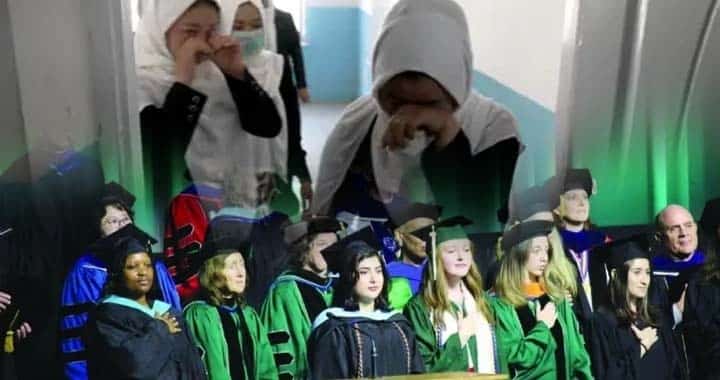
Few developments in recent years have illustrated that proverb more vividly than the latest news that dozens of Afghan girls have graduated from American universities through international scholarship programmes.
The achievement itself deserves celebration. Young Afghan women who saw their futures abruptly interrupted refused to surrender their ambitions. They persevered, studied, competed, and graduated. Their success is a testament to determination, resilience, and the universal truth that talent does not disappear simply because a government closes a school gate.
Yet behind the celebration lies a question that refuses to go away.
If educating Afghan girls is wrong, why does it suddenly become acceptable when the classroom is thousands of miles away?
For more than four years, millions of Afghan girls have been told to wait. They have been told that secondary schools must remain closed. They have been told that universities are off limits. They have been told that the time is not right, that conditions are not suitable, that decisions are being reviewed.
Meanwhile, an entire generation has been left in limbo.
A girl in Kabul cannot attend university.
A girl in Kandahar cannot pursue a degree.
A girl in Helmand cannot walk into a lecture hall.
A girl in Herat cannot continue the education she once dreamed of completing.
But somehow, Afghan girls graduating from universities in the United States does not trigger the same alarm.
That contradiction sits at the heart of the issue.
The Taliban leadership insists that its education policies are rooted in principle. If that is the case, principles should apply universally. A principle that changes according to geography is not a principle. It is a privilege.
If higher education is considered inappropriate for Afghan women, then why celebrate Afghan women receiving degrees abroad?
And if higher education is beneficial for Afghan women abroad, then why deny it to Afghan women at home?
Those are not Western questions.
Those are Afghan questions.
Those are the questions millions of Afghan fathers and mothers quietly ask when they watch their daughters lose years of their lives waiting for a classroom door to reopen.
The irony becomes even sharper when one examines how power often functions in closed systems. Ordinary families carry the burden of restrictions, while the well-connected find pathways around them. The rules become rigid for the public and flexible for the privileged.
History is filled with governments that demanded sacrifices from ordinary citizens while protecting their own circles from the consequences of those sacrifices.
Afghans have seen this before.
They know what double standards look like.
They know what selective morality looks like.
And they know what happens when one set of rules exists for the population and another for those close to power.
The real tragedy is not merely educational.
It is societal.
A nation cannot develop while systematically excluding half of its human capital. Doctors, engineers, teachers, researchers, entrepreneurs, and administrators do not emerge from isolation. They emerge from classrooms.
Every year of exclusion is a year of lost potential.
Every closed classroom is a closed opportunity.
Every girl denied an education is a setback not only for herself but for Afghanistan as a whole.
The graduation of these young women in the United States therefore carries a deeper message. It proves that the problem was never capability.
The problem was never merit.
The problem was never whether Afghan girls could succeed.
They already have.
The graduates have answered that question beyond doubt.
The remaining question is for those who continue to defend educational restrictions.
If Afghan girls are capable of earning degrees from respected international universities, why are they still considered unfit to sit in a classroom in their own country?
That is where the proverb returns.
“Bal ta masaly kawi, pa khpala pe hamly kawi.”
Preaching one rule while benefiting from another has never been a sustainable model of governance.
And no amount of rhetoric can hide a contradiction that millions of Afghans can see with their own eyes.
Because the issue is no longer whether Afghan girls can learn.
The world has already witnessed the answer.
The issue is why some are still being told they cannot.



